

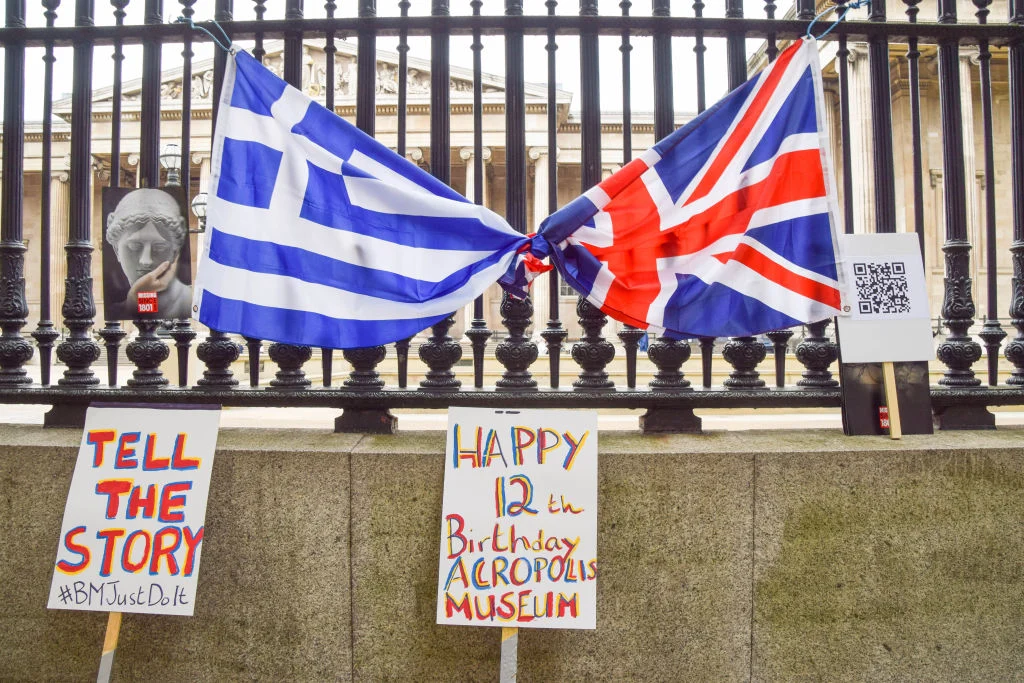
Introduction: A Fragile Optimism in Athens
George Osborne, the chairman of the British Museum, has once again signaled a willingness to break one of the most intractable diplomatic stalemates in the art world. Speaking to reporters in Athens this Tuesday, the former UK Chancellor of the Exchequer expressed a cautious, yet persistent, optimism regarding the Parthenon Marbles—a collection of ancient friezes and sculptures that have served as the focal point of a two-century-old geopolitical tug-of-war.
"I’m still optimistic that we can reach an agreement," Osborne stated. "If everyone enters into it with the spirit of we’re not going to get everything we want, as is always the case with a successful agreement, then there’s a deal to be done."
This latest overture arrives at a pivotal moment, as the debate over cultural restitution shifts from the hushed halls of museums to the high-stakes arena of international diplomacy. With the United Kingdom and the European Union set to meet for a landmark summit in Brussels next month, the fate of the sculptures—carved by the legendary Phidias between 447 and 432 BCE—has transitioned from a bilateral headache into a broader issue of European cultural cohesion.
Chronology: From the Acropolis to Bloomsbury
To understand the depth of the current deadlock, one must look back to the early 19th century. The marbles were removed from the Parthenon in Athens between 1801 and 1812 by Lord Elgin, then the British ambassador to the Ottoman Empire. At the time, Greece was under Ottoman rule. Elgin argued he had permission from the local authorities to remove the pieces; critics, however, have long maintained that the removal was an act of colonial looting.
Following their removal, the sculptures were eventually sold to the British government in 1816 and placed in the British Museum, where they have remained ever since.
Key Milestones:
- 1832: Greece gains independence from the Ottoman Empire and immediately begins formal requests for the return of the marbles, viewing them as an essential component of the nation’s cultural identity.
- 1963: The British Museum Act is passed by the UK Parliament. This legislation prohibits the museum from disposing of items in its collection, effectively creating a legal shield that has prevented the return of the marbles for over 60 years.
- 2009: The opening of the state-of-the-art Acropolis Museum in Athens significantly intensified the pressure on London. The new facility, built specifically to house the marbles, debunked previous British arguments that Greece lacked the infrastructure to properly preserve or display them.
- 2023: Negotiations between the British Museum and Greek officials appeared to reach a fever pitch, with rumors of a long-term "loan" arrangement. However, the deal collapsed after the Greek government refused to concede the issue of ownership.
The Legal and Ethical Labyrinth
The core of the dispute remains a collision between two incompatible worldviews. The British Museum operates under the strictures of the 1963 Act, which mandates the preservation of its collection for "humanity." British officials frequently characterize the museum as a "universal institution," where the marbles can be viewed in a global context alongside other world civilizations.
Greece, conversely, views the sculptures as a "dismembered" masterpiece. The Greek position is that the marbles are not merely independent objects but integral parts of the Parthenon’s architectural structure. The argument is fundamentally one of integrity: the sculptures were taken illegally, and their return is a matter of historical justice, not merely a diplomatic exchange.
The Preservation Debate
In recent years, the argument for the return of the marbles has gained domestic momentum within the UK, fueled by internal controversies at the British Museum. Reports of management failures, security lapses, and concerns regarding the physical climate control of the galleries housing the marbles have weakened the British assertion that the objects are safer in London than in Athens.
Official Responses and the "Bayeux" Comparison
The tension reached a new diplomatic high in September when Greek Prime Minister Kyriakos Mitsotakis published an op-ed in the Guardian. He directly challenged recent comments made by the British Museum’s director, Nicholas Cullinan, who had drawn a comparison between the Parthenon Marbles and the Bayeux Tapestry.
Cullinan had cited the French loan of the tapestry as a "compelling example of international partnership," suggesting that a similar model of "reciprocal exchange" could solve the Greek dilemma. Mitsotakis was quick to dismantle this analogy:
"Nobody would seriously contemplate cutting what survives of the tapestry in two and displaying half in London and half in Bayeux, and claiming this was an adequate way to understand it," Mitsotakis wrote. "Yet that is exactly what happened to the Parthenon sculptures."
Osborne, however, remains unmoved by the historical parallel, emphasizing that his goal is not to win the argument of who "owns" the past, but to create a mechanism where the sculptures can be seen in both locations. "I very much hope we can come to some arrangement whereby the Parthenon sculptures that are in London can be seen in Athens but they have to be shared," Osborne reiterated on Tuesday.
The Implications: A European Diplomatic Flashpoint
The conflict is no longer confined to museum boards and ministerial offices. As the UK recalibrates its relationship with the European Union post-Brexit, the Parthenon Marbles have become a symbolic bargaining chip.
During a conference at the University of Athens on October 6, Prime Minister Mitsotakis made it clear that the issue would be on the agenda at the upcoming EU-UK summit in Brussels. "The Parthenon sculptures will be part of this debate. This is not just an issue for Greece, it’s an issue for Europe," he noted.
This suggests that the Greek government intends to leverage broader European diplomatic solidarity to pressure the British government. By framing the marbles as a European cultural heritage issue, Athens is attempting to shift the narrative from a bilateral "property dispute" to a broader question of how European nations should reconcile their colonial pasts with their modern, collaborative futures.
Looking Forward: Is a "Middle Way" Possible?
The challenge for George Osborne is to find a path that satisfies the British Museum’s legal mandate while acknowledging the Greek demand for reunification. The "middle way" discussed in previous years—a long-term cultural exchange—remains the most likely solution. Under such a plan, the marbles might travel to Athens on a revolving basis, accompanied by a reciprocal flow of rare Greek antiquities to the British Museum.
However, the hurdle remains the question of "ownership." Greek Culture Minister Lina Mendoni has been adamant that any deal cannot be interpreted as an acknowledgement of the UK’s legal claim to the marbles. For the British Museum, however, relinquishing the claim of ownership—even implicitly—could open a floodgate of claims for other contested items in their vast collection, from the Benin Bronzes to the Rosetta Stone.
As the Brussels summit approaches, the eyes of the global art world are fixed on this delicate dance. Osborne’s call for a "spirit of compromise" is the latest attempt to break the ice, but as history has shown, the Parthenon Marbles are not merely pieces of stone—they are symbols of sovereignty, identity, and the heavy, lingering weight of history. Whether the two nations can find a way to share these treasures without further fracturing their diplomatic ties remains one of the most significant cultural questions of the decade.



