Introduction: The Sentinel of Global Maritime Security
In an era defined by hyper-connected global trade, the vast expanse of the world’s oceans remains the lifeblood of the international economy. Yet, beneath the calm surface of the high seas lies a persistent, evolving threat: maritime piracy and armed robbery. For over thirty years, the International Chamber of Commerce (ICC) International Maritime Bureau’s (IMB) Piracy Reporting Centre (PRC) has stood as the world’s foremost frontline defense against these criminal activities.
Established in 1991, the PRC has evolved from a nascent reporting desk into a sophisticated, 24-hour nerve center. By bridging the gap between vulnerable vessels, naval forces, and national authorities, the Centre has played an indispensable role in safeguarding maritime commerce. As the nature of piracy shifts from low-level opportunistic theft to sophisticated, transnational criminal operations, the mandate of the IMB PRC has never been more critical.
The Chronology of Vigilance: 34 Years of Operational Evolution
1991–2000: Establishing the Infrastructure
The early 1990s marked a pivotal moment in maritime security. The collapse of geopolitical stability in certain regions and the surge in maritime traffic necessitated a dedicated body to monitor, report, and combat pirate activity. In 1991, the IMB launched the PRC in Kuala Lumpur, Malaysia. Initially, the Centre functioned as a rudimentary clearinghouse for distress calls. However, it quickly established itself as a reliable point of contact, providing masters and shipowners with a centralized mechanism to report incidents that would otherwise go unnoticed by local law enforcement.
2001–2010: The Rise of the Somali Crisis
The turn of the millennium brought a seismic shift in the piracy landscape. The collapse of the Somali state led to the emergence of piracy as a lucrative industry, with heavily armed syndicates hijacking massive merchant vessels for multi-million dollar ransoms. During this decade, the PRC’s role expanded exponentially. It began coordinating with international naval coalitions, such as the EU NAVFOR and the Combined Maritime Forces, to broadcast real-time warnings to ships transiting the Gulf of Aden and the Somali Basin. The PRC became the "eyes and ears" of the industry, providing the tactical intelligence necessary for naval intervention.
2011–2020: Diversification and Technology
As piracy off the coast of Somalia was contained through the widespread adoption of Best Management Practices (BMP) and the presence of Armed Security Personnel (ASP), the threat center shifted. West Africa’s Gulf of Guinea and Southeast Asia’s archipelagic waters became the new hotspots. The PRC integrated digital tracking and automated alert systems, ensuring that ships received real-time data on criminal hotspots, effectively creating a virtual perimeter around high-risk zones.
2021–Present: Navigating Modern Asymmetric Threats
Today, the PRC handles a complex landscape involving cyber-enabled piracy, kidnapping for ransom, and armed robbery at anchorages. The transition into 2025 has highlighted the need for data-driven, proactive security. The Centre now focuses on long-term analysis, helping authorities allocate patrol resources based on historical patterns and predictive modeling.
Supporting Data: The Pulse of Global Piracy
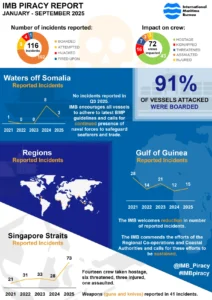
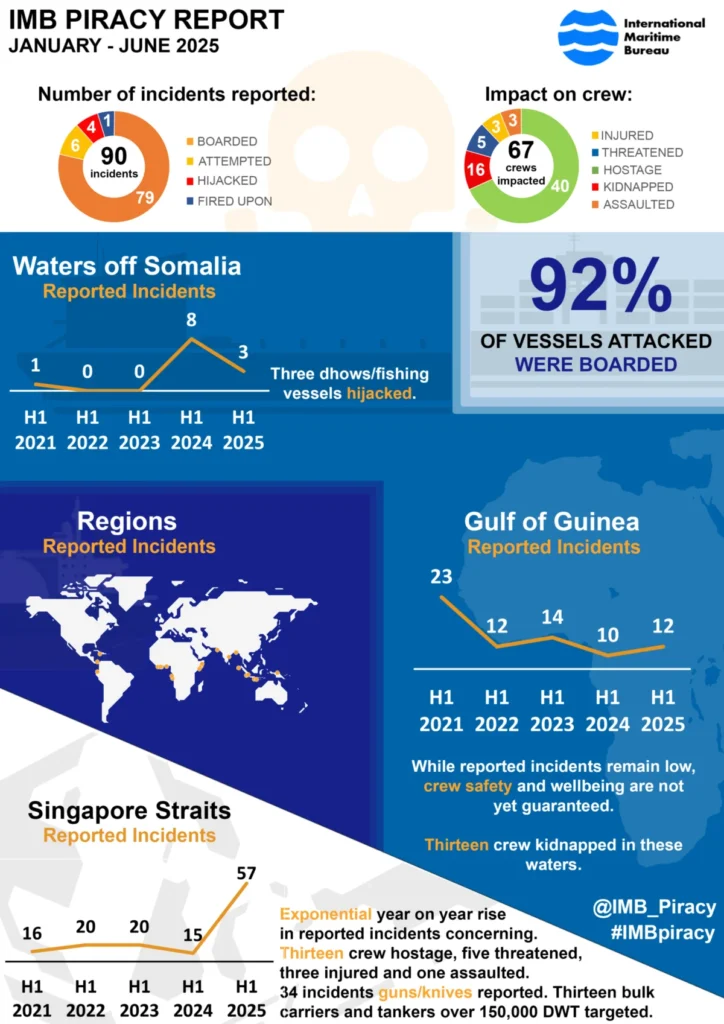
The IMB PRC does not merely record events; it synthesizes data to form a global security picture. According to the recently released 2025 Jan – June Piracy and Armed Robbery Against Ships report, the intelligence gathered remains a vital barometer for the industry.
The Power of Reporting
The IMB emphasizes that every incident—whether a successful hijacking, an attempted boarding, or a suspicious approach—is a data point that dictates the global response. When a shipmaster reports an incident to the PRC, the following occurs:
- Immediate Verification: The PRC verifies the incident with the vessel’s owner and nearby ships.
- Warning Broadcasts: All vessels in the vicinity are notified via the GMDSS (Global Maritime Distress and Safety System) and email alerts.
- Agency Coordination: The PRC immediately relays the intelligence to the relevant Coastal States and regional naval command centers.
The data gathered is categorized into two distinct metrics: Actual Incidents (where the pirates succeed in boarding or hijacking) and Attempted Incidents (where the crew’s defensive measures or early detection prevent the boarding). This data allows for the identification of "hot zones," such as the anchorages off the coast of Callao, Peru, or the Singapore Strait, where armed robbery remains a persistent issue.
Official Responses and Strategic Collaboration
The efficacy of the IMB PRC is built upon its unique position as a non-governmental entity that holds the trust of both the shipping industry and state authorities.
Bridging the Gap
Maritime piracy is a legal grey area; it often occurs in international waters where jurisdiction is ambiguous. Michael Howlett, Director of the ICC International Maritime Bureau, has frequently underscored that the primary objective of the PRC is "to ensure that piracy is never treated as a cost of doing business." By maintaining a neutral, third-party reporting mechanism, the PRC forces governments to acknowledge incidents that might otherwise be downplayed for geopolitical or economic reasons.
The Call for Transparency
The IMB continuously urges shipowners to move away from the "culture of silence." Often, masters or owners hesitate to report low-level robberies due to fear of increased insurance premiums or the bureaucratic burden of investigations. However, the PRC maintains that under-reporting leads to a dangerous misconception that a region is safe. When incidents go unreported, patrols are diverted elsewhere, and the criminal groups are emboldened to escalate their tactics.
Implications for the Global Maritime Industry
Economic Impact and Supply Chain Stability
The implications of maritime piracy extend far beyond the immediate threat to crew safety. Piracy imposes a "hidden tax" on global trade. When ships are forced to detour to avoid high-risk areas, the resulting fuel costs, increased transit times, and potential delays in just-in-time delivery systems ripple through the global economy. For smaller shipping lines, a single hijacking can lead to bankruptcy. The work of the PRC, by providing the warnings necessary to allow ships to continue on their routes safely, directly contributes to the stabilization of global supply chains.
The Evolution of Crew Safety
Perhaps the most significant implication of the PRC’s work is the preservation of human life. The psychological trauma experienced by crews subjected to pirate attacks is profound. The PRC’s focus on providing preemptive warnings and advice on hardening ships—such as the use of razor wire, water cannons, and the creation of "citadels" (safe rooms)—has statistically reduced the success rate of boarding attempts.
Future Challenges: The Digital Frontier
As we look toward the mid-2020s and beyond, the PRC is bracing for new threats. The rise of "digital piracy"—where navigation systems are spoofed to lure vessels into pirate-controlled waters—is a growing concern. The PRC is currently expanding its operational focus to incorporate cyber-security reporting, recognizing that the modern pirate is as likely to use a laptop as they are an assault rifle.
Conclusion: A Call to Action
The IMB Piracy Reporting Centre stands as a testament to the power of international cooperation and standardized intelligence gathering. However, its effectiveness is entirely dependent on the participation of the global shipping community. As stated in their latest directives, the PRC is a collaborative tool; it is only as strong as the reports it receives.
For shipowners and operators, the message remains clear: transparency is the most effective weapon in the fight against maritime crime. By consistently reporting all actual, attempted, and suspicious incidents, the industry provides the authorities with the evidence-based justification needed to deploy naval assets, prosecute offenders, and secure the shipping lanes that power our world.
For further information or to request the full 2025 Jan – June Piracy and Armed Robbery Against Ships report, please contact:
Michael Howlett
Director, ICC International Maritime Bureau
Tel: +44 207 423 6960
Email: [email protected]
To access the latest report, visit the official ICC-CCS portal.
Appendix: Understanding the IMB Reporting Protocol
To ensure the highest level of responsiveness, the IMB PRC recommends that all vessels adhere to the following reporting protocol:
- Initial Notification: Contact the PRC immediately upon the first sign of a suspicious approach or boarding.
- Comprehensive Data: Provide the vessel’s position (LAT/LONG), the description of the attacking craft, the number of individuals involved, and the presence of weapons.
- Follow-up: Maintain regular contact with the PRC until the vessel is safely clear of the threat area.
- Post-Incident Reporting: Assist in the formal investigation process by providing logbook entries and witness accounts to the relevant authorities, facilitated by the PRC.
By adhering to these protocols, the maritime industry ensures that the "sentinel on the high seas" remains vigilant, effective, and capable of protecting the mariners who sustain the global economy.