

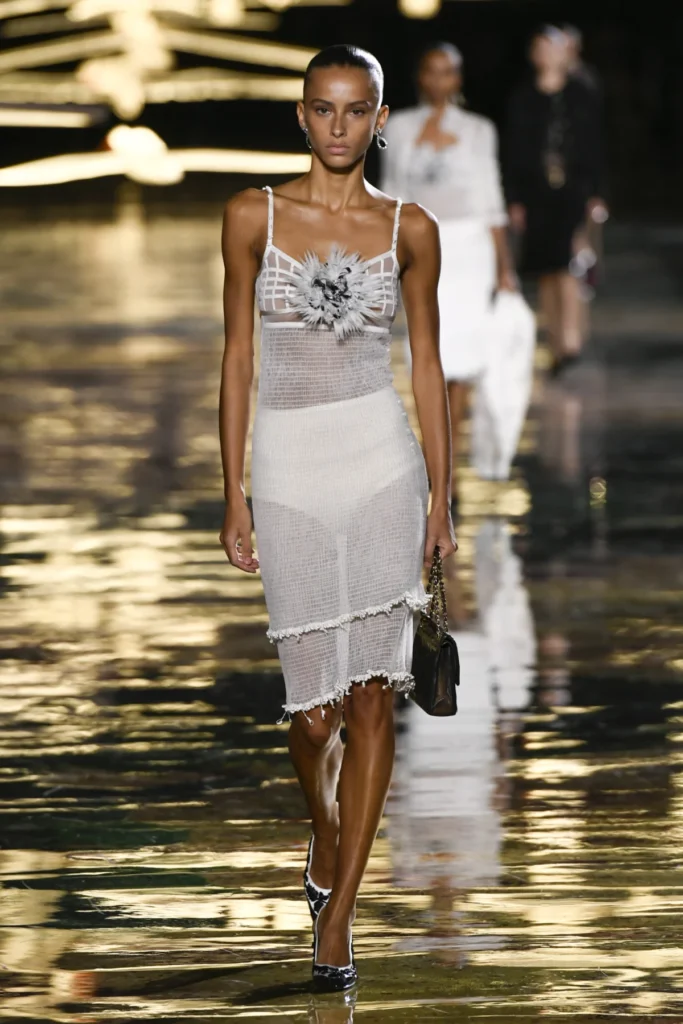
Just twelve months ago, the fashion world held its collective breath as Matthieu Blazy stepped into the hallowed, storied ateliers of Chanel. The transition was one of the most scrutinized in recent history, carrying the weight of a legendary legacy and the high expectations of a global luxury powerhouse. On Monday night, beneath the soaring, iconic glass vaults of the Grand Palais, Blazy returned not as a newcomer, but as a conquering hero. With a year of unprecedented commercial success and creative reinvigoration behind him, his Spring 2027 collection served as both a victory lap and a bold manifesto for the house’s future.
The Atmosphere: A Sanctuary of Flight and Reflection
As guests arrived at the Grand Palais, they were met with a scene of ethereal tranquility. Suspended in midflight from the vast steel-and-glass ceiling were 95 sculptures of birds—an installation inspired by the river sanctuary in southern Italy where Blazy spends his vacations. This motif was not merely aesthetic; it was a deliberate nod to the concept of freedom, a core pillar of Gabrielle “Coco” Chanel’s personal philosophy and a theme that feels increasingly urgent in the current geopolitical climate.
The audience, a curated mix of industry titans, editors, and house ambassadors—including the ever-poised Nicole Kidman—offered a visual history of Blazy’s tenure. Guests were seen sporting archival favorites from his previous collections, with the intricate, tactile designs from his Métiers d’Art show proving to be a particular standout among the crowd. The air was thick with a sense of continuity, suggesting that in just one year, Blazy has successfully woven his own distinct vocabulary into the house’s established lexicon.
Chronology: From Archives to Avant-Garde
The Spring 2027 show was meticulously curated to bridge the divide between the founder’s origins and the brand’s future. The mood board backstage was a tribute to the human side of Gabrielle Chanel—a side often overshadowed by the rigid, austere myths of her later years. Blazy’s research focused on her early life: the transition from the stifling Edwardian tailoring of her youth to the radical act of borrowing her lovers’ suits, eventually culminating in the invention of the iconic Chanel tweed suit.
“They are very interesting because you see a side of Chanel that is not known, which is the funny side, the joyful side, the fact that she loved to play music, the fact that she was obsessed with wearing costumes,” Blazy noted in a post-show interview.
The runway itself unfolded as a 83-look narrative of this discovery. The opening segment channeled the early 20th-century spirit, reinterpreting the androgyny that defined Chanel’s early rebellion. As the show progressed, the silhouettes shifted, tracking the evolution of the modern woman—or rather, as Blazy puts it, the “many women” who inhabit the Chanel universe. The finale, featuring model Dyanira Hurbuscher carrying Gabrielle Chanel’s personal 2.55 handbag, provided a poignant, symbolic full-circle moment that anchored the show’s avant-garde experiments in the house’s foundational history.
Supporting Data: A Versatile Collection
If the hallmark of Blazy’s first year was his architectural, often boxy silhouettes—which admittedly divided some of the brand’s more traditional devotees—the Spring 2027 collection was a direct, sophisticated response to that feedback.
Blazy introduced a newfound fluidity, balancing his signature structural integrity with a series of form-fitting silhouettes. The collection moved from clingy, semisheer knits that draped like a second skin to a pearl-embroidered corset top paired with sharp, masculine trousers. The diversity of the collection was striking:
- Tailoring: The signature wide, cropped jackets remained, but were reimagined with corset-inspired ribbon trims, sloping hems, and sleeveless iterations, such as a standout zebra-patterned gilet.
- Minimalist vs. Maximalist: The collection offered a masterclass in range. Minimalists were served by a crisp ivory coatdress featuring subtle, strategic slits outlined in mismatched gold buttons. Conversely, the maximalists were treated to bold, clashing patterns across three-piece ensembles.
- Playfulness: The collection leaned into the whimsical, featuring tulle-heavy dancer silhouettes and ethereal parachute dresses printed with soft, atmospheric clouds and starlit night skies.
- The Next-Gen Suit: Perhaps the most significant technical development was the introduction of a new stretch fabric. Designed to mimic the aesthetic of traditional tweed while offering the comfort and performance of high-end athletic wear, the garment acknowledges the shifting demands of the contemporary wardrobe. “We all look at Nike,” Blazy admitted, signaling that Chanel is not above learning from the giants of sportswear to define the next era of luxury.
Official Responses and Creative Direction
The soundtrack of the show, featuring Nicole Kidman reading excerpts from Virginia Woolf’s Orlando and To the Lighthouse, added an intellectual layer to the proceedings. The choice was deeply personal and thematic, linking the fluidity of gender and time in Woolf’s writing to the evolution of Chanel’s own designs.
Blazy, speaking on the importance of the collection’s tone, reflected on the current state of the world. “We open the same phone every day to watch our news, and not to get too philosophical, but I think there is a space for poetry, beauty, joy, and it’s a good remedy to the dark times,” he stated.
His commitment to the “joyful” Chanel—the woman who wore costumes and played music—serves as a departure from the perceived coldness that sometimes haunts historical fashion houses. By humanizing the founder, Blazy has effectively humanized the brand, making it more accessible without sacrificing its exclusivity.
Implications: A New Era Defined
One year into his tenure, Matthieu Blazy has achieved what many deemed impossible: he has revitalized the world’s most recognizable luxury brand without erasing its past. The implications of this collection are twofold:
- Commercial Resilience: By successfully integrating athletic-wear sensibilities into the core Chanel offering, Blazy has positioned the brand to remain relevant to a younger, more comfort-conscious demographic while maintaining the prestige required for its ultra-luxury clientele.
- Creative Authority: Blazy has proven that he is not merely a caretaker of the Chanel archives, but a designer capable of steering the house into uncharted territory. His ability to synthesize disparate influences—from 1920s Paris to Italian bird sanctuaries and modern athletic technology—has solidified his position as the premier architect of the current fashion landscape.
As the show reached its climax, set to the rhythmic, high-energy pulse of Britney Spears’ “Gimme More,” the message was clear: the house of Chanel is not merely looking back at its archives for inspiration; it is using them as a springboard for a future that is, above all else, dynamic.
When asked how he felt about his first year at the helm, Blazy offered a modest, knowing grin. “It’s a good start,” he said. For the fashion industry, which has witnessed the rebirth of a legend in real-time, it is clear that the “start” has already blossomed into a defining era. The birds in the rafters may have been suspended, but under Blazy’s direction, the brand is clearly taking flight.



