

By Anna Husarska
October 1, 2026
The Kremlin’s strategic calculus in Ukraine has shifted from a purely battlefield-centric offensive to a total war of isolation. As the conflict drags into its third year, Vladimir Putin’s regime is executing a multi-pronged campaign designed not merely to break the morale of Ukraine’s international backers, but to physically sever the country from the global community. By targeting merchant vessels, port infrastructure, and critical border crossings, Russia is attempting to turn Ukraine into an island of economic and diplomatic desolation.
The Lviv Incident: A Dangerous Escalation
The recent strike by a jet-powered Russian drone near the Polish border—a mere mile from one of the most vital logistical arteries in Europe—marks a terrifying departure from previous tactical norms. The drone struck a freight train, sending shockwaves through the diplomatic corridors of Kyiv, Brussels, and Washington.
The timing of the strike was particularly chilling. It occurred shortly after the conclusion of the Yalta European Strategy (YES) Annual Meeting, an event often described as the "Ukrainian Davos." The train tracks in question had, only hours earlier, carried a delegation of high-profile international figures, including former UK Prime Minister Boris Johnson, former Swedish Prime Minister Carl Bildt, former CIA Director David Petraeus, and former Polish President Aleksander Kwaśniewski.
Whether the strike was a calculated warning shot or a display of staggering incompetence remains a subject of intense debate among intelligence analysts. However, the proximity to the NATO frontier suggests that the Kremlin is no longer operating under the assumption that geographical distance from the front lines equates to safety.
Chronology of a Strangled Border
To understand the significance of the Lviv drone strike, one must view it within the broader timeline of Russia’s systematic assault on Ukrainian logistics:
- Early 2026: Russia expands its aerial campaign, moving beyond energy infrastructure to target the "last mile" of Western aid delivery—border checkpoints and regional rail hubs.
- May 2026: A series of precision strikes on Black Sea port facilities effectively shuts down the remaining "grain corridors," forcing Ukraine to rely almost exclusively on land routes through Poland, Romania, and Slovakia.
- August 2026: Reports emerge of Russian sabotage operations aimed at secondary rail bridges in Western Ukraine, signaling a move to create "logistical bottlenecks."
- September 2026 (YES Conference Week): International dignitaries arrive in Kyiv via train, citing the safety and reliability of the rail network.
- October 1, 2026: A jet-powered drone hits a freight train near the Polish border, serving as a visceral reminder that no transit route in Ukraine is immune to Russian reach.
The Anatomy of Isolation: Supporting Data
The Kremlin’s strategy of isolation relies on three distinct pillars: economic strangulation, diplomatic intimidation, and infrastructure degradation.
1. Economic Attrition
The destruction of port facilities has forced Ukraine to move a larger percentage of its exports and imports via rail and truck. By targeting these, Russia is effectively trying to bankrupt the Ukrainian state by increasing the cost of logistics to unsustainable levels. Insurance premiums for any cargo entering Ukraine have skyrocketed, deterring private sector investment and delaying the delivery of non-military goods essential for civil society.
2. The Rail Network as a Target
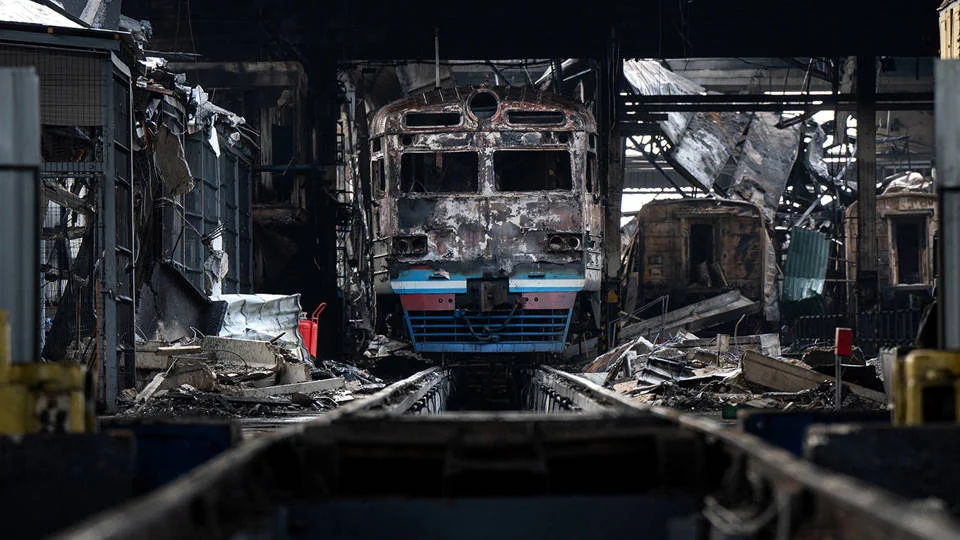
Ukraine’s rail system has been the "lifeline of the nation." With over 20,000 kilometers of track, it is the primary method for moving both troops and humanitarian aid. Intelligence reports indicate that Russia is utilizing advanced long-range reconnaissance drones to map "choke points"—bridges, tunnels, and switching yards—that are difficult to repair.
3. The "Near-Miss" Diplomacy
The frequency of strikes near high-profile political transit routes creates a climate of fear. If the Kremlin can successfully intimidate Western officials into avoiding Kyiv, it achieves a victory without firing a shot at a foreign diplomat. The message is clear: "You are not safe, even when you are leaving."
Official Responses: A Fragile Defiance
The response from the international community has been a mixture of stern condemnation and cautious ambiguity.
The European Union issued a statement calling the strike on the border-adjacent train a "provocation of the highest order," but avoided explicit threats of military escalation. Behind closed doors, officials are grappling with the reality that increasing air defense coverage in Western Ukraine would require a massive commitment of Patriot and NASAMS systems—assets that are currently stretched thin protecting energy grids and major cities.
The Ukrainian Ministry of Infrastructure has remained defiant. "Our railways are the veins of our country," a spokesperson stated. "They can bomb the tracks, but we will rebuild them. They can hit the trains, but the world will still come to Kyiv."
However, the private sentiment among some Western diplomats is increasingly anxious. There is a growing fear that Russia is intentionally pushing the envelope to see how the West defines a "red line." If a train carrying a former head of state were to be hit, the ensuing diplomatic crisis could force an unprecedented escalation from NATO, a scenario the Kremlin likely calculates as a risk worth taking to test Western resolve.
Implications: The Future of the Conflict
The strategy of isolating Ukraine holds profound implications for the duration and intensity of the war.
The Risk of Miscalculation
The primary danger of the current Russian strategy is the "accident" factor. As drone strikes move closer to the Polish border, the margin for error shrinks. An errant missile or a navigation failure could result in a strike on Polish soil. Under Article 5 of the North Atlantic Treaty, such an event would trigger a collective defense response, potentially dragging NATO into a direct kinetic conflict with Russia.
The "Iron Curtain" of Logistics
If Russia succeeds in making the borders too dangerous for transit, Ukraine will face a "logistical Iron Curtain." The inability to move goods effectively will lead to a gradual degradation of the Ukrainian military’s ability to sustain operations in the East, as ammunition and fuel supplies become increasingly susceptible to long-range strikes.
The Psychological Warfare Component
Finally, the strikes are intended to undermine the "Ukraine Fatigue" narrative. By showing the world that Ukraine is under constant, omnipresent threat, the Kremlin hopes to demoralize Western voters and their representatives. The logic is cynical but simple: if the cost of supporting Ukraine includes the constant risk of assassination or diplomatic humiliation, the political appetite for support may eventually wane.
Conclusion: The Necessity of Response
The strike near the Polish border is not an isolated tactical event; it is a strategic manifestation of Russia’s desire to finalize the partition of Ukraine from the European economic space. Ignoring these provocations will only embolden the Kremlin to tighten the noose.
To counter this, the West must shift from a reactive posture to a proactive one. This means not only providing more air defense systems for border regions but also acknowledging that the security of Ukraine’s logistics is synonymous with the security of Europe’s eastern flank. If the Kremlin is allowed to isolate Ukraine, they will have effectively won the war by other means—proving that the West’s promise to support Ukraine "as long as it takes" has a limit defined by the reach of a Russian drone.
The trains in Ukraine must continue to run, not just for the sake of the Ukrainian economy, but as a symbolic assertion that the West will not be bullied into abandoning its partners. The time for hand-wringing is over; the time for a robust, multi-layered defense of Ukraine’s connectivity is now. The cost of inaction—a isolated, crumbling, and desperate Ukraine—is a price the global order cannot afford to pay.



