

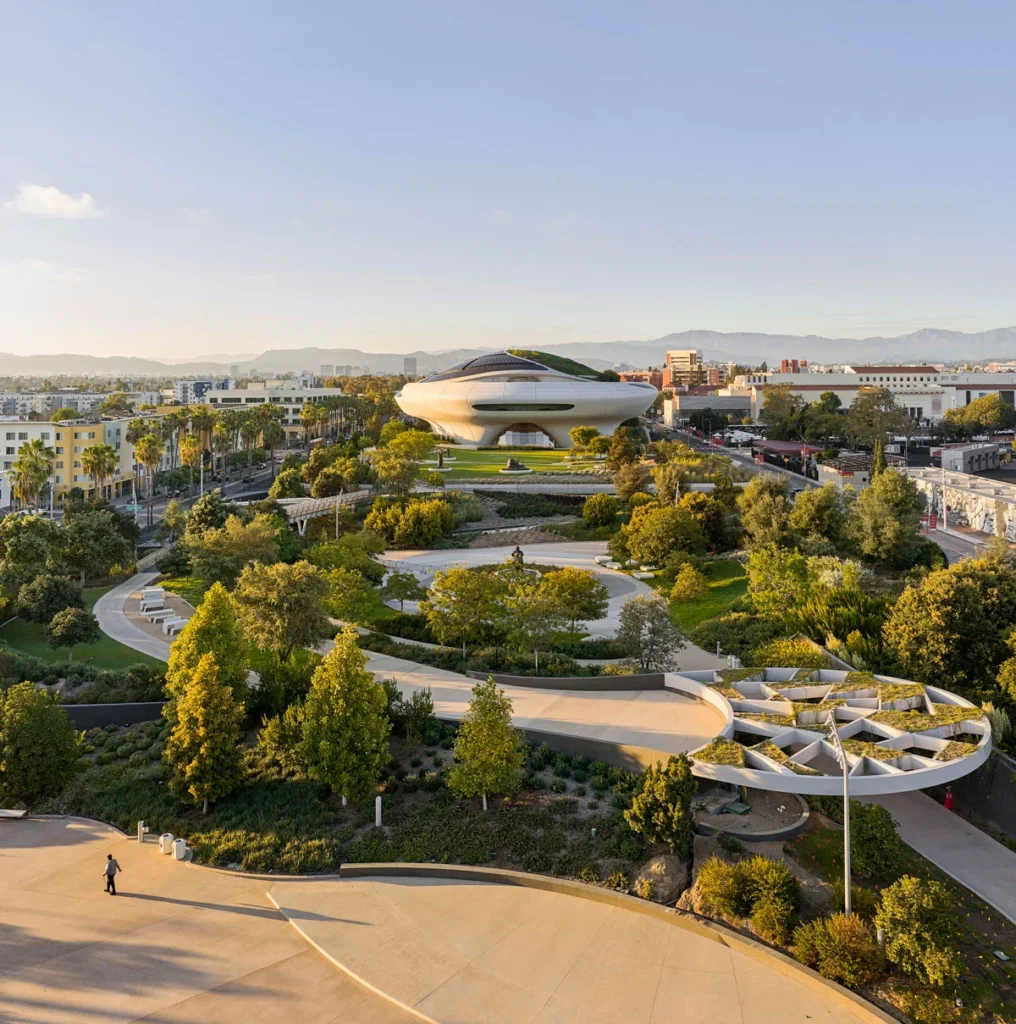
The Lucas Museum of Narrative Art, the ambitious $1 billion cultural endeavor spearheaded by filmmaker George Lucas and his wife, Mellody Hobson, opened its doors in Los Angeles with grand promises of being a "people-first" institution. Yet, within days of its public debut, the museum has found itself embroiled in a sharp architectural and philosophical controversy. The expansive, architecturally striking public plaza surrounding the structure—initially billed as a "generous civic space" intended to serve as a seamless bridge between the institution and the surrounding Exposition Park—has been permanently fenced off.
What was meant to be a porous, inviting gateway has, in practice, become a gated compound. For critics and urban planners alike, the installation of permanent stainless-steel barriers is not merely a logistical adjustment; it is a profound contradiction to the museum’s founding ethos, raising uncomfortable questions about the privatization of public land and the shifting definitions of accessibility in contemporary cultural institutions.
The Chronology of a Shifting Vision
The trajectory of the Lucas Museum’s relationship with its public space has been one of gradual contraction. When the project was first conceived, the architectural vision, led by Ma Yansong of MAD Architects, emphasized transparency and fluidity. The museum was designed to be a "gateway" to the park, a building that did not merely sit in the landscape but served as a connector, inviting the public to flow through its perimeter as part of their daily urban life.
- 2017–2020: During the planning and groundbreaking phases, leadership consistently messaged that the museum would be an inclusive space. The goal was to democratize art—focusing on "people’s art" like comics, illustrations, and cinematic imagery—and to integrate that mission into the physical fabric of Los Angeles.
- 2025: A year of significant internal transition, the museum underwent substantial organizational changes, including the departure of long-standing director Sandra Jackson-Dumont and a reduction of 14 percent of its full-time staff, specifically targeting the education and public programming departments.
- October 2026: The grand opening weekend served as the breaking point for public perception. Visitors were greeted by fences lined with plastic greenery that blocked entry to the plaza from both sides. The Los Angeles Times reported that these temporary, "makeshift" barriers—widely criticized as an aesthetic and philosophical blight on a billion-dollar campus—would soon be replaced by permanent stainless-steel gates.
Architectural Intent vs. Operational Reality
The design language of the Lucas Museum was supposed to signify openness. MAD Architects, known for their futuristic, fluid structures, had promised a campus that would harmonize with the natural beauty of Exposition Park. However, the current reality suggests a disconnect between the architect’s intent and the security requirements of the museum’s operations team.
Dixon Junliang Lu, a principal at MAD Architects, has defended the change by noting that the design "evolved as the project developed and the operational and security requirements became more defined." This reflects a recurring pattern in modern museum architecture: the tension between the aesthetic ideal of the "open plaza" and the pragmatic, often risk-averse, realities of managing a high-profile, high-traffic facility in a major metropolitan area.
Museum spokesperson Seth Fowler has clarified that the primary drivers for the fencing are twofold: the protection of pedestrians from surrounding car traffic and the necessity of managing visitor flow. While the museum maintains that unticketed visitors can still access the gift shop and café, the necessity of passing through a gated checkpoint fundamentally alters the psychological experience of the space. The act of "entering" has replaced the act of "arriving."
A Contradiction in Mission: The "People’s Museum"
The controversy is exacerbated by the unique legal and social arrangement of the museum’s existence. The site is being leased from the State of California for a nominal fee of $30 a year. This arrangement was justified by the museum’s promise to deliver a significant public good: a center for "people’s art" that would be accessible to the widest possible demographic.
Critics argue that by walling off the plaza, the institution is reneging on the implicit social contract that accompanied its subsidized land lease. If a museum is built on public land to celebrate the art of the masses, the installation of a perimeter fence creates an exclusionary barrier that feels at odds with that mission. As the Los Angeles Times poignantly summarized: "Sure, anyone can come, but they are no longer invited."
This incident is the latest in a series of decisions that suggest the museum is retreating from its educational and civic responsibilities. The 2025 layoffs of the education staff and the subsequent decision to omit didactic texts from the galleries—a move the museum claims is intended to "privilege looking"—have led many to characterize the institution as a passive gallery rather than a center of learning.
The Problem with "Privileged Looking"
The museum’s aesthetic choice to forgo educational signage is a radical, if controversial, departure from standard curatorial practice. While proponents argue it allows for a purer, more visceral connection between the viewer and the art, historians and educators argue that it abdicates the institution’s responsibility to contextualize complex narrative art. By removing the "didactic," the museum risks turning art history into mere spectacle, depriving the public of the knowledge-building tools they were promised.
Implications for the Future of Public Space
The "gating" of the Lucas Museum serves as a case study in the broader crisis of civic space in Los Angeles. As cities become increasingly dense and real estate values soar, the few remaining open spaces are under constant pressure to become "managed" environments.
- The Rise of the "Gated Campus": The transition from an open plaza to a fenced compound suggests that institutional security is being prioritized over civic permeability. This trend is not unique to the Lucas Museum but is becoming a hallmark of high-end cultural development in the 21st century.
- The Erosion of Public Trust: When an institution promises a "generous civic space" and then pivots to a "highly controlled" one, it damages the credibility of the arts sector. The public becomes less likely to trust future claims of accessibility when the physical environment dictates otherwise.
- The Impact on Neighborhood Integration: By cordoning off the plaza, the museum has effectively turned its back on the neighborhood. Instead of acting as an anchor that draws the community in, it stands as a siloed monument, disconnected from the rhythm of the city around it.
Conclusion: What Defines a Museum?
The Lucas Museum of Narrative Art stands at a crossroads. It possesses the resources, the location, and the collection to be a transformative force in Los Angeles. However, the decision to prioritize controlled access over open, inclusive civic space suggests a misunderstanding of what makes a museum truly "of the people."
If a museum’s primary role is to serve as a bridge—between the past and present, between the artist and the viewer, and between the institution and the community—then the installation of stainless-steel gates is a failure of that mission. A museum that fears its own public, or that views its plaza as a threat to be managed rather than an opportunity to be shared, risks becoming an architectural island.
As the dust settles on the opening weekend, the institution must grapple with the image it has projected. To truly honor the legacy of "narrative art," the museum must recognize that the most compelling narrative it creates is the one it writes through its own actions. By choosing to fence itself off, the Lucas Museum has, for now, chosen a narrative of exclusion—a story that sits in stark contrast to the inclusive, democratic vision that George Lucas and Mellody Hobson once so clearly articulated. Whether the institution will eventually choose to "re-open" its gates remains to be seen, but for the residents of Los Angeles, the fences remain a cold, hard reminder of the distance between a vision and its manifestation.



