

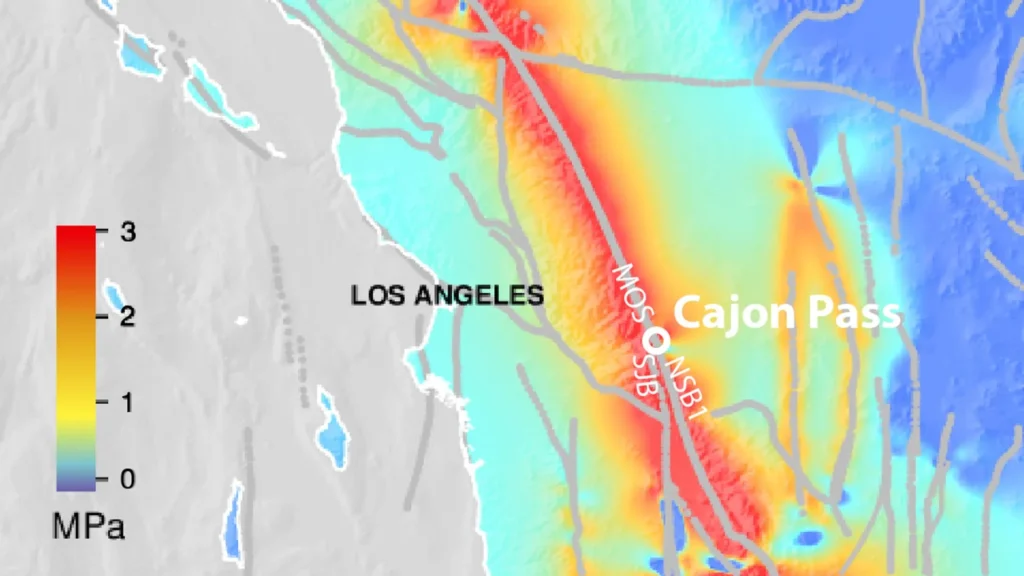
Southern California, a region defined by its sun-drenched coastlines and sprawling urban centers, sits atop one of the most complex and closely monitored geological tapestries on the planet. For decades, seismologists have grappled with the "Big One"—the inevitable, high-magnitude earthquake that looms over the San Andreas Fault system. Now, a groundbreaking study published in the Journal of Geophysical Research: Solid Earth suggests that the region’s seismic risk may be even more precarious than previously understood, with stress levels reaching unprecedented highs not seen in a millennium.
The Anatomy of a Seismic Threat
Earthquakes are fundamentally a result of the Earth’s restless nature. As the massive tectonic plates that comprise the Earth’s crust grind against one another, they do not slide smoothly. Instead, they catch, locking into place while the relentless motion of the planet continues to push from behind. This creates an accumulation of immense elastic energy. When the friction can no longer hold that force back, the crust snaps, releasing decades or centuries of stored energy in a violent, ground-shaking event.
In Southern California, this process is dominated by two primary juggernauts: the San Andreas and San Jacinto fault systems. These faults do not act in isolation; they are part of a synchronized, subterranean dance that dictates the tectonic architecture of the region. Northeast of Los Angeles, these two systems converge at the Cajon Pass. This geological junction serves as a critical "earthquake gate," a complex nexus where a rupture propagating along one fault line may—depending on specific environmental and physical conditions—jump to the other, potentially triggering a cascading disaster that dwarfs the impact of a single-fault rupture.
A Chronology of Silence and Stress
The urgency of this new research is underscored by the region’s long period of relative seismic quiet. The last major earthquake to significantly impact this fault system was the magnitude 7.9 Fort Tejon event in 1857. Since that day, Southern California has undergone unprecedented urbanization, transforming from a frontier landscape into one of the world’s most densely populated and infrastructure-dependent regions.
During this extended hiatus, the tectonic plates have never stopped moving. The San Andreas and San Jacinto faults have been silently, steadily accumulating stress, a "debt" that will eventually be paid in the form of seismic activity. By reconstructing 1,000 years of seismic history, an international team of researchers—led by Dr. Liliane Burkhard of the University of Bern, in collaboration with the University of Hawaiʻi at Mānoa, the U.S. Geological Survey (USGS) Earthquake Science Center, and the Scripps Institution of Oceanography—has quantified just how much of that debt has accrued.
Modeling a Millennium
To understand the current state of the fault, the research team developed a sophisticated, physics-based, four-dimensional earthquake cycle model. Unlike static maps, this 4D approach tracks both spatial movement and the evolution of the system over time. The model was calibrated using a treasure trove of historical and geological data:
- Radiocarbon Dating: Analyzing organic materials trapped in fault traces to pinpoint the timing of past ruptures.
- Dendrochronology: Examining tree rings for evidence of trauma caused by massive ground shifts centuries ago.
- Historical Archives: Utilizing accounts of surface ruptures that predated modern seismic instrumentation.
"The model tracks how each earthquake changes stress on neighboring fault segments, how stress accumulates during the quiet intervals between events, and how the deeper layers of the crust slowly relax following large ruptures," explains Dr. Burkhard. By simulating the last 1,000 years of California’s geological history, the team was able to create a "stress map" of the present day.
The Findings: Extreme Stress Levels
The results of the study are stark. The research team identified that tectonic stresses in several segments of the fault system have reached—and in some locations exceeded—the highest values recorded in the entirety of the 1,000-year simulation.
The focus of this stress is the Cajon Pass. The researchers found that the San Jacinto-Bernardino section is currently under a stress load of 3.6 MPa (megapascals), while the nearby Mojave South section of the San Andreas is at 2.8 MPa. These figures are not merely abstract numbers; they represent mechanical pressures that are at the upper limits of what the crust can withstand. More concerning than the absolute stress, however, is the configuration. When both faults reach these high levels of stress simultaneously, the potential for a "multi-fault rupture"—an event where the earthquake jumps from one fault to the other—increases dramatically.
The "Earthquake Gate" Phenomenon
The concept of the Cajon Pass as an "earthquake gate" is central to understanding the potential for future catastrophe. Historically, this junction has acted as both a wall and a bridge.
- The Barrier Effect: In the 1857 Fort Tejon earthquake, the rupture reached the Cajon Pass and stopped, preventing the energy from migrating onto the San Jacinto system.
- The Bridge Effect: Conversely, the 1812 Wrightwood earthquake demonstrated the terrifying alternative, where the rupture successfully bypassed the junction, tearing through both systems in a single, continuous event.
The study indicates that the gate is not a static feature. Instead, it is a dynamic participant that responds to the fluctuating stress levels surrounding it. "Cajon Pass doesn’t simply block or channel earthquakes," says Dr. Burkhard. "It responds to stress conditions, and those conditions change over centuries." Currently, the stress alignment suggests that the conditions required for a "bridge" event are more favorable than they have been in recent history.
Implications for Public Safety and Infrastructure
The potential for a dual-fault rupture carries profound implications for the Los Angeles, San Bernardino, Riverside, and Coachella Valley regions. An earthquake that triggers both the San Andreas and San Jacinto faults would cover a significantly larger geographic area than a single-fault event, potentially paralyzing the heart of Southern California.
The Cajon Pass is not just a geological curiosity; it is a critical artery for modern civilization. It serves as a vital corridor for:
- Transportation: Major highways and rail lines that facilitate the movement of goods and people across the state.
- Energy: Essential pipelines and high-voltage electrical transmission lines that power the region.
- Emergency Response: A major rupture in this pass could sever the very pathways that emergency responders rely on to provide aid to affected communities.
From the perspective of urban planning, this research provides a clearer, physics-based picture of the "worst-case" scenarios. By understanding which segments of the fault are most likely to interact, emergency managers can better simulate evacuation routes, hospital surge capacities, and infrastructure resilience efforts.
A Note of Caution: Prediction vs. Preparedness
Despite the gravity of the findings, Dr. Burkhard and her colleagues are quick to temper the news with a critical scientific disclaimer: this study is not a prediction.
"The study is not a forecast of when an earthquake will occur," Dr. Burkhard emphasizes. "Even when faults are highly stressed, science cannot yet determine the exact timing of a rupture." Instead, the model serves as a tool for hazard assessment. It allows scientists to define the range of "physically plausible" scenarios, moving away from vague speculation toward a more rigorous understanding of the risks.
This research reinforces the reality that Southern California is a region of high seismic potential. The fact that the fault system is "critically stressed" does not mean an earthquake is imminent tomorrow, but it does mean that the region is currently in a state where a major event is not only possible but increasingly likely based on historical cycles.
Conclusion: Living with the Fault
The work of Dr. Burkhard’s team provides a vital service to the scientific community and the public at large. By grounding seismic risk in 1,000 years of data and rigorous physics, they have removed some of the mystery surrounding the San Andreas and San Jacinto systems.
As Southern California continues to grow, the integration of these findings into building codes, emergency preparedness drills, and infrastructure development will be essential. The "earthquake gate" at Cajon Pass remains closed for now, but the study serves as a potent reminder that the pressure beneath the surface is mounting. In the realm of geology, time is a long-term measurement, and while we cannot predict the exact hour or day of the next major rupture, we now have a clearer understanding of the forces at play, allowing for a more proactive approach to surviving the inevitable.



