

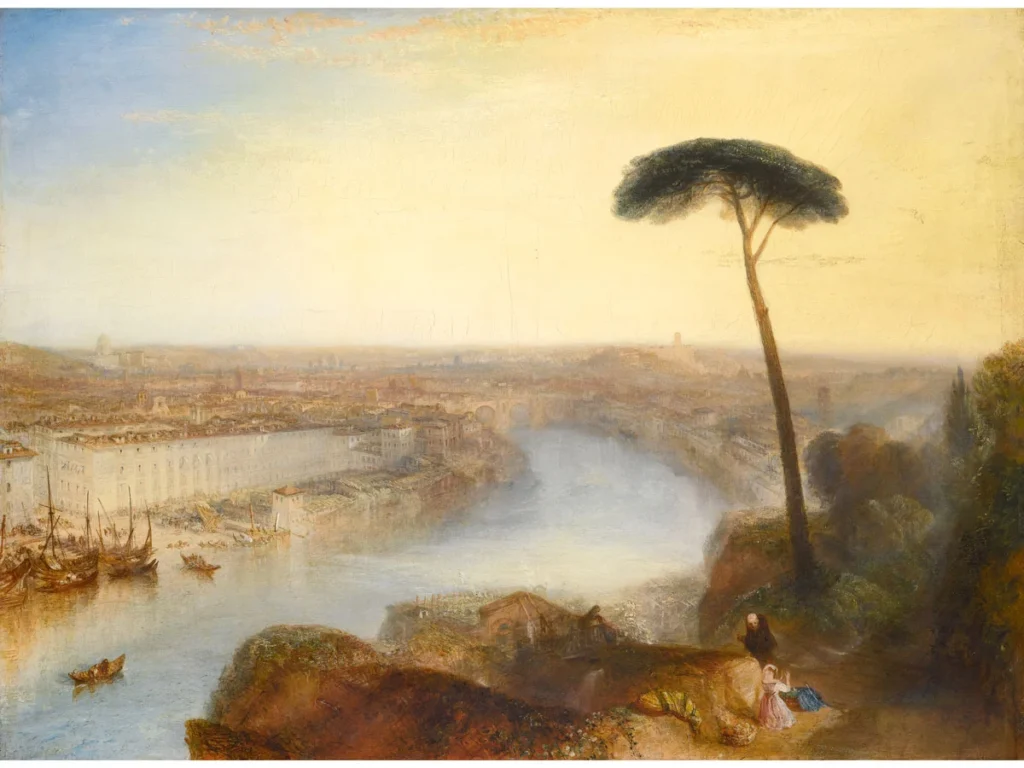
The international art market is bracing for a seismic event this winter as Sotheby’s prepares to offer one of the most significant works by Joseph Mallord William Turner ever to appear at public auction. Rome, from Mount Aventine (1836), a luminous testament to the British master’s obsession with light and the "Eternal City," is slated to lead the Old Master Evening Sale in London on December 9. With an estimate of £50 million (approximately $66.2 million), the painting represents not only a pinnacle of 19th-century landscape art but also a rare opportunity for collectors to acquire a work of impeccable provenance and pristine condition.
Before the hammer falls in London, Sotheby’s has orchestrated a symbolic homecoming for the masterpiece. The painting is currently on public display at the Palazzo Rondinini, a magnificent 18th-century Baroque palace in Rome, where it will remain through October 1. This exhibition marks a poignant moment in the painting’s 191-year history, returning the work to the very city that inspired its creation nearly two centuries ago.
Main Facts: A Rare Jewel of the Romantic Era
Rome, from Mount Aventine is widely regarded as one of the finest examples of Turner’s "Golden Age." Executed at the height of his creative powers, the painting captures a panoramic view of Rome bathed in a transformative, ethereal glow. The composition showcases Turner’s unparalleled ability to blend topographical accuracy with atmospheric poetry, a technique that would eventually pave the way for the Impressionist movement.
The painting’s rarity cannot be overstated. While Turner’s watercolors frequently appear on the market, his large-scale finished oil paintings are overwhelmingly held in public institutions, most notably the Tate Britain in London. Rome, from Mount Aventine is one of only a handful of major Turner oils remaining in private hands. Its appearance at auction is a "generational event," occurring only a decade after its last record-breaking sale.
The physical state of the work further elevates its value. In an era where many 19th-century canvases have undergone extensive restoration, relining, or cleaning, this painting remains on its original canvas and within its original frame. It has never been relined—a process where a new canvas is glued to the back of the original to provide support—meaning the texture of Turner’s brushwork remains exactly as it was when it left his studio in 1836.
Chronology: From a Private Commission to a Prime Minister’s Collection
The history of Rome, from Mount Aventine is a narrative of elite patronage and political power. Its journey through the centuries provides a window into the evolution of art collecting in Great Britain.
1828–1836: The Genesis of a Masterpiece
The painting was born out of Turner’s deep fascination with Italy. Although the work was completed in London in 1836, Sotheby’s specialists believe it was meticulously mapped out and conceived during Turner’s travels in Italy years earlier. The work was commissioned by Hugh Andrew Johnstone Munro of Novar, a wealthy Scottish landowner and one of Turner’s most devoted patrons and close personal friends. Munro was a significant figure in the 19th-century art world, and his collection was renowned for its breadth and quality.
1876: The Rosebery Acquisition
Following Munro’s death, the painting was put up for sale in 1876. It was acquired by Archibald Primrose, the 5th Earl of Rosebery, for the sum of £6,142. To put this into modern context, that figure equates to approximately £636,000 today—a substantial sum for the period but a fraction of its current valuation.
The purchase was more than a financial investment; it was a romantic gesture. Lord Rosebery bought the painting as a wedding gift to celebrate his marriage to Hannah de Rothschild, the daughter of Baron Mayer de Rothschild and the wealthiest woman in England at the time. The painting remained a centerpiece of the Rosebery family’s collection for over 130 years, hanging in their ancestral homes as a symbol of the union between two of Britain’s most powerful dynasties.
2014: The Record-Breaking Auction
For over a century, the painting was largely hidden from public view, held within the private confines of the Rosebery estate. In 2014, the family made the decision to bring the work to auction for the first time. The sale at Sotheby’s London was a landmark moment, where the painting fetched £30.3 million (the equivalent of roughly £43.5 million in today’s inflation-adjusted terms). That sale set a record for Turner, solidifying his status as the most commercially successful British artist of the 19th century.
2024: The Return to the Block
Now, only ten years after its last sale, the painting returns to Sotheby’s with a significantly higher estimate, reflecting the tightening supply of "trophy" Old Master works and the continued global demand for blue-chip art assets.
Supporting Data: The Economics of a Masterpiece
The valuation of Rome, from Mount Aventine at £50 million reflects a broader trend in the art market where "masterpiece-level" works continue to appreciate even amid economic volatility.
- Price Appreciation: Between 1876 and 2014, the painting’s value increased from £6,142 to over £30 million. The current estimate of £50 million represents a potential 65% increase in value in just one decade, far outpacing general inflation and many traditional investment vehicles.
- Scarcity Value: Of the approximately 500 oil paintings Turner produced, the vast majority were bequeathed to the British nation upon his death (the Turner Bequest). Private collectors are essentially competing for a dwindling pool of approximately 20 major oils that remain outside of museum walls.
- The "Turner Effect": Turner’s market performance has historically been robust. His other major Roman view, Modern Rome – Campo Vaccino, sold for £29.7 million in 2010 to the J. Paul Getty Museum. The current estimate for Mount Aventine suggests that the market now values these top-tier works at nearly double what they commanded 15 years ago.
Official Responses: Expert Analysis
The announcement of the sale has sent ripples through the academic and commercial art sectors. Sotheby’s specialists have been vocal about the painting’s importance, framing it as a pivotal moment in the history of Western art.
Julian Gascoigne, Senior Specialist of British Paintings at Sotheby’s London, emphasized the painting’s technical virtuosity:
“Few paintings capture Turner’s genius as vividly and completely as this extraordinary vision of Rome’s timeless beauty. Created at the height of his powers, it is a work of extraordinary ambition, beauty, and innovation—one that has come to define not only Turner’s achievement but the very course of modern painting.”
Art historians point to the painting’s use of "sfumato" and its radical treatment of light as a precursor to the work of Claude Monet. By dissolving solid forms into a haze of gold and ochre, Turner was moving away from the rigid constraints of 18th-century landscape painting toward a more subjective, emotional experience of nature.
Experts also highlight the significance of the Rome exhibition. By placing the work in Palazzo Rondinini, Sotheby’s is appealing to the "grand tour" sensibility of high-net-worth collectors, emphasizing the painting’s cultural heritage and its status as a bridge between the British and Italian artistic traditions.
Implications: What This Sale Means for the Art World
The upcoming auction of Rome, from Mount Aventine carries several significant implications for the global art market and the preservation of cultural heritage.
The Rise of the "Mega-Lot"
The £50 million estimate places this Turner in a league usually reserved for the likes of Leonardo da Vinci, Rembrandt, or the giants of Impressionism and Modernism (Picasso, Monet). It signals that the "Old Master" category—often unfairly characterized as a slow-moving market—can still generate "blockbuster" numbers when the quality and provenance are exceptional.
Private vs. Public Collections
There is a perennial debate regarding whether works of this caliber should reside in public museums or private collections. When a work like this goes to auction, there is often a hope among the public that a major institution (like the National Gallery or the Getty) will secure it. However, with an estimate of £50 million, few museums have the acquisition budget to compete without significant philanthropic support. If the painting is purchased by a private collector in Asia or the Middle East, it may once again disappear from public view for several decades.
A Benchmark for the "Old Master" Market
The December 9 sale will serve as a bellwether for the health of the high-end art market. If the painting exceeds its estimate, it will demonstrate that there is still immense liquidity at the top end of the market for works with "unimpeachable" credentials. If it struggles, it may suggest a cooling of interest in traditional European masters in favor of contemporary art.
The Preservation of Integrity
The fact that the painting remains unrestored is a powerful message to the market about the value of "original state." In an age of high-tech conservation, the market is increasingly placing a premium on works that have been left alone, viewing the natural aging process as part of the object’s soul and historical integrity.
As the December auction approaches, the eyes of the world will be on London. Rome, from Mount Aventine is more than just a painting; it is a survivor of the 19th century, a gift of love from a Prime Minister to his bride, and a luminous vision of a city that has captivated the human imagination for millennia. Whether it ends up in a museum or a private penthouse, its sale will be remembered as a defining moment in the modern history of the art trade.



