

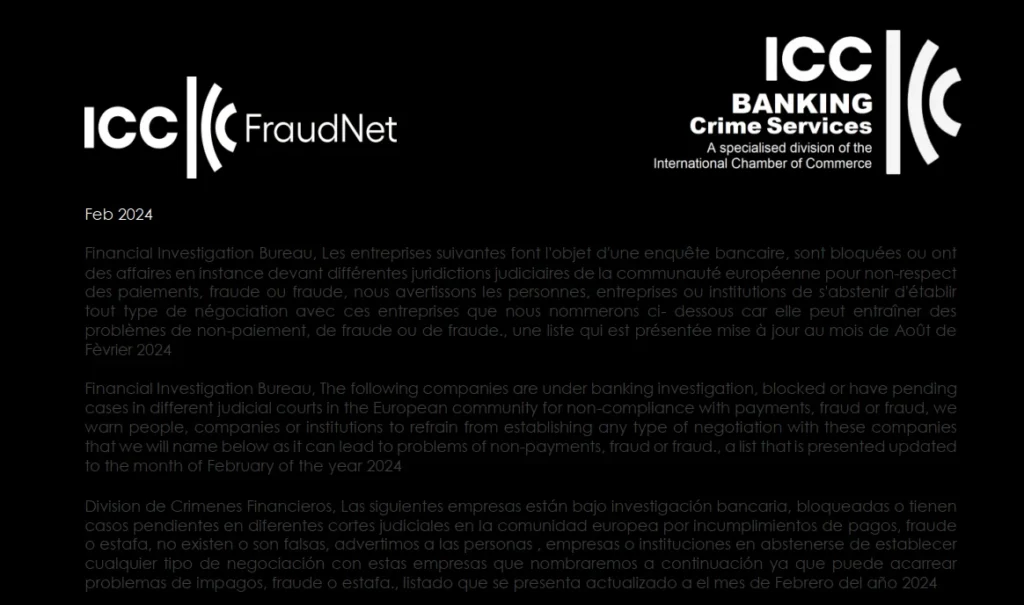
In a formal advisory issued this week, the International Chamber of Commerce Commercial Crime Services (ICC-CCS) has alerted the global business community to the emergence of fraudulent "blacklists" currently circulating through international trade networks. These documents, which falsely claim to be compiled by the ICC-CCS, list various individuals and companies as targets for suspicion or sanction.
The ICC-CCS has moved swiftly to debunk these materials, characterizing them as malicious fabrications designed to deceive industry stakeholders and irreparably damage the reputations of the entities named within them. The organization has categorically denied any involvement in the creation or distribution of such lists, urging the public to exercise extreme caution and to treat any such document as a sophisticated fraudulent attempt at corporate sabotage.
The Anatomy of the Fraud: Main Facts
The fraudulent lists in question mimic the formatting and branding typically associated with official ICC-CCS correspondence. By co-opting the organization’s letterhead and utilizing the unauthorized use of the ICC-CCS logo, the perpetrators have successfully lent an air of professional legitimacy to their disinformation campaign.
The primary purpose of these documents appears to be the systematic defamation of specific companies and individuals. By positioning these entities on a "blacklist," the anonymous actors behind this scheme aim to trigger internal compliance investigations, freeze business partnerships, and erode trust within the international supply chain.
Key elements of the fraud include:
- Unauthorized Branding: The illicit use of the ICC-CCS logo and trademarked imagery.
- False Attribution: Claims that the data contained within the lists is the result of rigorous intelligence gathering or official oversight by the ICC-CCS.
- Targeted Defamation: The inclusion of specific contact details for companies and individuals, effectively marking them for exclusion from trade and finance.
A Timeline of Deception: Chronology of the Disinformation
While the exact origin of these documents remains under investigation, industry experts and internal ICC-CCS analysts have traced the initial appearance of these lists to the early months of this year.
Phase 1: Initial Discovery (Q1)
Reports of suspicious documents began surfacing in late Q1, primarily through email channels and professional networking forums. Initial recipients were largely concentrated in the logistics and maritime sectors, where the ICC-CCS holds significant influence.
Phase 2: Escalation (Q2)
By the second quarter, the lists began appearing in more formal digital environments, including B2B databases and trade compliance forums. It was during this period that the ICC-CCS began receiving a spike in inquiries from companies demanding clarification on their inclusion in these mysterious documents.
Phase 3: Formal Identification (Q3 to Present)
Following a comprehensive internal audit of its publication protocols, the ICC-CCS confirmed that none of these documents originated from their offices. The organization officially categorized the documents as a malicious campaign of disinformation, leading to the issuance of the public advisory currently circulating.
The Landscape of Trade Security: Supporting Data
The rise of these fraudulent lists coincides with a period of heightened sensitivity regarding supply chain integrity. In the current global economic climate, companies are increasingly reliant on third-party compliance registers to mitigate risk.
For instance, the International Hologram Manufacturers Association (IHMA)—which often collaborates with legitimate regulatory bodies to ensure brand protection—operates a registry designed to protect members from the counterfeiting of holograms and copyright infringement. The perpetrators of the current fraud have exploited this general awareness of "security registries" to mask their malicious intent.
Data from cybersecurity analysts suggests that:
- Rise in Impersonation Attacks: There has been a 22% increase in "brand-jacking" incidents globally over the last 18 months, where bad actors impersonate regulatory or industry watchdog groups.
- Targeting of Reputation: Malicious actors have moved beyond simple financial phishing to "reputational phishing," where the goal is to disrupt competitor operations by poisoning their professional standing.
- Compliance Vulnerability: Many mid-sized firms rely on manual cross-referencing for compliance checks. The sophistication of these fraudulent lists makes it difficult for entry-level compliance officers to distinguish between a legitimate ICC-CCS advisory and a forgery.
Official Responses: ICC-CCS Stance
Michael Howlett, Director of the ICC-CCS, has been unequivocal in his condemnation of the fraud. His statements serve as a definitive baseline for how industry stakeholders should view these documents moving forward.
Dismissal of Baseless Claims
"The ICC-CCS would like to make it clear that our organization does not produce lists of this nature," Director Howlett stated during a press briefing. "The contents are entirely false and should not be relied upon by any company or individual."
Strategic Intent of the Perpetrators
Mr. Howlett emphasized that the lists are not mere clerical errors but are, in fact, intentional acts of malice. "It appears that these lists have been created by unknown parties and circulated with the intent of damaging the reputations of the listed companies. They should be completely disregarded and given no credence whatsoever."
Institutional Protocol
The ICC-CCS has reiterated its official protocol: they do not circulate blacklists to the public or private sector via unsolicited emails or informal channels. Any regulatory or security-related guidance issued by the ICC-CCS is disseminated through established, verifiable channels and official web portals. The organization is currently working with legal counsel and cyber-intelligence specialists to track the provenance of these documents.
Broad Implications: The Cost of Disinformation
The consequences of such fraudulent activities are far-reaching, affecting not just the companies named on the lists, but the integrity of the international trade ecosystem as a whole.
Erosion of Trust
The most immediate casualty of this campaign is the erosion of trust between partners. If companies begin to believe that their peers are being "blacklisted" by the ICC-CCS without warning, they may prematurely sever contracts, leading to significant financial losses and legal friction.
The Burden on Compliance
Compliance departments are now forced to dedicate additional resources to verify the authenticity of every security alert they receive. This "verification fatigue" can slow down legitimate business operations and increase the administrative burden on small-to-medium enterprises (SMEs) that may not have the resources to conduct deep-dive background checks on every notification they receive.
Legal and Regulatory Risks
The companies targeted by these lists may find themselves in a precarious position. While they are victims of a smear campaign, they must also manage the fallout of being falsely accused of non-compliance. This can lead to:
- Unnecessary Audits: Internal stakeholders or banking partners may trigger audits based on the false information.
- Contractual Disputes: Partners may cite the "blacklist" as grounds for suspending performance or triggering force majeure clauses.
- Defamation Costs: Legal action may be required to clear a company’s name, which can be both costly and time-consuming.
Recommendations for Industry Stakeholders
In light of these developments, the ICC-CCS and industry experts have provided a series of recommendations to protect against the spread and impact of these fraudulent lists:
- Verification is Mandatory: Never accept a blacklist or a compliance alert at face value. If you receive a document claiming to be from the ICC-CCS, verify it directly on their official website or by contacting their headquarters through confirmed contact channels.
- Report the Fraud: If your company receives one of these documents, do not circulate it to colleagues or partners. Instead, report it immediately to the ICC-CCS. Providing them with the metadata (such as the email address from which it was sent or the platform where it was found) will assist in their ongoing investigation.
- Cross-Reference Internal Policy: Establish a strict protocol for "blacklisting." Real regulatory lists from bodies like the ICC-CCS are typically distributed through formal, secure channels and are accompanied by official documentation, not simple text files or PDFs distributed via email.
- Educate Teams: Ensure that procurement, legal, and compliance teams are aware of this specific threat. A well-informed team is the first line of defense against social engineering and corporate sabotage.
Conclusion
The circulation of fraudulent "blacklists" under the guise of the ICC-CCS represents a sophisticated attempt to weaponize information against unsuspecting companies. By masquerading as an authoritative source, the perpetrators hope to leverage the trust that the global business community places in the ICC-CCS to achieve their own nefarious ends.
As the investigation into these documents continues, the message from the ICC-CCS is clear: skepticism is a necessity. The organization remains committed to upholding the integrity of international trade and will continue to pursue those who seek to undermine it through deceit. Businesses are urged to remain vigilant, ignore these baseless lists, and rely exclusively on verified communications to ensure the safety and security of their international operations.
For further information or to report a suspicious document, stakeholders should visit the official ICC-CCS website and use the established contact channels provided there. Do not trust any information provided by third-party intermediaries claiming to represent the interests of the ICC-CCS without direct confirmation from the source.



