

By Denys Shtilierman
October 5, 2026
The preamble to the Charter of the United Nations begins with a solemn pledge: "We the peoples of the United Nations determined to save succeeding generations from the scourge of war." It is a foundational promise that has defined the post-WWII international order. Yet, as the world enters the final quarter of 2026, that promise rings hollow. Russia’s war of aggression against Ukraine, now deep into its fourth year, has exposed a structural rot at the very heart of the global security architecture.
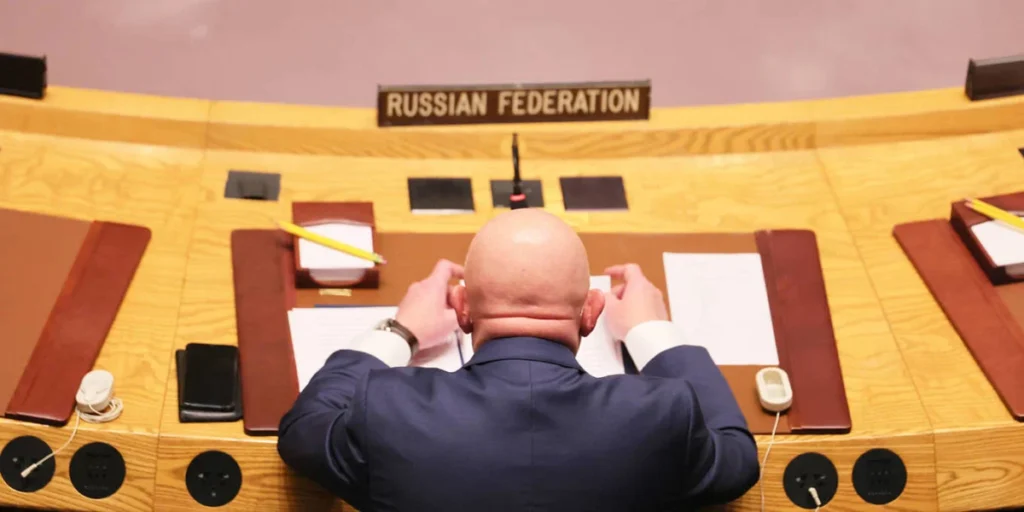
For over three decades, the international community has operated under the assumption that the Russian Federation is the legal successor to the Soviet Union’s permanent seat on the UN Security Council (UNSC). However, a closer examination of the events of 1991 reveals that this transition was not a matter of settled law, but a convenient political fiction. As the Kremlin continues to utilize its veto power to shield its military campaigns from international accountability, the time has come to challenge the legitimacy of Russia’s presence at the world’s most powerful table.
The Genesis of an Irregular Transition: Main Facts
To understand the current crisis, one must revisit the chaotic dissolution of the Soviet Union. On December 24, 1991, Russian President Boris Yeltsin sent a letter to the UN Secretary-General, informing the body that the Russian Federation would continue the membership of the USSR in the United Nations and all its organs, including the Security Council.
Crucially, this was not a formal admission process. Article 4 of the UN Charter is explicit: "Membership in the United Nations is open to all other peace-loving states which accept the obligations contained in the present Charter." Admission is to be effected by a decision of the General Assembly upon the recommendation of the Security Council.
Russia bypassed these requirements entirely. There was no vote, no rigorous vetting of its adherence to the Charter, and no formal consensus among the remaining Soviet republics. Instead, the international community—eager to maintain stability during the collapse of a superpower—simply accepted a fait accompli. Russia "inherited" the seat through diplomatic acquiescence rather than legal procedure. By doing so, the UN allowed a state to step into the shoes of its predecessor without ever having to prove its own qualification for the seat of a permanent member.
A Chronology of Diplomatic Evasion
The history of Russia’s UNSC membership is marked by a series of strategic maneuvers designed to prevent any legal scrutiny of its status:
- December 1991: The Alma-Ata Protocol establishes the Commonwealth of Independent States (CIS). While Russia claims succession, the legal implications for the UN seat are never submitted to the International Court of Justice (ICJ) or the General Assembly for a vote.
- 1992–2014: Russia maintains a status quo, utilizing its veto power to influence global conflicts, including those in the Balkans, Syria, and Georgia, often projecting the image of a "stabilizing" force.
- February 2014: The annexation of Crimea signals the first major post-Soviet breach of the UN Charter’s territorial integrity principles. Russia utilizes its UNSC position to block resolutions condemning the action.
- February 2022: The full-scale invasion of Ukraine marks the ultimate failure of the UNSC’s primary mandate. The body is paralyzed as the aggressor state presides over the very council tasked with stopping it.
- 2024–2026: As the war drags into its fourth year, the global perception of the UNSC shifts from a protector of peace to an accomplice of aggression. Legal scholars and several member states begin openly questioning the validity of Russia’s credentials.
Supporting Data: The Erosion of Global Norms
The argument for revisiting Russia’s seat is not merely symbolic; it is supported by the stark reality of the Council’s current dysfunction. Since 2022, Russia has utilized its veto power—or the threat thereof—to prevent the UN from taking meaningful action on the war in Ukraine.
Statistical analysis of UNSC activity between 2022 and 2026 shows that the Council has reached its lowest level of productivity since the height of the Cold War. In 2025 alone, Russia vetoed 14 resolutions related to humanitarian corridors, ceasefire monitoring, and the establishment of special tribunals for war crimes.
Furthermore, legal experts point to the "Declaration on Principles of International Law concerning Friendly Relations," which states that a state’s status as a successor must be aligned with the Charter’s commitment to sovereign equality. If a successor state systematically violates the Charter, the "automatic" nature of its succession becomes legally indefensible. Data from the UN Secretariat archives confirms that no legal opinion was ever issued in 1991 to justify the bypass of Article 4, leaving Russia’s status in a perpetual state of "legal limbo."
Official Responses and International Stance
The international reaction to the calls for Russia’s removal has been a study in diplomatic tension.
The Kremlin’s Stance
The Russian Foreign Ministry maintains that its UNSC status is "indisputable" and "historically grounded." They argue that the transition was recognized by the UN Secretariat in 1991 and that any attempt to reopen the question is an act of "illegal political engineering" intended to dismantle the post-war order.
The Western Perspective
While the United States, the UK, and France have been hesitant to formally challenge the seat—fearing a collapse of the entire UN structure—the rhetoric is shifting. In a September 2026 address to the General Assembly, several European leaders hinted that the UNSC "cannot remain a sanctuary for aggressors." While no formal motion has been tabled, the legal groundwork is being prepared by international law firms and academic think tanks in The Hague.
The Global South
Many nations in the Global South remain wary. They fear that if Russia’s seat is challenged, the precedent could be used to challenge other permanent members, leading to a geopolitical free-for-all. However, there is growing support for a reform of the Council that would include the removal of veto power in cases where a member is an active party to a conflict.
Implications: The Future of the Global Order
If the international community were to seriously pursue the de-legitimization of Russia’s UNSC seat, the implications would be seismic.
1. A Crisis of Legitimacy: The immediate implication would be the potential for a "constitutional crisis" within the UN. If Russia refuses to vacate, the organization could face a split, with a "UN 2.0" emerging that excludes the aggressor state.
2. Redefining Succession Law: A successful challenge would establish a new international legal precedent: that permanent membership is not a birthright of the successor state, but a responsibility that must be earned and maintained. This would fundamentally alter how states approach international treaty obligations.
3. The Path to Reform: The current war has laid bare the fact that the UNSC, as currently constituted, is incapable of handling 21st-century threats. Revisiting the Russia question could serve as the catalyst for the long-overdue expansion of the Security Council, bringing in voices from Africa, Latin America, and South Asia.
4. Ending the Impunity: Ultimately, the goal of revisiting this legal status is to end the era of impunity. As long as an aggressor can veto the resolutions meant to stop them, the UN remains in violation of its own Charter.
Conclusion
The "scourge of war" that the UN was created to prevent has found a home within the halls of the Security Council. The 1991 transition was a moment of diplomatic convenience that has turned into a systemic failure. Russia’s occupation of a permanent seat—secured through an irregular process and maintained through the violation of the Charter—is the single greatest obstacle to the credibility of the United Nations.
To save the organization, the world must be willing to do the hard work of revisiting the foundations. It is not enough to hope for peace; the international community must ensure that the institutions tasked with maintaining it are built upon a foundation of law, not the shifting sands of political expediency. As the fourth year of the war in Ukraine continues, the question is no longer whether Russia’s seat is problematic, but how much longer the world can afford to ignore that it was never legally theirs to begin with.



