

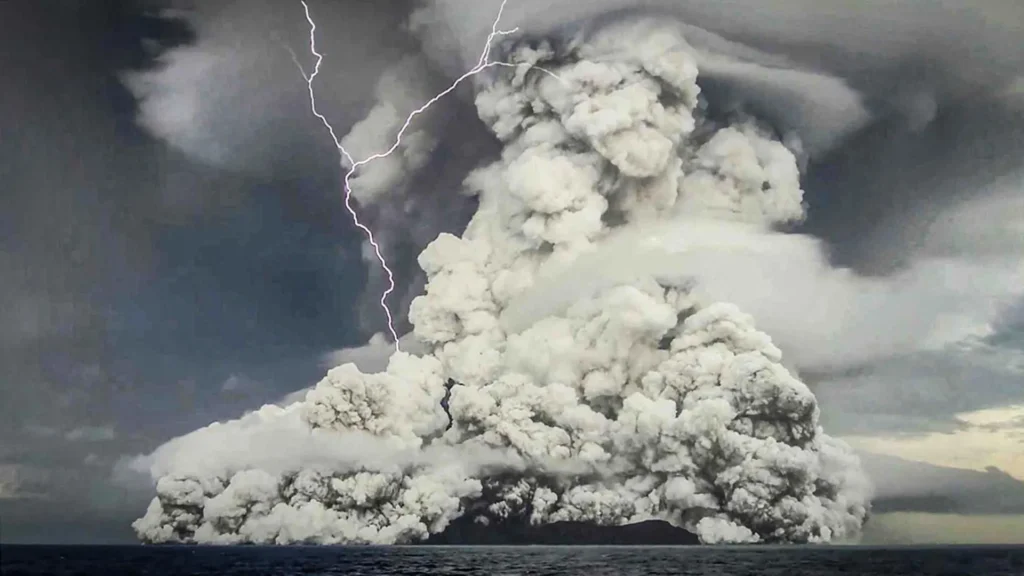
In January 2022, the South Pacific witnessed an event of cataclysmic proportions. The Hunga Tonga-Hunga Ha’apai volcano erupted with a ferocity rarely seen in the modern era, sending a colossal plume of ash, water vapor, and chemicals into the stratosphere. While the immediate destruction captured global headlines, a secondary, hidden phenomenon was unfolding within the volcanic cloud—a process that researchers are now hailing as a potential blueprint for mitigating the climate crisis.
New findings published in Nature Communications reveal that the massive volcanic plume did more than just release pollution; it effectively triggered a large-scale chemical reaction that destroyed significant quantities of methane. This discovery provides a rare, real-world proof of concept for atmospheric methane removal, offering a glimmer of hope in the race to curb near-term global warming.
The Chemical Fingerprint: Detecting Destruction from Space
The discovery began not on the ground, but in the digital eyes of the European Space Agency’s Sentinel-5P satellite. Monitoring the eruption via the TROPOMI instrument, scientists observed an anomalous and record-breaking concentration of formaldehyde.
In the complex chemistry of the atmosphere, formaldehyde acts as a "chemical fingerprint." It is a transient byproduct created during the short-lived breakdown of methane. Because formaldehyde survives for only a few hours before degrading, its persistent presence within the volcanic plume over a 10-day trajectory—stretching all the way to South America—served as a definitive signal that methane was being systematically destroyed inside the cloud.
"When we analyzed the satellite images, we were surprised to see a cloud with a record-high concentration of formaldehyde," says Dr. Maarten van Herpen of Acacia Impact Innovation BV, the study’s lead author. "Because formaldehyde only exists for a few hours, this showed that the cloud must have been destroying methane continuously for more than a week."
Chronology of the Eruption and Its Atmospheric Impact
To understand the scale of this phenomenon, one must look at the timeline of the event. When the undersea volcano ruptured, it did not merely spew lava; it acted as a massive injector of marine material into the stratosphere.
- January 15, 2022: The eruption occurs, launching a gargantuan plume of volcanic ash and seawater into the stratosphere.
- January 16–25, 2022: As the plume drifts across the Pacific, satellite instruments detect a sustained, massive spike in formaldehyde concentrations within the cloud.
- Post-Eruption Analysis (2022–2024): Researchers correlate the satellite data with atmospheric models, realizing that the combination of volcanic ash and salt-laden water vapor created a highly reactive environment.
- Scientific Validation (2024): The peer-reviewed study confirms that the plume acted as a natural chemical reactor, removing methane at a rate equivalent to the daily emissions of two million cows.
Supporting Data: The Volcanic Methane Budget
The numbers behind this discovery are staggering. Researchers calculated that the eruption released approximately 300 gigagrams (Gg) of methane—a volume comparable to the annual emissions of two million cows. However, the plume also removed roughly 900 megagrams (Mg) of methane per day.
This discovery challenges current climate accounting. The "global methane budget"—the balance sheet scientists use to track how much methane enters and leaves the atmosphere—has historically focused on biological sources like wetlands and anthropogenic sources like fossil fuel extraction. Atmospheric dust and volcanic mineral aerosols were previously ignored as significant "sinks" for methane.
"We now know that atmospheric dust impacts the methane budget," explains Professor Matthew Johnson of the University of Copenhagen. "Because dust has not previously been taken into account, it is important that we correct the data on which these estimates are based. The Hunga Tonga eruption has forced us to reconsider how much methane is actually being scrubbed by natural processes."
The Mechanism: Salt, Sunlight, and Chlorine
The process discovered in the stratosphere mirrors a 2023 breakthrough involving Saharan dust. In that study, scientists found that when dust from the Sahara mixes with sea salt in the Atlantic, it creates "iron salt aerosols." When sunlight hits these microscopic particles, they release chlorine atoms.
Chlorine is a highly reactive oxidant; it acts like a pair of chemical scissors, attacking and breaking apart methane molecules. What makes the Hunga Tonga case "completely surprising," according to Professor Johnson, is that this mechanism—previously thought to be confined to the lower atmosphere (the troposphere)—was occurring at an extreme altitude in the stratosphere.
The underwater nature of the eruption was key. It blasted vast quantities of salty ocean water and volcanic ash into the upper atmosphere. In the presence of intense solar radiation, these particles catalyzed the production of chlorine, which then facilitated the rapid degradation of methane.
Implications: An "Emergency Brake" for the Climate
Methane is a potent greenhouse gas. While it has a shorter atmospheric lifespan than carbon dioxide (about 10 years compared to centuries for CO2), it is 80 times more effective at trapping heat over a 20-year period. Consequently, methane reduction is often described as the "emergency brake" of climate change.
"If we can reduce methane emissions today, we see a climate benefit within a decade," note the researchers. However, the team is careful to emphasize that this is not a panacea. "Reducing methane is not a substitute for reducing carbon dioxide. Long-term temperature stabilization still requires major reductions in CO2 emissions."
The significance of the study lies in the potential for Atmospheric Methane Removal (AMR). Currently, climate policy focuses on preventing new emissions. This study suggests that if we can identify safe, effective ways to accelerate the natural breakdown of methane already present in the atmosphere, we could lower the risk of crossing dangerous climate tipping points while decarbonization efforts continue.
Official Responses and Technical Challenges
The study involved a multidisciplinary team, including experts from the Royal Netherlands Meteorological Institute, the University of Copenhagen, and the Royal Belgian Institute for Space Aeronomy. The team faced significant technical hurdles in validating their findings.
Dr. Isabelle De Smedt of the Royal Belgian Institute for Space Aeronomy noted that extracting the formaldehyde signal from the TROPOMI data was a monumental task. "Retrieving formaldehyde from TROPOMI in a stratospheric volcanic plume is far outside the instrument’s standard operating conditions," she explained. "We had to carefully correct the satellite’s sensitivity for the unusual altitude of the signal and account for interference from high sulfur dioxide concentrations."
These rigorous corrections were essential to prove that the methane destruction was not a measurement error, but a genuine, large-scale chemical event. The study was supported by Spark Climate Solutions, an organization focused on emerging climate technologies, reflecting the high interest in the potential for human-led methane removal.
A Blueprint for the Future?
Could humans replicate what the volcano did? The idea of using aerosols to clean the atmosphere is not new, but it is fraught with risk. The researchers emphasize that any attempt to manipulate atmospheric chemistry must be approached with extreme caution to avoid unintended ecological consequences.
However, the Hunga Tonga event has provided the most compelling evidence to date that large-scale, deliberate methane removal is chemically possible. More importantly, it has provided a way to measure that removal using satellites, addressing a major criticism of previous AMR proposals: the difficulty of verifying success.
"It’s an obvious idea for industry to try to replicate this natural phenomenon—but only if it can be proven to be safe and effective," concludes Professor Johnson. "Our satellite method could offer a way to help figure out how humans might slow global warming."
As the world grapples with rising temperatures, the unexpected lesson from the South Pacific serves as a reminder that nature holds complex mechanisms for atmospheric regulation. While the Hunga Tonga eruption was a destructive event, its aftermath has illuminated a pathway that, if navigated with care, could prove vital in the battle for a cooler planet.



