

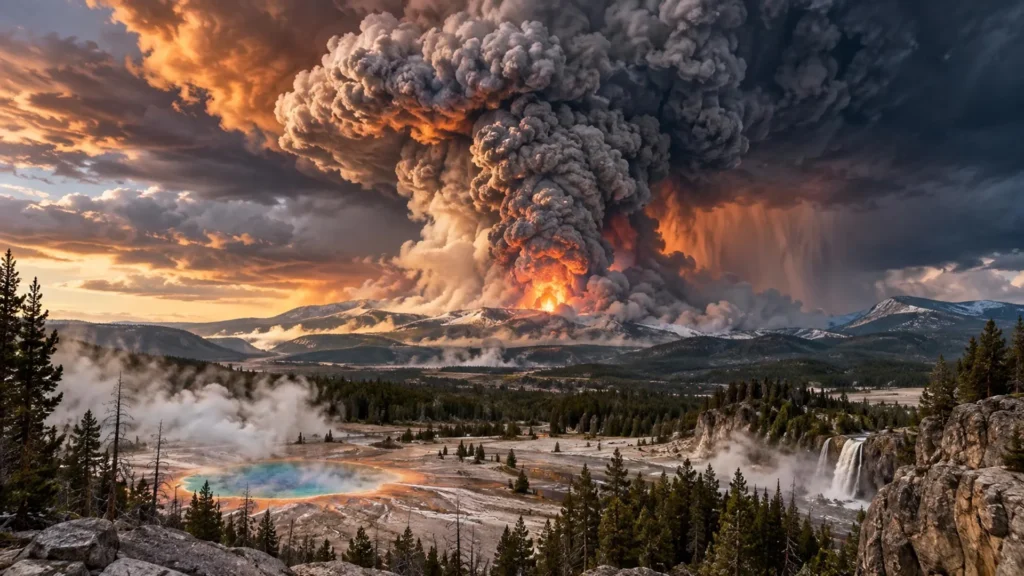
Six hundred and thirty-one thousand years ago—a mere blink in the eye of deep geological time—the North American continent was subjected to an event of unimaginable ferocity. In what is now northwestern Wyoming, the Yellowstone volcanic system unleashed a super-eruption that shattered the surrounding landscape for hundreds of kilometers and blanketed much of the continent in a thick layer of ash. The effects were global, altering weather patterns and climate for years. Today, Yellowstone remains a living, breathing geological engine, and while no human witnessed that ancient cataclysm, modern civilization exists in the precarious shadow of its potential reawakening.
The Anatomy of a Super-Volcano
To the average visitor, Yellowstone National Park is a landscape of serene beauty, defined by Old Faithful and its vibrant geothermal pools. To volcanologists, however, it is a high-stakes laboratory. The "sleeping" supervolcano is monitored by an intricate web of seismometers, GPS stations, strainmeters, and satellite interferometry. These instruments track the subtle, constant heartbeat of the caldera, measuring the migration of magma, the movement of pressurized hydrothermal fluids, and the expansion of the Earth’s crust.
The fear of a super-eruption is not rooted in superstition, but in the volatile behavior of the crust beneath the caldera. When earthquakes migrate upward or occur in intensifying "swarms," scientists at the Yellowstone Volcano Observatory (YVO) are forced to distinguish between routine hydrothermal movement and the terrifying prospect of a magmatic ascent.
Chronology of a Catastrophe: A Thought Experiment
While the probability of a super-eruption in our lifetime remains statistically low, researchers have developed comprehensive models to predict how society might react to such an unprecedented disaster.
T-2 Months: The First Signs
It begins with a series of sharp, rhythmic spikes on the seismographs at the University of Utah. These are not the typical tremors associated with shifting fault lines; they are concentrated, shallow, and migrating toward the surface. The YVO initiates its emergency response protocols, deploying additional sensors to map the subterranean movement. The scientific community is caught in a delicate balance: how to warn the public without triggering mass panic over what could, in the end, be a false alarm.
T-1 Month: The Escalation
The situation worsens. GPS data reveals broad, accelerating uplift across the caldera. Strain measurements confirm that magma is forcing its way into the crust. The YVO raises the alert level to "advisory." Media interest peaks, and the inevitable tension between transparent communication and the prevention of public hysteria begins. Behind closed doors, federal agencies like FEMA begin the impossible task of drafting evacuation plans for hundreds of thousands of people.
T-2 Weeks: The Imminent Threat
The probability of a super-eruption within three weeks climbs above 90%. The warning level is elevated to "watch." The sky above the park is effectively closed to aviation. As news reaches the public, the social fabric begins to fray. While global leaders debate the logistics of accepting "volcano refugees," misinformation spreads like wildfire online. Conspiracists allege that the catastrophe is a state-sponsored plot, while others naively believe they can weather the storm in improvised bunkers.
T=0: The Rupture
The silence is shattered as seismic instruments are overwhelmed. The eruption does not begin as a single blast but as a series of violent phreatomagmatic explosions, as magma hits the hydrothermal system, vaporizing water and sending superheated steam and rock into the stratosphere.
Within hours, a 50-kilometer-high column of ash rises into the atmosphere. The heat is absolute; pyroclastic density currents—superheated avalanches of gas and rock—obliterate everything within a 50-kilometer radius. The immediate death toll, while concentrated in the sparsely populated region, is devastating.

T+3 Days: North America in Twilight
By the third day, the "umbrella cloud" has drifted across the continent. Sunlight is choked off, and the sky turns an apocalyptic grey. The electrical grid fails as damp, conductive ash shorts out substations and clogs air intakes. Water pumps, communication networks, and supply chains vanish. The modern, interconnected world suddenly finds itself decentralized and dark.
Official Responses and Global Coordination
The response to a Yellowstone event would define the 21st century’s geopolitical landscape. If the global community acts with true coordination, it could manage the resettlement of millions. However, the reality of international politics suggests a more fractured response. Many nations may cite economic constraints or resource shortages as reasons to close their borders, leaving the most marginalized to fend for themselves.
The economic fallout would be immediate. The loss of North American agricultural output—the "breadbasket of the world"—would trigger a global food crisis. Banking and insurance sectors would collapse under the weight of the reconstruction costs, likely pushing the world into a multi-year global recession.
Long-Term Implications: A World Transformed
Ten years post-eruption, the Earth would look significantly different. The global climate would have entered a "volcanic cooling episode," with sulfate aerosols reflecting sunlight and lowering average temperatures by up to 1.5°C.
Agriculture would be forced into a state of local, vertical, and intensive production. Livestock farming would diminish, replaced by more efficient, albeit less traditional, food sources like insect farming and seaweed cultivation. Health impacts would be a primary concern; the inhalation of silica-rich ash would lead to a surge in silicosis, lung cancer, and cardiovascular disease, placing an insurmountable burden on already crippled health systems.
Excess mortality estimates reach as high as 1.3 billion premature deaths, a sobering figure that underscores the scale of the disaster. Yet, humanity would endure. History suggests that while our systems are fragile, the species is resilient.
Legacy and Reflection
A million years from now, an observer—perhaps a descendant of humanity—might land on Earth to study its geological history. They would find the scar of the Yellowstone caldera, a massive, elliptical depression in the landscape. They would look at the data and wonder if our technological civilization lived through the fire, or if we were simply fortunate enough to have missed the eruption by a few millennia.
The super-eruption of Yellowstone is a reminder of our place in the universe. We are stewards of a planet that is not static, but dynamic and occasionally violent. Our survival depends not just on the strength of our technology, but on our ability to cooperate as a global community in the face of forces that are, ultimately, indifferent to our existence.
The study of such a catastrophe is not meant to inspire fear, but to emphasize the necessity of preparedness. By understanding the triggers, the potential impacts, and the social requirements of survival, we equip ourselves to handle not just the extreme events of the geological past, but the challenges of a rapidly changing present. Yellowstone reminds us that while we may build our lives on the surface of the Earth, we are constantly living on the threshold of its profound and terrifying power.



