White Gold Corp. [TSXV: WGO; OTCQX: WHGOF; FRA: 29W] has officially entered the development stage for its flagship White Gold project in the Yukon Territory, filing a maiden Preliminary Economic Assessment (PEA) that positions the asset as a cornerstone of the region’s emerging gold mining landscape.
The announcement, made on Friday, provides a comprehensive technical and financial roadmap for a project that has long been anticipated by investors and industry observers. Situated roughly 95 kilometres south of Dawson City, the White Gold project benefits from a storied geological legacy—the Yukon’s legendary placer mining district—and now stands as a potential multi-generational mining operation.
The market reacted favorably to the disclosure, with shares of White Gold Corp. rising 1.52% to $2.00 in early Friday trading, reflecting investor confidence in the project’s viability and the company’s strategic trajectory.
The Core Data: A Look at the PEA Economics
The maiden PEA presents a compelling argument for the economic potential of the White Gold project. The study envisions a 12,000 tonne-per-day open-pit mining operation with a 9.4-year mine life.
Production and Profitability
The project is projected to produce an average of 188,000 ounces of gold annually. Notably, this output is front-loaded, with production reaching 223,000 ounces per year over the first five years of the operation. These figures were modeled against a gold price of US$3,600 per ounce, while the life-of-mine all-in-sustaining cost (AISC) is estimated at a competitive US$1,480 per ounce.
The fiscal outlook is equally robust. The study projects a life-of-mine after-tax free cash flow of $2.7 billion, averaging approximately $280 million per year. These figures suggest that the White Gold project could provide significant economic returns, even when accounting for the substantial initial capital investment.
Capital Requirements
As with any major mining project in the Yukon’s rugged terrain, the entry costs are significant. The initial capital expenditure (CAPEX) is pegged at just over $1.0 billion. In addition to the startup costs, the PEA accounts for $357 million in sustaining capital—which includes contingencies—and a further $112 million allocated for closure and reclamation, ensuring that the company remains committed to environmental stewardship throughout the project’s life.
Chronology: From Exploration to Development
The path to this PEA has been defined by years of systematic, data-driven exploration. White Gold Corp. has moved methodically from early-stage prospecting to the definition of a world-class resource.
- Foundation: The company’s exploration program focused on identifying high-grade deposits in a historically productive, yet underexplored region.
- August 2025 Resource Estimate: The bedrock for the current PEA was the mineral resource estimate finalized in August 2025. This estimate outlined an indicated resource of 1.73 million ounces of gold (35.2 million tonnes at 1.53 g/t gold) and 1.26 million ounces of inferred material (32.3 million tonnes at 1.22 g/t gold).
- The PEA Filing (Present): By incorporating the Golden Saddle, Arc, Ryan’s Supreme, and VG deposits, the PEA utilizes only 60% of the currently known resource, leaving significant room for future expansion.
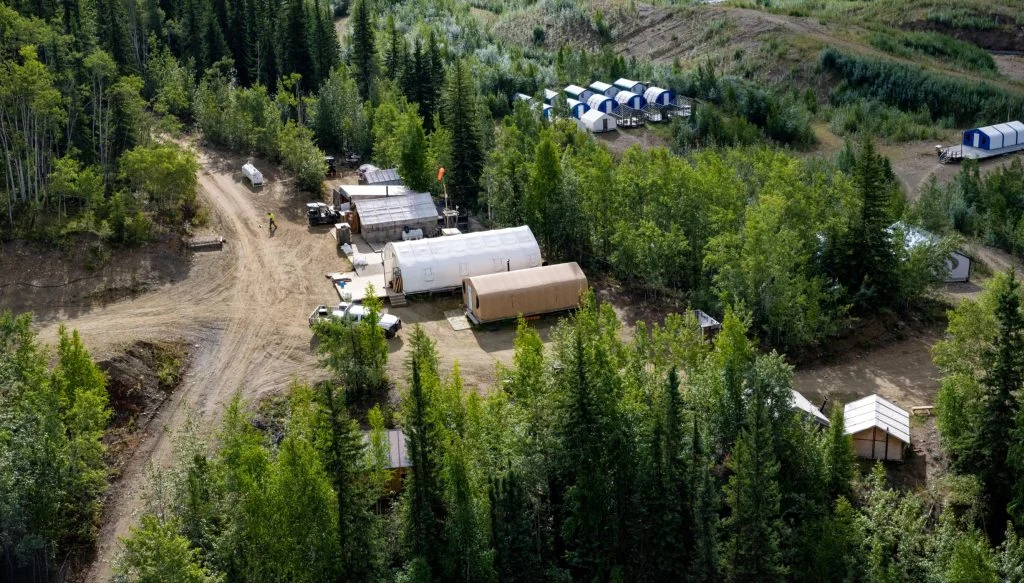
- Infrastructure Integration: A critical component of the development plan is the project’s integration with the proposed Northern Access Route (NAR) from Dawson City. This infrastructure project is essential for linking the property to the broader supply chain. Currently, the site is accessed by an all-weather gravel road, utilizing a combination of barge crossings on the Stewart River during the summer and ice roads during the winter.
Strategic Significance: Why This Project Matters
The White Gold project is not just a single mine; it is a catalyst for district-wide development. The PEA establishes a "technically straightforward" open-pit model that minimizes operational complexity, which is often a significant hurdle for remote northern projects.
Untapped Potential
Perhaps the most intriguing aspect of the PEA is what it omits. By relying on only 60% of the current resource, the company has significant "upside optionality."
- Open at Depth and Along Strike: All four deposits included in the PEA—Golden Saddle, Arc, Ryan’s Supreme, and VG—remain open for expansion.
- 2025 and 2026 Drilling: The current PEA does not include the results from the 2025 drilling season or the ongoing 2026 exploration programs. As these results are integrated into future models, the mineral resource is expected to grow.
- Underground Potential: Beyond the open-pit potential, the Golden Saddle deposit shows promise for underground mining, which could further extend the mine life and improve the overall grade profile.
- The Exploration Pipeline: Beyond the primary deposits, White Gold Corp. has identified more than 25 additional targets in the immediate vicinity. These targets represent a vast pipeline of future exploration that could transform the project into a multi-decade mining district.
Implications for Stakeholders
The filing of the PEA is a milestone for White Gold Corp., but it also carries broader implications for the Yukon Territory and the investment community.
Economic Impact on the Yukon
For the local economy, the development of a mine of this scale would represent a major influx of capital, job creation, and infrastructure development. The proposed Northern Access Route (NAR) is a key feature of the region’s long-term infrastructure strategy, and the White Gold project serves as a primary driver for its necessity and completion.
Investment Perspective
For investors, the project offers a unique value proposition. With a 52-week trading range of $0.82 to $2.50, the market has seen volatility, but the recent news serves as a validation of the company’s "data-driven" approach. By demonstrating a project that can withstand conservative economic modeling while retaining massive exploration upside, the company has effectively "de-risked" the asset in the eyes of many analysts.
However, as with any junior mining company, investors are encouraged to conduct their own due diligence. The transition from PEA to feasibility study and, eventually, construction, involves navigating complex regulatory, environmental, and financing hurdles. The current PEA provides a framework, but the path to production will require continued disciplined capital allocation and successful execution of the permitting process.
Official Stance and Future Outlook
White Gold Corp. management has signaled that this PEA is merely the "development framework." The company’s philosophy has been to maintain a high level of technical rigor, and the current study is intended to provide a transparent look at both the opportunities and the requirements for bringing the White Gold project to life.
As the company proceeds into subsequent studies, the focus will likely shift toward:
- Resource Conversion: Moving inferred resources into the indicated or measured categories to improve the project’s bankability.
- Optimizing Infrastructure: Engaging with provincial and federal authorities to accelerate the development of the Northern Access Route.
- Exploration Success: Converting the 25+ identified targets into secondary or tertiary deposits that could provide supplementary feed for the mill.
In conclusion, the maiden PEA for the White Gold project marks a transition for the company from a pure-play explorer to a potential developer. With a substantial, high-value asset, clear technical parameters, and a massive pipeline of untapped exploration targets, White Gold Corp. has solidified its position as a key player in Canada’s gold mining sector. The coming months will be critical as the company integrates new drill data and moves toward more advanced engineering studies, providing further clarity on the timeline for construction and eventual production.
Disclaimer: Resource World Magazine Inc. has prepared this editorial for general information purposes only and should not be considered a solicitation to buy or sell securities in the companies discussed herein. The information provided has been derived from sources believed to be reliable but cannot be guaranteed. This editorial does not take into account the reader’s investment criteria, investment expertise, financial condition, or financial goals. Recipients should rely on their own due diligence and seek their own professional advice before investing.