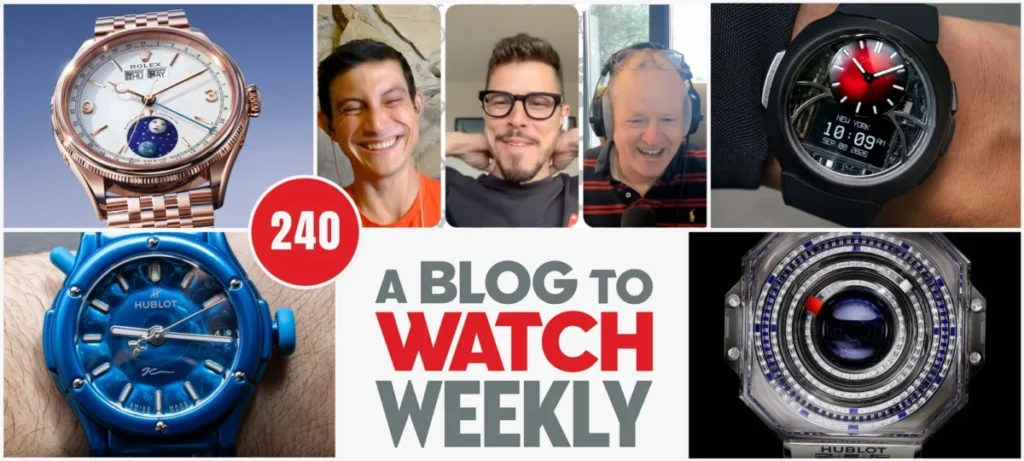
The landscape of luxury watchmaking is shifting. As heritage brands navigate the delicate balance between traditional craftsmanship and the aggressive pressures of modern marketing, the community finds itself at a crossroads. This week’s installment of aBlogtoWatch Weekly—featuring hosts Rick, David, and Ripley—delves into the paradoxes defining today’s market. From the experimental digital pivots of H. Moser & Cie. to the polarizing "Padellone" aspirations of Rolex, the industry is proving that it is no longer enough to simply manufacture a high-quality timepiece. In an era of hyper-connectivity and intense brand competition, the conversation surrounding the "why" of watchmaking has become as significant as the "how."
The Strategic Crossroads: Branding and Market Positioning
The Marketing Malaise
The discussion begins with a critical assessment of the current state of watch marketing. The hosts observe a concerning trend: many established watch houses appear to have lost their narrative thread. In an era where digital engagement is paramount, several legacy brands have struggled to sustain a meaningful dialogue with their audience.
The criticism leveled by the aBlogtoWatch team touches on a broader industry malaise. Historically, horological marketing relied on the mystique of legacy and the inherent prestige of mechanical excellence. Today, that prestige is being diluted by generic social media campaigns and a lack of authentic storytelling. The team posits that brands that fail to engage in a genuine "conversation" with collectors risk being sidelined by smaller, more agile independent makers who prioritize community interaction and transparent brand building.
H. Moser & Cie. and the Digital Pivot
A focal point of this week’s analysis is the audacious move by H. Moser & Cie. to integrate digital elements into their traditionally haute horlogerie portfolio. While purists often recoil at the mention of "digital" in the context of Swiss mechanical excellence, Moser has built a reputation on subverting expectations. By bridging the gap between high-tech conceptual art and mechanical mastery, Moser is challenging the industry’s rigid definitions of value. This pivot is not merely about functionality; it is a signal of intent to capture a younger, digitally native demographic that views luxury not as a static object, but as an experience.
Can Cartier Topple the Crown? The Quest for Hegemony
A recurring, albeit provocative, theme in the horology world is the potential for Cartier to challenge the absolute market dominance of Rolex. While Rolex operates as the benchmark of industrial perfection, brand recognition, and secondary market liquidity, Cartier represents a different philosophy: the intersection of jewelry and horology.
The Cartier Advantage
Cartier’s strength lies in its design language. Unlike Rolex, which is tethered to a handful of iconic, incremental design iterations (the Submariner, the Datejust, the Daytona), Cartier possesses an expansive, historically rich archives. From the Tank to the Santos, and the Crash to the Baignoire, Cartier offers a stylistic diversity that Rolex simply cannot match.
The Hurdles to Crown Supremacy
However, the hosts argue that "toppling" Rolex is a complex ambition. For Cartier to truly challenge the Crown, it would need to address several key factors:
- Perceived Mechanical Value: While Cartier has made massive strides with its Manufacture movements, it still fights the perception among some collectors as being a "jeweler’s watch."
- Secondary Market Stability: Rolex’s secondary market performance acts as an informal currency. Cartier’s secondary market is robust, but it lacks the universal, almost liquid status of a steel Rolex sports model.
- Distribution and Scarcity: Rolex’s strategy of artificial scarcity creates a "lottery" effect that keeps demand perpetually high. Cartier’s approach is more consumer-friendly, which, ironically, makes it less "hyped" in the current market environment.
The Rolex Perpetual 1908 Padellone: A New Era?
Perhaps the most contentious topic of the week is the introduction of the Rolex Perpetual 1908 "Padellone." The term Padellone (Italian for "large frying pan") is historically associated with large-cased vintage watches, often featuring complex complications. By applying this design language to the modern 1908 collection, Rolex is signaling a distinct move upmarket.
Breaking Down the Complication
The 1908 line was launched to replace the Cellini, signaling Rolex’s renewed focus on the dress watch segment. With the Padellone, the brand is adding a level of complication that elevates the watch from a simple time-only piece to something more akin to a high-horology statement.

The Pricing Implication
The price point of the new 1908 model has triggered significant debate. The team questions whether this is a strategic move to reposition Rolex as a "true" luxury contender, capable of competing with the likes of Vacheron Constantin or Patek Philippe in the dress watch arena. If Rolex moves too far upmarket, do they alienate the base that made them the world’s most successful watch brand? Or is this a necessary evolution to ensure the brand remains relevant in a world where luxury consumers are increasingly seeking higher-priced, more complex mechanical art?
Hublot and the Jeff Koons Effect: The Art of Provocation
If Rolex represents the establishment, Hublot represents the "Art of Fusion." Their latest collaboration with artist Jeff Koons serves as a case study in polarizing marketing.
The Marriage of High Art and High Tech
The use of sapphire cases, combined with the whimsical aesthetic of Koons’ balloon animals, creates a timepiece that is fundamentally designed to be noticed. The aBlogtoWatch team notes that Hublot excels in exactly what many other brands fail at: guaranteeing a reaction.
Supporting Data on Niche Luxury
While the mainstream watch press often critiques the sheer volume of Hublot’s output, the sales data suggests a different story. These watches are not meant for the traditionalist who wants a subtle, understated timepiece. They are designed for a demographic that views watches as extensions of contemporary art collections. The "wild pricing" mentioned by the hosts is a function of the materials used (sapphire processing is notoriously difficult) and the prestige associated with the Koons name. It is a calculated gamble on exclusivity and aesthetic shock value.
Implications for the Future: From the NFL to the Open Road
The episode concludes with a lighter, yet surprisingly analytical, segment: matching watches to NFL teams. While this might appear as mere entertainment, it highlights the importance of "brand personality."
Brand Personality Mapping
The exercise of mapping luxury goods to sports franchises reveals how deeply entrenched these brands are in our cultural psyche.
- The "Rolex" Teams: Consistent, high-performing, legacy-driven franchises that dominate the headlines.
- The "Independent/Boutique" Teams: Underdogs or highly specialized organizations that rely on unique strategies rather than sheer budget or scale.
The team’s plan to pivot toward a "Watch Brands vs. Car Brands" comparison for their next episode suggests a deeper interest in the sociology of luxury. Brands like Ferrari, Porsche, and Aston Martin carry specific connotations of engineering and lifestyle that map seamlessly onto the watch industry.
Final Synthesis: What Does It Mean for the Collector?
The overarching takeaway from this week’s aBlogtoWatch Weekly is that the watch industry is in a period of "re-evaluation."
- The Death of Passive Marketing: Brands can no longer rely on heritage alone. They must participate in the digital conversation, whether through innovative social media engagement or, as in the case of H. Moser & Cie., experimental product design.
- The Upmarket Shift: Rolex’s push into more complex dress watches (the 1908) suggests that the entry-level to mid-level luxury market is becoming increasingly crowded, forcing the giants to look toward higher-margin, more "exclusive" tiers of production.
- Diversity of Value: There is a growing divide between those who view watches as instruments (the tool watch purist) and those who view them as wearable art (the Hublot/Koons collector). Both segments are valid, but they require vastly different marketing strategies.
As we look toward the future, the brands that will thrive are those that can maintain their historical integrity while fearlessly engaging with the shifting sands of global culture. Whether it is through the lens of a $50,000 dress watch or a sapphire-encased work of art, the "conversation" is only getting louder. For the collector, the challenge is no longer just finding a watch that keeps time—it is finding a watch that tells the right story.