

For centuries, the genesis of Paris has been a subject of scholarly friction, a historical puzzle obscured by layers of medieval masonry, industrial development, and the relentless march of urban modernization. While modern Paris is celebrated for its Haussmann-era boulevards and Roman ruins in the Latin Quarter, the city’s true foundation—the elusive Gallic settlement of Lutetia—has remained a ghost in the archaeological record.
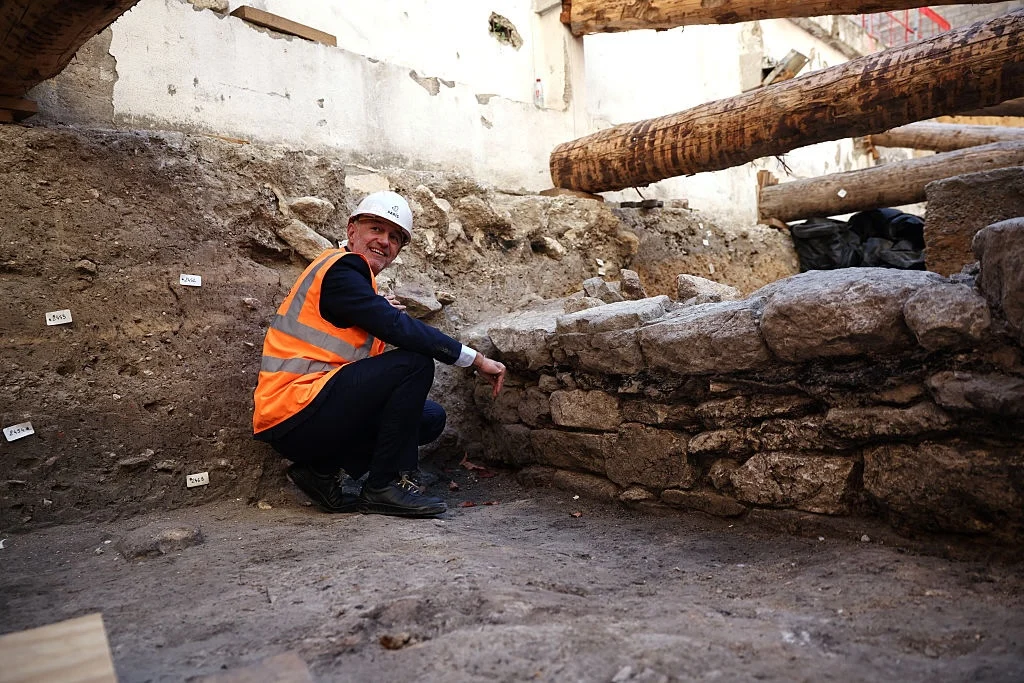
That changed this summer beneath the foundations of the Hôtel-Dieu hospital on the Île de la Cité. A discovery of a 72-foot-long stone-and-wood wall, carbon-dated to the twilight of the Gallic era, has provided the "smoking gun" that researchers have sought for decades. This find not only anchors the origins of Paris to the heart of the Seine but potentially corroborates the dramatic accounts penned by Julius Caesar himself.
The Main Facts: A Discovery Beneath the Hospital
The excavation at the Hôtel-Dieu, situated in the shadow of Notre-Dame Cathedral, was initiated as part of routine construction work. However, as teams broke through the subterranean layers, they encountered a structural remnant that defied conventional understanding of the island’s early history.
The structure—a massive defensive wall composed of both stone and timber—dates to between 200 BCE and 10 BCE. Alongside the wall, archaeologists unearthed a Gallic spearhead, a poignant artifact that hints at the military tension defining the transition from Celtic independence to Roman hegemony. The discovery effectively challenges the "Nanterre theory," which had previously suggested that the true Lutetia was located west of the city center. By proving that a major, fortified settlement existed on the Île de la Cité during the late Iron Age, the Hôtel-Dieu excavation has shifted the geographical focus of Paris’s origin story back to the center of the Seine.
Chronology: From the Parisii to the Roman Conquest
To understand the significance of this discovery, one must look at the timeline of the region:
- 3rd–2nd Century BCE: The Parisii, a sub-tribe of the Senones, establish a foothold along the Seine. They trade in river goods and organize into a loose political structure.
- 52 BCE: The pivotal year of the Gallic Wars. Julius Caesar, in his Commentarii de Bello Gallico, recounts the siege of Lutetia. He describes it as a oppidum—a fortified town—situated on an island. He notes that the inhabitants, choosing destruction over subjugation, burned their bridges and their own homes to deny the Romans a prize.
- 1st Century BCE – 1st Century CE: Following the conquest, the Romans consolidate their hold, building a new, orthogonal city on the Left Bank, featuring the thermal baths and amphitheaters that remain visible today.
- 1990s – Early 2000s: Archaeologists find significant Gallic evidence in Nanterre, leading many to believe that the "real" Lutetia was there, and that the Île de la Cité was merely a minor river outpost.
- 2023/2024: The Hôtel-Dieu excavation provides the long-awaited physical evidence of a massive defensive structure on the island, effectively resetting the historical clock.
Supporting Data: The Case for Caesar’s Credibility
The debate surrounding the location of Lutetia has long been a struggle between text and terrain. Caesar’s writings have been treated with skepticism by generations of archaeologists who found the physical evidence in the heart of Paris lacking.
The new find offers a compelling bridge between the two. Not only is the wall dated to the exact era of the Roman incursions, but the physical site itself shows clear signs of burning. Archaeologists have recovered charred seeds and scorched timber remnants in the immediate vicinity of the wall. While the French Ministry of Culture remains cautious, the evidence is strikingly aligned with Caesar’s narrative of a city set aflame by its own inhabitants.
"This is not just a wall," one researcher noted. "It is a record of a society under existential threat." The density of the find—a structure spanning 72 feet—suggests that the settlement on the Île de la Cité was not a mere village, but a significant strategic fortification, exactly as described in ancient Roman texts.
Official Responses and Scholarly Shifts
The impact on the archaeological community has been seismic. Matthieu Poux, a professor of archaeology at the University of Lyon II, was perhaps the most prominent skeptic of the Île de la Cité theory. For years, he argued that the lack of material culture on the island made the "Caesar’s Lutetia" claim implausible.
Upon reviewing the data from the Hôtel-Dieu site, Poux’s stance underwent a radical transformation. "I have no doubt," he told the New York Times, conceding that the findings force a complete reappraisal of Parisian origins. He further emphasized that this single excavation has increased the available evidence regarding Gallic Paris "tenfold," turning a theoretical argument into a tangible, provable historical reality.
The French Ministry of Culture has been more measured, emphasizing that while the find is monumental, rigorous scientific protocols must be observed. The Ministry has authorized continued excavation, stressing that further analysis of the carbon dating and the architectural techniques used in the wall’s construction is required before they can definitively claim it was the specific site burned by the Parisii in 52 BCE.
The Implications: Why This Matters
For one of the most excavated cities in the world, the discovery of the Gallic wall is an embarrassing yet exhilarating revelation. It serves as a reminder that even in a city as well-mapped as Paris, the past is never fully settled.
1. Re-centering the History of Paris
For decades, the story of Paris began with the Romans. We knew about the Roman baths in the Latin Quarter and the forum beneath the Luxembourg Gardens. By confirming a pre-existing, sophisticated Gallic fortification on the Île de la Cité, historians can now argue that Paris was not a Roman invention, but a pre-existing Gallic center that the Romans simply repurposed for their own administrative needs.
2. The Methodological Shift
This discovery highlights the importance of "urban archaeology." Because the Hôtel-Dieu is a functioning institution, excavations were only possible through modern construction projects. This underscores a broader trend: in dense, historical capitals, our understanding of history is inextricably linked to the pace of urban renewal. Every new foundation poured in Paris carries the potential to rewrite the city’s biography.
3. Preservation and Public Display
The Ministry of Culture has confirmed that the wall will be carefully removed, cleaned, and studied in a laboratory setting. Long-term plans include a public display, likely integrated into a museum exhibit that will allow visitors to see the remnants of the very people who fought to keep Paris independent. This is a crucial step in moving archaeology out of the academic journal and into the public consciousness.
Conclusion: A City Reborn
The wall beneath the Hôtel-Dieu is more than a collection of stones; it is the missing link in the French national narrative. It confirms the existence of a proud, defensive, and ultimately sacrificial culture—the Parisii—who laid the groundwork for the global metropolis we know today.
As excavations continue around the hospital, archaeologists expect to find more traces of the domestic lives of those who walked these streets two millennia ago. We are likely only at the beginning of a new chapter in the history of Paris. For a city that prides itself on its timelessness, this discovery is a humbling reminder that the foundations of modern civilization are built upon the ashes of those who came before.
The ghost of Lutetia has finally been laid to rest, replaced by the solid, stone-and-timber reality of a city that has been fighting to define its identity for over two thousand years. The debate is no longer about if the Parisii lived on the island, but how much more of their world lies waiting beneath the pavement of the Seine’s banks.



