

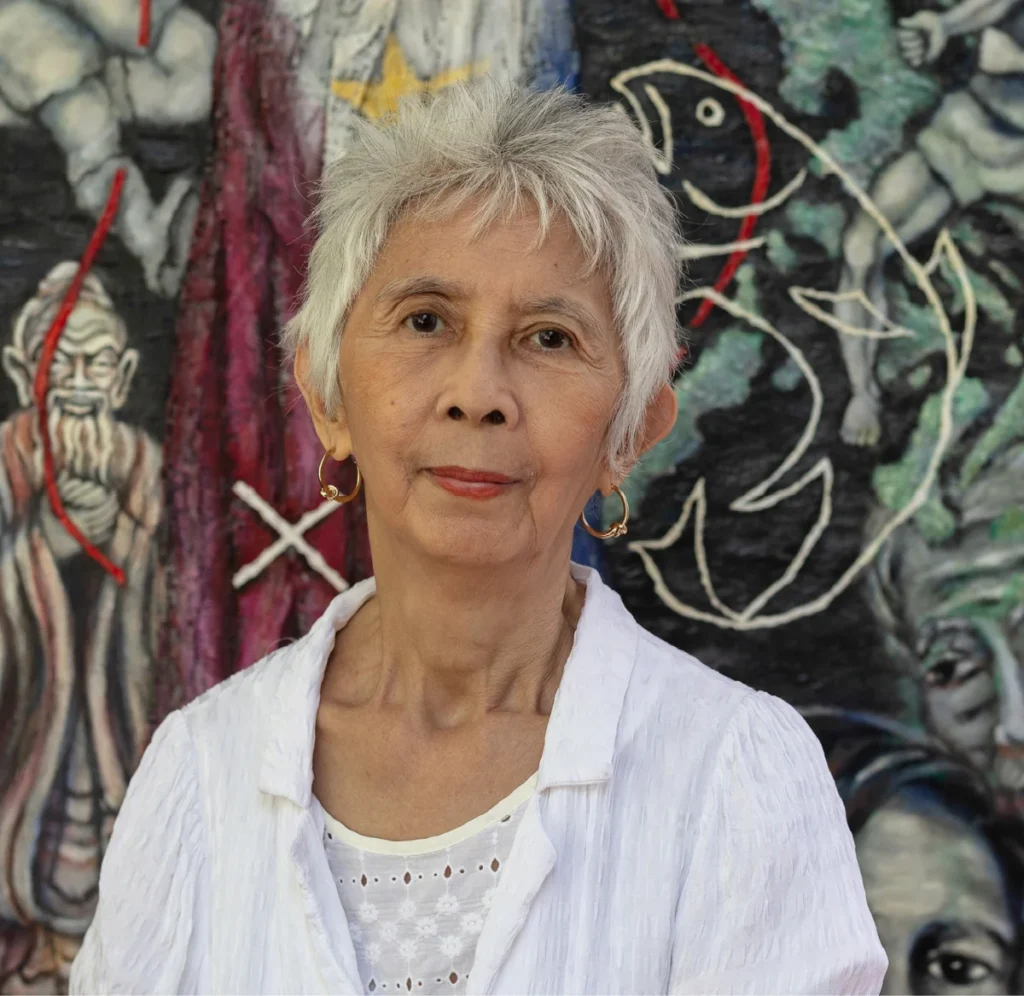
In a historic milestone for Philippine culture, Imelda Cajipe Endaya, a titan of social realism and feminist art, has been conferred the Order of National Artists of the Philippines for Visual Arts. At 77, Endaya becomes the first woman to ever receive this prestigious accolade, marking a significant shift in the recognition of gender dynamics within the nation’s artistic canon. The award, bestowed on September 1 following the recommendation of the Cultural Center of the Philippines (CCP) and the National Commission for Culture and the Arts (NCCA), serves as the ultimate recognition of a career spanning more than five decades.
The Magnitude of the Order of National Artists
The Order of National Artists is the highest national recognition granted to Filipinos who have made distinct and significant contributions to the development of Philippine arts and letters. Established in 1972 through Proclamation No. 1001, the order is administered by the CCP and the NCCA, acting as a testament to the cultural identity and creative spirit of the nation.
For decades, the list of recipients has been scrutinized for its historical male-centrism. By selecting Endaya, the nominating bodies have not only acknowledged her technical brilliance but have also signaled an institutional pivot toward valuing the marginalized voices that have historically shaped the country’s visual language. Her induction is not merely a personal victory; it is a long-overdue validation of the feminist art movement that has simmered beneath the surface of Philippine institutional history for over fifty years.
A Chronology of Artistic Defiance
Imelda Cajipe Endaya’s trajectory is inextricably linked to the socio-political turbulence of the Philippines. Born in 1949, she emerged as an artist during the late Marcos era—a time when art became a primary vehicle for political dissent.
The Formative Years (1970s)
Endaya’s career began in the early 1970s, a period defined by the imposition of Martial Law. During this time, she affiliated with the Philippine Association of Printmakers (1970–1976), honing a craft that favored the democratization of art. Unlike oil painting, which was often viewed as a commodity for the elite, printmaking allowed for reproducibility and accessibility, aligning with her burgeoning interest in social realism.
The Rise of Feminism (1980s–1990s)
As the nation transitioned toward the EDSA Revolution, Endaya’s work shifted from general social commentary to a deeply personal exploration of the Filipino woman’s plight. In 1987, she co-founded Kasibulan (Kababaihan sa Sining at Bagong Sibol na Kamalayan), a groundbreaking collective of women artists dedicated to subverting the patriarchal structures of the Philippine art world. Throughout the 90s, her role evolved into that of an institutional shaper, serving on the NCCA’s Committee on Visual Arts from 1995 to 2001.
The International Perspective (2000s–Present)
Moving into the 21st century, Endaya expanded her scope to address the complexities of globalization, labor migration, and the Filipino diaspora. Her installations began to incorporate found objects—fabrics, household items, and archival documents—that bridged the gap between the domestic sphere and the geopolitical arena. This period saw her works enter major global collections, culminating in her 2022 landmark retrospective at the CCP, Pagtutol at Pag-asa (Refusal and Hope), which served as the definitive exhibition of her life’s work.
Supporting Data: An Institutional Footprint
Endaya’s influence is not limited to exhibitions; it is embedded in the physical archives of national and international museums. Her works are held in the permanent collections of the Bangko Sentral ng Pilipinas, the Cultural Center of the Philippines, and the Philippine National Art Gallery. Internationally, her presence has been solidified through acquisitions by the National Gallery of Singapore, the Okinawa Prefectural Museum, and the Fukuoka Asian Art Museum.
Her intellectual contributions are equally significant. As a co-founder of Pananaw: Philippine Journal of Visual Arts, she helped establish a critical framework for discussing local art, ensuring that Filipino artists had the vocabulary to write their own histories rather than relying on Western art criticism. Her work at international platforms like S.E.A. Focus in Singapore and Art Basel Hong Kong in 2026 further proves that her voice remains relevant and globally resonant.
The Philosophy of "Pagtutol at Pag-asa"
To understand Endaya’s art, one must understand her insistence on "inserting reality" into the canvas. Speaking to Artforum regarding her exhibition at the Silverlens gallery in New York, she emphasized that her work is not merely decorative; it is a tactical intervention.
"I wanted to insert a part of my reality into the painting," she noted. Her "reality" is one of migration, the displacement of domestic workers, and the resilience of mothers and activists. By utilizing collage and mixed media, she breaks the "fourth wall" of the painting, forcing the viewer to confront the visceral experience of the subjects she portrays. She does not paint the struggle from a distance; she brings the viewer into the kitchen, the assembly line, and the overseas workplace, making the personal political.
Official Responses and Reflections
The conferment of the award has been met with widespread celebration across the Philippine arts community. Critics and scholars have praised the decision as a watershed moment for gender parity in the arts.
In a formal statement following the announcement, Endaya expressed both humility and a forward-looking urgency. Acknowledging her role as the first woman to receive this honor, she noted, "People say I have just broken a glass ceiling. There should be more successful women artists after me." Her sentiment reflects the ethos of Kasibulan—that the victory of one is a tool for the advancement of many. She frames her own achievement not as a culmination, but as an opening of a door for younger generations of female artists to walk through.
Implications: A New Era for Philippine Art
The induction of Imelda Cajipe Endaya into the Order of National Artists has several profound implications for the future of the nation’s cultural landscape:
- Institutional Correction: The NCCA and CCP have signaled a move toward a more inclusive definition of "National Artist," one that recognizes activist, feminist, and socially engaged practices as being just as "monumental" as the traditional fine arts.
- Mentorship and Pedagogy: Endaya’s legacy as an "informal educator" will likely be reinvigorated. Her methodology—blending historical research with artistic practice—will become a benchmark for students of the visual arts in the Philippines.
- Gendered Discourse: The focus on the "glass ceiling" suggests that the conversation surrounding gender inequality in Philippine art is moving from the fringes to the center of institutional policy. It encourages a reappraisal of other female pioneers who may have been overlooked in previous selection cycles.
- The Globalization of Local Issues: By honoring an artist whose work focuses on the Filipino diaspora and labor migration, the state is acknowledging that the "Philippine experience" now spans the globe. Endaya’s work helps legitimize the narratives of migrant workers as being central to the national identity.
Conclusion
Imelda Cajipe Endaya’s recognition is a triumph of persistence. Over five decades, she has held a mirror to the nation, refusing to look away from the inequities of gender, class, and colonial history. Her work, characterized by its refusal to be silenced and its constant cultivation of hope, remains a beacon for artists who believe that art is a powerful weapon for social change.
As the first woman to hold the title of National Artist for Visual Arts, she has left an indelible mark on the landscape of Philippine culture. Her career is a testament to the idea that art is not just a reflection of reality, but a force that shapes it. As she looks toward the future, the legacy she leaves is one of open-ended possibility—a promise that the glass ceiling she has shattered will remain open for all those who follow in her footsteps.



