

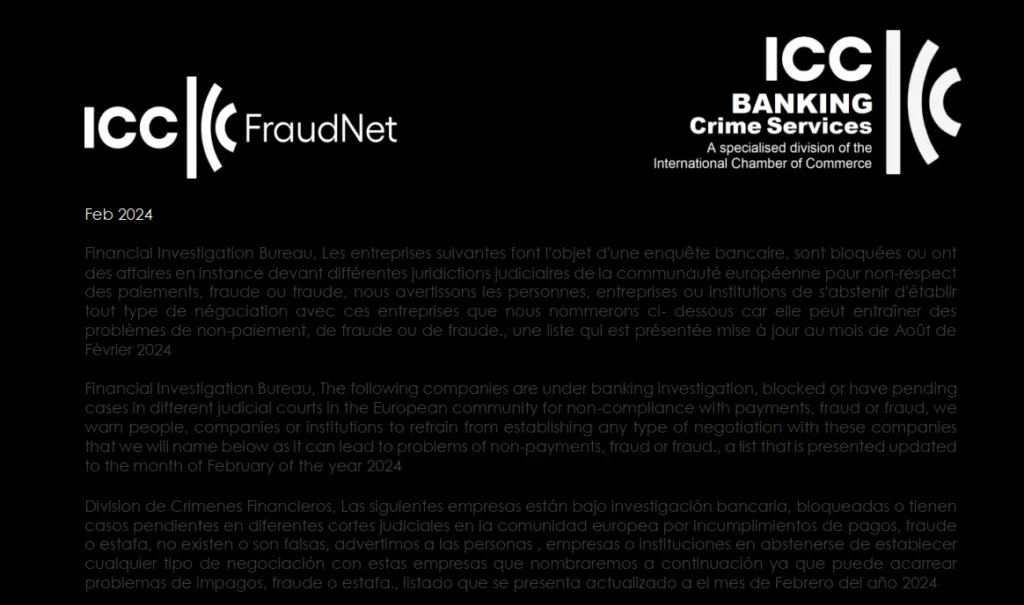
In a sophisticated attempt to sow discord and inflict reputational damage within the global trade and security sectors, malicious actors have begun circulating fraudulent "blacklists" falsely attributed to the International Chamber of Commerce Commercial Crime Services (ICC-CCS). These documents, which purportedly catalog the contact details of various individuals and companies, are being used as a weaponized misinformation campaign to cast aspersions on the integrity of legitimate business entities.
The ICC-CCS, a renowned global authority dedicated to combating commercial crime, has issued a formal and urgent warning to the business community: these lists are entirely fabricated. They carry no official backing, and the inclusion of any entity on such a list should be treated as a malicious attempt at character assassination rather than a reflection of reality.
The Anatomy of the Fraud: Main Facts
The fraudulent campaign involves the unauthorized and illegal use of the ICC-CCS brand, including its logo and official styling, to grant an air of legitimacy to these spurious documents. By mimicking the aesthetic of official ICC-CCS correspondence, the perpetrators aim to deceive industry stakeholders into believing that the listed companies have been flagged for illicit activity or regulatory non-compliance.
Key facts regarding this situation include:
- Fabricated Origins: The ICC-CCS does not compile, maintain, or circulate "blacklists" of companies or individuals. Any document claiming to be such a list is, by definition, a forgery.
- Unauthorized Branding: The misuse of the ICC-CCS name and trademark constitutes a serious breach of intellectual property rights and an attempt to impersonate a trusted international body.
- Malicious Intent: The primary objective of these lists appears to be the systematic tarnishing of reputations, potentially to disrupt supply chains, influence competitive positioning, or facilitate extortion.
- No Credibility: The ICC-CCS has categorically stated that the information contained within these documents is baseless and should be afforded zero credence by the public or private sector.
A Timeline of Deception: Chronology of the Incident
While the exact date of the inception of this campaign remains under investigation, the recent surge in reports suggests a coordinated effort to penetrate specific industry verticals.
Early Detection
Reports began to surface when various companies, often in the high-security manufacturing and logistics sectors, contacted ICC-CCS to inquire about their sudden appearance on an "official" watchlist. These organizations were bewildered, as they had no prior contact with the ICC-CCS regarding any compliance or legal investigations.
Escalation and Distribution
As the documents proliferated, it became clear that the distribution was not targeted at a single entity but was being broadcasted to industry associations and potential clients. This "scattergun" approach was clearly designed to maximize the visibility of the defamatory content, ensuring that stakeholders across multiple regions were exposed to the misinformation.
Official Response and Public Awareness
Upon identifying the pattern, ICC-CCS launched an internal investigation, confirming that no such lists existed within their databases. The organization then moved to publicly debunk the documents, issuing formal statements to alert its membership and the broader commercial community to the ongoing fraud.
Supporting Data: The Mechanism of Misinformation
The digital age has provided malicious actors with unprecedented tools to craft high-fidelity forgeries. By leveraging the reputation of established organizations like the ICC-CCS, these bad actors exploit the "trust bias"—the human tendency to believe information that appears to originate from an authoritative source.
The Role of Counterfeit Documentation
In the context of global trade, the security of documents is paramount. The ICC-CCS often works in conjunction with organizations like the International Hologram Manufacturers Association (IHMA). The Register managed by the IHMA serves as a critical defense against the counterfeiting of holograms and intellectual property infringement. By hijacking the context of these protective measures, the perpetrators attempt to confuse the narrative, making their "blacklist" seem like an extension of legitimate anti-counterfeiting efforts.
Patterns of Malice
Data analysts observing the spread of these lists have noted several markers of coordinated misinformation campaigns:
- Uniform Formatting: The documents follow a rigid, professional-looking structure to mimic standard industry audit reports.
- Lack of Specificity: The lists often contain vague accusations or simply present company names without accompanying evidence, which is a hallmark of defamatory intent rather than legitimate investigative reporting.
- Targeting Competitors: Preliminary analysis suggests that in several instances, the companies listed on these fraudulent documents are direct competitors to other, undisclosed parties, raising questions about the role of corporate espionage.
Official Responses: ICC-CCS Takes a Stand
The leadership of the ICC-CCS has been unequivocal in its condemnation of these activities. Michael Howlett, the Director of the ICC-CCS, has taken a proactive role in addressing the fallout of this misinformation campaign.
"ICC-CCS would like to make it clear that our organization does not produce lists of this nature," Howlett stated in a recent briefing. "The contents are entirely false and should not be relied upon. It appears that these lists have been created by unknown parties and circulated with the intent of damaging the reputations of the listed companies. They should be completely disregarded and given no credence whatsoever."
Howlett’s statement serves as the definitive word on the matter. The ICC-CCS emphasizes that their work is rooted in rigorous, evidence-based investigation and transparent reporting—processes that bear no resemblance to the anonymous, unsubstantiated lists currently in circulation.
Furthermore, the organization has reminded its members and the global business community that any communication from the ICC-CCS will always originate from verified channels. If a document does not bear the standard verification markers, or if it originates from an unofficial email or platform, it should be immediately treated as a security threat.
The Broader Implications: Navigating the Era of Disinformation
The appearance of these fraudulent blacklists is a sobering reminder of the vulnerabilities inherent in the global digital economy. As companies rely more heavily on reputation management and third-party compliance screening, the potential for bad actors to manipulate these systems grows exponentially.
Reputational Risk and Economic Impact
The damage caused by such misinformation can be profound. Even if a company is eventually exonerated, the initial "smear" can lead to:
- Loss of Contracts: Clients may pause or terminate relationships due to the perceived "compliance risk" associated with the false allegations.
- Increased Scrutiny: Unfounded lists can trigger unnecessary internal or third-party audits, draining corporate resources and time.
- Erosion of Trust: Misinformation can poison the well of professional trust, making it difficult for honest organizations to conduct business with new partners who may have encountered the fraudulent list.
Cybersecurity and Intellectual Property
The unauthorized use of the ICC-CCS brand is not merely a reputation issue; it is a legal one. The systematic use of logos and organizational identities to commit fraud is a violation of international intellectual property laws. This incident underscores the necessity for companies to implement stronger digital identity verification protocols to prevent their brands from being weaponized in similar campaigns.
Recommendations for Businesses
To mitigate the risk of falling victim to such campaigns, the ICC-CCS and industry experts recommend the following best practices:
- Verification: Always verify the authenticity of any documentation that purports to be from an international body or regulatory agency. Contact the organization directly through their official, verified website—never use contact details provided on the document itself.
- Due Diligence: If your company is mentioned in an unexpected report, treat it as a potential cyber-threat. Notify your legal and compliance departments immediately and preserve all evidence, including the metadata of the email or document.
- Cross-Referencing: Utilize trusted industry channels to check if such "lists" have been reported as fraudulent by others in the sector. Often, these campaigns target multiple players simultaneously.
- Public Correction: If a false list is discovered, work with industry bodies and legal counsel to issue a formal rebuttal, ensuring that stakeholders are aware of the situation and the fact that the document is a forgery.
Conclusion: A Call for Vigilance
The circulation of fraudulent "blacklists" is a direct attack on the integrity of the global business environment. By attempting to manipulate the reputation of legitimate companies, the perpetrators are not only violating the law but are also undermining the very foundations of trust upon which international trade relies.
The stance of the ICC-CCS is clear: this is a coordinated, baseless, and malicious effort that warrants immediate rejection. As the business world continues to navigate the complexities of the digital landscape, the commitment to vigilance and fact-based verification must remain at the forefront of every organization’s strategy. By dismissing these forgeries with zero credence, the business community can collectively neutralize the threat and protect the sanctity of professional reputation.
Any organization that receives a document claiming to be a blacklist from the ICC-CCS or any of its divisions is urged to report the incident to the appropriate authorities and dismiss the contents as entirely fraudulent. In an era where information is the most valuable currency, protecting the truth is the most vital defensive maneuver a company can undertake.



