

Executive Summary: A Complex Landscape of Maritime Risk
The global maritime security landscape is undergoing a significant, albeit nuanced, transformation. According to the latest data from the International Maritime Bureau (IMB) covering the first nine months of 2024, the industry has witnessed a paradoxical trend: while the aggregate volume of reported piracy and armed robbery incidents has declined in several historically volatile "hotspots," the severity of individual attacks remains a critical concern for shipowners, insurers, and international naval forces.
From the Gulf of Guinea to the treacherous corridors of the Singapore Straits and the re-emerging threats off the coast of Somalia, the maritime domain remains a theater of high-stakes risk. While the data suggests a decrease in sheer incident counts—notably reaching a multi-decade low in West African waters—the persistence of crew kidnappings and vessel hijackings underscores that the threat of maritime crime is evolving rather than vanishing.
Main Facts: The 2024 Incident Landscape
The maritime industry has been closely monitoring three primary regions throughout 2024, each presenting unique challenges to the safety of merchant shipping.
The Gulf of Guinea: A Historic Low
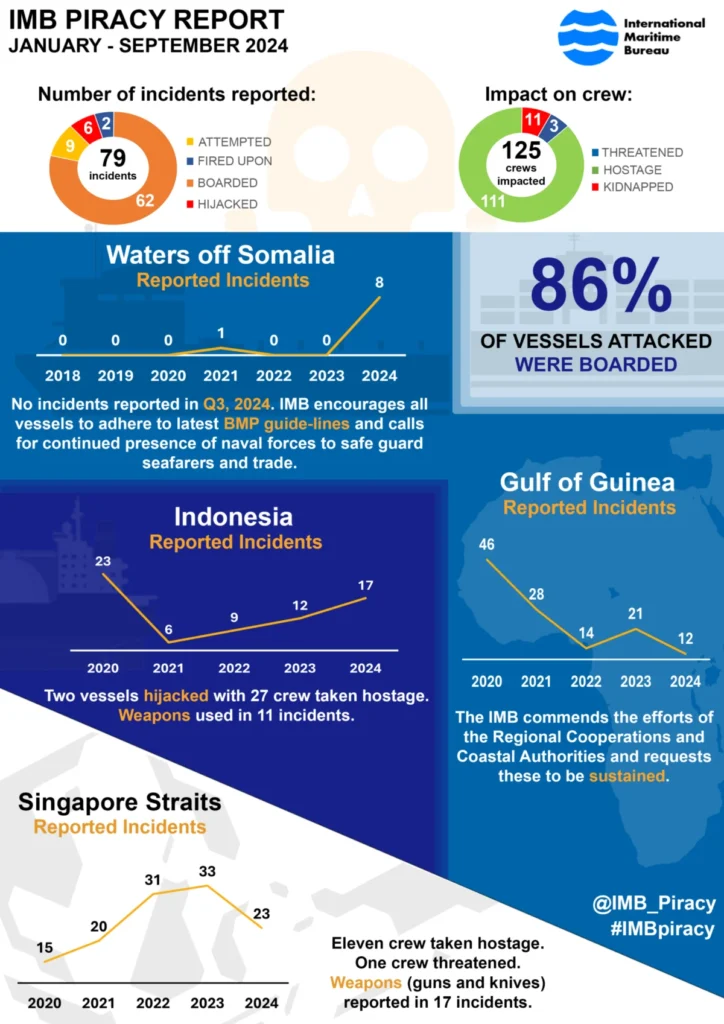
Perhaps the most striking statistic to emerge from the 2024 report is the situation in the Gulf of Guinea. With only 12 reported incidents in the first nine months of the year, the region has reached its lowest level of piracy activity since 1996. This drastic reduction is a testament to the increased presence of regional navies, improved information sharing, and the implementation of robust onboard security protocols. However, this statistical victory is tempered by the human cost; despite the lower volume of attacks, 11 crew members were kidnapped and 21 were held hostage, indicating that when incidents do occur, they remain highly violent and targeted.
The Resurgence of Somali Piracy
After years of relative calm, the waters off Somalia and the Gulf of Aden have experienced a worrying uptick in activity. Eight incidents were recorded in the first nine months of 2024, including three successful vessel hijackings and two instances where vessels were fired upon. Interestingly, the IMB noted a complete absence of reports between July and September 2024, a lull likely attributed to the seasonal monsoon conditions which render small-skiff operations hazardous. Nevertheless, the capability of Somali pirate networks to project force remains a looming threat.
Singapore Straits: Persistence and Precision
The Singapore Straits, one of the world’s busiest and most vital shipping arteries, continues to be a primary area of concern for opportunistic crime. While the number of incidents dropped from 33 during the same period in 2023 to 23 in 2024, the efficacy of the perpetrators remains alarmingly high. In 96% of the reported cases, attackers successfully boarded the vessels. This high success rate highlights a systemic vulnerability in the security postures of vessels transiting these narrow, congested waters.
Chronology of Trends: A Nine-Month Retrospective
To understand the trajectory of these security risks, one must look at the progression of events across the 2024 calendar year.
- Q1 2024 (January – March): The year began with heightened vigilance following a late 2023 resurgence of Somali piracy. Industry groups issued multiple warnings as hijacked vessels signaled a return to the "mother-ship" model of operations. Simultaneously, the Singapore Straits saw a consistent stream of boarding attempts, mostly occurring under the cover of darkness.
- Q2 2024 (April – June): This period saw the stabilization of incident counts in the Gulf of Guinea. While the international community celebrated the decrease in frequency, the abduction of crew members during this window reminded the industry that the threat was not eliminated. The Singapore Straits continued to report opportunistic boardings, primarily targeting large bulk carriers and tankers.
- Q3 2024 (July – September): The monsoon season acted as a natural deterrent in the Indian Ocean, leading to a quiet quarter for Somali-based piracy. However, the Gulf of Guinea saw localized pockets of insecurity, and the Singapore Straits maintained a persistent threat level. As of the end of September, the global industry shifted its focus toward the final quarter, emphasizing the need for continued adherence to Best Management Practices (BMP).
Supporting Data: Comparative Analysis and Regional Risks
The data provided by the IMB serves as a diagnostic tool for the maritime industry. The shift in statistics is not merely a numbers game; it reflects the effectiveness of regional interventions.
| Region | Incidents (Jan-Sept 2023) | Incidents (Jan-Sept 2024) | Primary Threat Type |
|---|---|---|---|
| Gulf of Guinea | Higher | 12 (Low) | Kidnapping/Hostage |
| Somalia/Gulf of Aden | Low | 8 | Hijacking/Firearms |
| Singapore Straits | 33 | 23 | Opportunistic Boarding |
The "Boarding" Phenomenon
The 96% success rate in the Singapore Straits is a critical data point. It indicates that perpetrators are highly familiar with the navigational constraints of the region. As ships are forced to slow down or navigate complex traffic separation schemes, they become "sitting ducks" for small, fast-moving craft. The IMB’s data suggests that these are not sophisticated, long-term hijacking operations, but rather "low-level" crimes—theft of ship stores, engine parts, or cash. Yet, as the IMB warns, even a low-level incident can distract a bridge team, potentially leading to catastrophic navigational errors in high-traffic waters.
Official Responses and Strategic Countermeasures
International maritime organizations, including the IMB, the International Maritime Organization (IMO), and regional maritime security centers, have been uniform in their response to these statistics: caution is the better part of valor.
The IMB’s Stance
The IMB has explicitly cautioned that the decrease in reported numbers should not be interpreted as a decrease in risk. There is a persistent fear of "under-reporting," where vessels may fail to report minor incidents due to the bureaucratic burden or fear of increased insurance premiums. The IMB continues to advocate for the universal adoption of the latest Best Management Practices (BMP), which provide comprehensive guidelines on hardening vessels, establishing citadels, and maintaining constant vigilance.
Regional Naval Cooperation
In the Gulf of Guinea, the success observed in 2024 is largely attributed to the Yaoundé Code of Conduct, which has fostered better cooperation between West African coastal states. Increased naval patrols and the establishment of Maritime Domain Awareness (MDA) centers have made it significantly more difficult for pirate skiffs to operate undetected.
In the waters off Somalia, the focus has shifted toward the presence of international task forces. The EU Naval Force (Operation Atalanta) and other multinational coalitions have reinforced the importance of the Internationally Recommended Transit Corridor (IRTC). The recent incidents have prompted these forces to issue renewed advisories to merchant vessels, reminding them that the absence of attacks during monsoon seasons is not a permanent state of peace.
Implications for the Future of Global Shipping
The implications of these trends are far-reaching, affecting everything from insurance premiums to crew welfare and international trade flows.
Navigational Hazards and Crew Safety
The IMB’s warning regarding the Singapore Straits highlights a critical, often overlooked aspect of maritime security: the nexus between piracy and navigation. In waters where a collision or grounding could result in a massive environmental disaster, an armed boarding is not just a criminal issue—it is a safety-of-life-at-sea (SOLAS) crisis. When crew members are forced to confront armed intruders, the risk of a panicked response leading to a vessel collision increases exponentially.
The Economic Impact of Piracy
While piracy is often discussed in terms of human tragedy, the economic impact is a constant drag on global trade. Even when an incident is "only" an opportunistic boarding, the costs are significant:
- Increased Insurance: High-risk areas carry heavy "War Risk" premiums, which are passed down the supply chain, ultimately increasing the cost of goods for the end consumer.
- Operational Delays: Ships forced to deviate from their routes or maintain higher speeds in dangerous areas consume more fuel and increase their carbon footprint.
- Crew Retention: The ongoing threat of kidnapping in regions like the Gulf of Guinea makes it increasingly difficult to recruit and retain high-quality maritime personnel. The psychological toll on seafarers who know they are transiting high-risk zones cannot be overstated.
The Role of Technology
As the industry moves toward 2025, technology will play a larger role in security. The integration of Long Range Identification and Tracking (LRIT), satellite-based AIS monitoring, and AI-driven pattern recognition for small craft are becoming essential tools for shipowners. However, technology is only as good as the human element operating it. The IMB’s message is clear: automation can assist, but the diligent implementation of BMP—maintaining lookouts, controlling access points, and training the crew—remains the first and most effective line of defense.
Conclusion: A Vigilant Future
The decline in piracy reports for the first nine months of 2024 is a positive signal that regional and international efforts are yielding results. However, the industry remains in a precarious equilibrium. The persistence of kidnapping in West Africa, the volatility off the Somali coast, and the high success rate of boardings in the Singapore Straits demonstrate that the maritime domain remains a challenging environment.
As global trade continues to rely on the freedom and security of the high seas, the maritime industry must avoid the trap of complacency. The data provided by the IMB serves as both a scorecard and a warning. By maintaining rigorous security protocols, fostering international cooperation, and prioritizing the safety of the men and women who serve at sea, the global shipping community can continue to navigate these risks and ensure the uninterrupted flow of commerce that sustains the modern world. The trend for the remainder of 2024 will depend on whether shipowners view these statistics as a reason to relax, or as proof that constant, proactive vigilance is the only way to keep the world’s oceans safe.



