

In a discovery that fundamentally shifts our understanding of planetary geology, researchers from the University of Oxford have unveiled evidence suggesting that Mars—a world long dismissed as geologically stagnant—once harbored massive, Earth-like magmatic systems deep within its interior. Published in the journal Nature Astronomy, the study challenges the long-held scientific dogma that complex, evolved crustal formation is the exclusive domain of planets governed by plate tectonics.
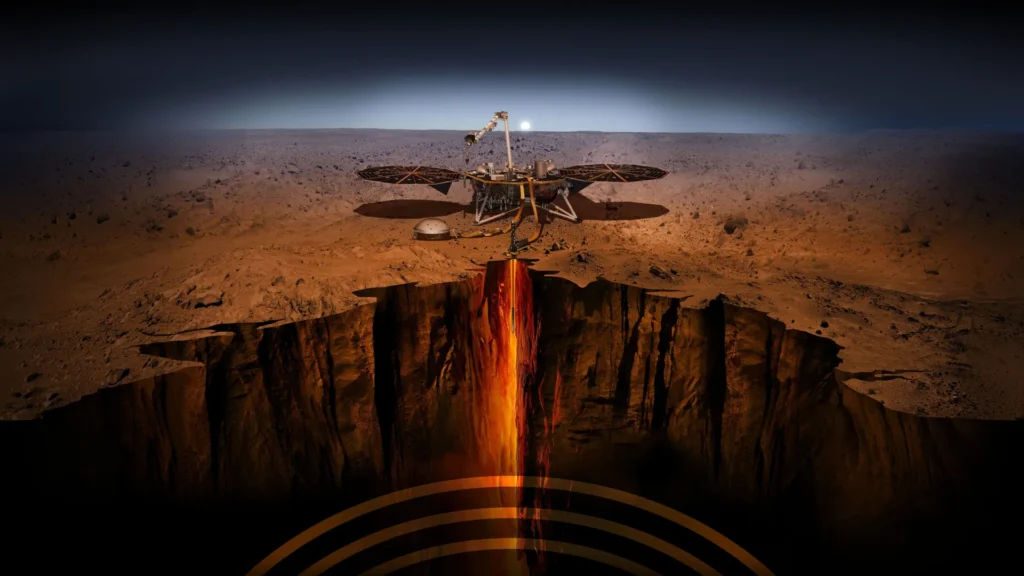
By re-examining seismic data harvested from NASA’s InSight lander, the team has identified evidence of a vast, chemically layered boundary located 24 kilometers beneath the Martian surface. This discovery suggests that the Red Planet was once a far more dynamic world, capable of internal recycling processes that mirror those responsible for building continents on Earth.
The Paradigm Shift: Rethinking the "Stagnant Lid"
For decades, planetary scientists have classified Mars as a "stagnant lid" planet. Unlike Earth, where the outer shell is broken into shifting tectonic plates that collide, subduct, and recycle crustal material, Mars possesses a single, solid lithospheric shell. Because plate tectonics is the engine behind Earth’s volcanic diversity and the creation of its continental crust, scientists historically assumed that the Martian crust was formed through relatively simple, localized volcanic activity.
The prevailing view was that Martian volcanism was primitive—essentially the direct eruption of molten rock from the mantle onto the surface with minimal modification. However, the Oxford-led team’s findings suggest a much more sophisticated narrative. The research indicates that Mars may have developed a highly evolved, complex crust through vigorous, internal recycling mechanisms that operate independently of plate tectonics. This suggests that the interior of Mars was not a quiet, cooling furnace, but a laboratory of geological transformation.
Chronology of a Discovery: From InSight to Insight
The journey toward this realization began in 2018, when NASA’s InSight (Interior Exploration using Seismic Investigations, Geodesy and Heat Transport) lander touched down in the Elysium Planitia region of Mars. Carrying the first dedicated seismometer to the Martian surface, the mission provided researchers with an unprecedented "x-ray" of the planet’s interior.
The Seismic Signal
Over its mission duration, InSight recorded hundreds of "marsquakes" and seismic vibrations triggered by meteoroid impacts. These waves traveled through the planet’s interior, reflecting and refracting off various subsurface boundaries. Researchers had previously detected an unexplained seismic discontinuity at a depth of roughly 24 kilometers, but its physical nature remained a subject of intense speculation.
The Data Synthesis
To decode this boundary, researchers from Oxford’s Departments of Earth Sciences and Statistics embarked on a rigorous computational study. They compared the seismic observations against a library of hundreds of potential rock compositions. By utilizing advanced thermodynamic modeling coupled with complex statistical methods, the team sought to map the seismic properties detected at that 24-kilometer mark to known geological materials.
The results were striking. The seismic data revealed a distinct "compositional filter." Below the 24-kilometer boundary, the seismic velocities were consistent with "ultramafic" material—rocks rich in iron and magnesium but low in silica. Above the boundary, the properties shifted to resemble "mafic" rocks, which contain a significantly higher proportion of silica. This chemical stratification is the smoking gun of a process known as magmatic differentiation.
Supporting Data: Evidence of Vast Magmatic Systems
The researchers theorize that the buried layer formed when molten rock accumulated in vast reservoirs deep underground. Over geological time, this magma underwent a process of fractional crystallization. In this cooling phase, dense crystals—rich in iron and magnesium—settled toward the bottom of the crust, while lighter, silica-rich melts rose upward, eventually cooling to form the upper crustal layer.
Transcrustal Magmatism
On Earth, this process is known as "transcrustal magmatism." It occurs beneath volcanic arcs and is the foundational process for the development of Earth’s continents. The fact that similar evidence exists on Mars suggests that the planet was once home to massive, connected magmatic systems that spanned hundreds, if not thousands, of kilometers across the northern hemisphere.
This contradicts the previous image of Mars as a planet dotted with isolated, simple volcanoes. Instead, it suggests that ancient Mars featured integrated, continent-sized volcanic plumbing systems. These systems were capable of reprocessing the planet’s crust, potentially creating a geological environment far more complex than anything previously imagined for a planet without moving tectonic plates.
Official Responses and Expert Perspectives
The implications of the study have reverberated through the planetary science community, prompting a re-evaluation of what is required for a planet to be considered "geologically alive."
Dr. Tobermory Mackay-Champion, the study’s lead author—who conducted the research at the University of Oxford before moving to the University of Bristol—emphasized the importance of moving beyond Earth-centric models. "We’ve traditionally assumed that volcanism on Mars was relatively simple compared to that on Earth," Dr. Mackay-Champion noted. "But this discovery suggests Mars could sustain large, long-lived systems where molten rock evolved and reprocessed itself throughout the entire crust. It raises exciting possibilities for how common such systems might be on rocky planets beyond our solar system."
Professor Jon Wade, a co-author of the study from Oxford’s Department of Earth Sciences, highlighted the broader implications for the search for life. "One of the big questions in planetary science is whether Earth is unique," Professor Wade stated. "If Mars could develop this kind of complex crust without plate tectonics, then maybe the conditions needed for habitability can emerge on more planets than we realized, including those previously dismissed based on size or their apparent lack of tectonic activity."
Implications for Habitable Planets
The discovery of complex crustal evolution on Mars fundamentally alters the search for habitable environments in the universe. Traditionally, astrobiologists have focused on plate tectonics as a primary "habitability factor." Plate tectonics is essential for the carbon-silicate cycle, which regulates a planet’s climate, maintains a stable atmosphere, and facilitates the recycling of water and other volatile elements required for life.
If a planet can achieve significant crustal evolution and geological recycling without the need for tectonic plates, the number of potentially habitable "rocky worlds" in the galaxy may be significantly higher than current estimates suggest.
Expanding the Search
This research suggests that "stagnant lid" planets should not be automatically categorized as geologically dead. If Mars—a planet that lost its internal heat and water early in its history—could sustain such complex magmatic systems, then larger or more active exoplanets could theoretically support even more advanced geological cycles.
Furthermore, this finding encourages a new way of analyzing exoplanets. Current telescope technology, such as the James Webb Space Telescope (JWST), focuses heavily on atmospheric composition. However, this study underscores the necessity of understanding a planet’s interior. A planet’s surface environment is often a direct result of the chemical and thermal processing occurring deep beneath its crust. By recognizing that complex magmatism can occur on planets without tectonic plates, scientists now have a new framework for evaluating the geological potential of alien worlds.
Conclusion: A New Chapter for Martian Geology
The legacy of NASA’s InSight mission continues to grow long after the lander’s final communication in December 2022. By peering into the hidden depths of Mars, the University of Oxford research team has opened a window into an ancient, bustling era of the planet’s history.
Mars was once a planet of massive magmatic systems, a world where the crust was constantly being reprocessed, refined, and reshaped. While the planet today is a cold, dry desert, the geological fingerprints found at 24 kilometers depth serve as a testament to its vibrant past. This discovery does more than just rewrite the history of our neighbor; it expands the horizons of astrobiology, suggesting that the ingredients for a complex, evolving world may be more common in the cosmos than we ever dared to hope.



