

Introduction: The Invisible Shield of Global Trade
The global economy relies on a fragile, invisible web of maritime supply chains. Over 80% of the world’s trade is transported by sea, yet these vast, untamed stretches of international waters remain susceptible to a persistent, age-old threat: piracy. Amidst the complexity of modern shipping, one organization stands as the primary sentinel against maritime criminality: the ICC International Maritime Bureau’s (IMB) Piracy Reporting Centre (PRC).
Since its inception in 1991, the PRC has evolved from a nascent reporting desk into a sophisticated, 24-hour nerve center. It serves as the global maritime community’s first line of defense, providing a critical nexus between vessels under duress, regional coast guards, naval task forces, and international maritime authorities. As modern piracy shifts from high-seas hijacking to sophisticated armed robbery in coastal anchorages, the role of the PRC has never been more consequential.
The Genesis and Evolution: A Chronology of Maritime Vigilance
The 1990s: Establishing the Perimeter
In the early 1990s, the international maritime community faced an alarming uptick in piracy, particularly in Southeast Asian waters. Recognizing that a fragmented response was fueling the impunity of criminal syndicates, the International Chamber of Commerce (ICC) established the IMB Piracy Reporting Centre in 1991. The mission was clear: create a centralized, independent platform where shipmasters could report incidents without the bureaucratic red tape that often hindered national authorities.
The 2000s: The Somalia Crisis and Global Response
The turn of the millennium brought the scourge of Somali piracy, which threatened to strangle the Suez Canal trade route. During this era, the PRC’s role shifted from a reactive reporting body to a proactive intelligence hub. By mapping "hot zones" and identifying the patterns of skiff-based attacks, the PRC helped catalyze the international naval coalition efforts. This period proved that data-driven reporting was the most effective weapon against maritime insurgency.
2010 to Present: The Era of Digital Vigilance
Today, the PRC has integrated advanced telecommunications and real-time broadcast technologies to alert vessels in high-risk areas. From the Gulf of Guinea to the Singapore Straits, the PRC serves as the "early warning system" for the global merchant fleet, utilizing satellite communication and rapid-response email alerts to ensure that shipmasters are never truly alone, even in the most remote corners of the ocean.
The Mechanics of Security: How the PRC Operates
The efficacy of the IMB Piracy Reporting Centre lies in its operational simplicity and speed. Operating 24 hours a day, 365 days a year, the center functions through three primary pillars:
- Immediate Reporting and Coordination: When a vessel reports an actual, attempted, or suspected attack, the PRC immediately contacts local law enforcement and maritime rescue coordination centers. By facilitating a direct line of communication between the ship and the nearest available security assets, the PRC drastically reduces the "response latency" that criminals exploit.
- Information Dissemination: The PRC sends out regular warning broadcasts to ships in the vicinity of reported attacks. These alerts act as a deterrent and allow vessels to implement the "Best Management Practices" (BMP)—a set of hardening measures that include increasing watchfulness, maneuvering to evade, and utilizing non-lethal deterrents.
- Data Analytics and Intelligence: By aggregating reports, the PRC generates granular data on piracy trends. This intelligence is invaluable for ship owners, insurers, and governments, allowing for the strategic allocation of naval patrols and the development of risk-mitigation policies.
Supporting Data: Why Reporting Matters
One of the most persistent challenges in maritime security is the "under-reporting" of incidents. Many shipmasters, fearing increased insurance premiums or protracted investigations, may hesitate to report suspicious activity or minor thefts. The IMB maintains that this is a critical mistake.
The Data Gap
Without comprehensive reporting, the scale of piracy remains obscured. Governments cannot allocate resources—such as patrol boats, drones, or aerial surveillance—to regions where they believe the risk is low. When a shipmaster reports an attempted robbery, they are not merely notifying the authorities of a local crime; they are contributing to a global dataset that justifies the deployment of international maritime security forces.
The 2024 Outlook
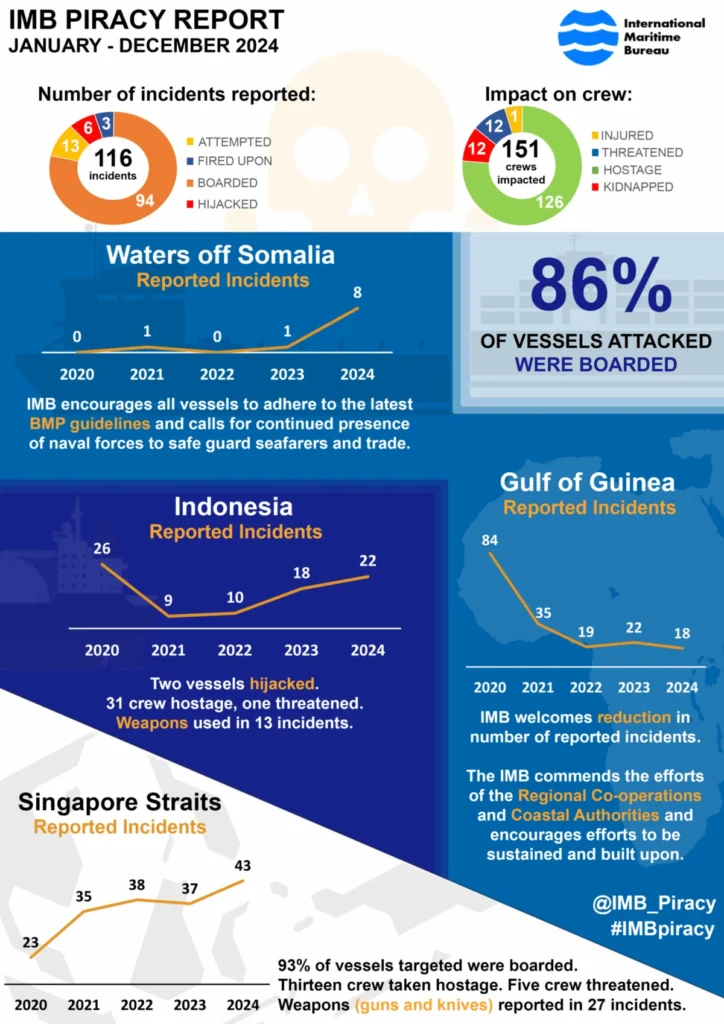
The 2024 Piracy and Armed Robbery Against Ships report, now available through the IMB, highlights the evolving nature of the threat. While large-scale hijacking for ransom has seen periods of relative quiet, opportunistic armed robbery—where perpetrators board vessels at anchor to steal ship stores or personal effects—has risen in specific bottlenecks. The data confirms that piracy is not a static threat; it shifts based on economic conditions, political instability, and the effectiveness of local policing.
Official Responses and Strategic Implications
The ICC Perspective
Michael Howlett, Director of the ICC International Maritime Bureau, emphasizes that the PRC is a collaborative endeavor. "Maritime security is not the responsibility of a single nation or agency; it is a shared obligation," Howlett notes. "The PRC acts as the bridge that connects the merchant navy to the enforcement community. However, this bridge only holds if the maritime industry maintains a culture of transparency."
Implications for the Shipping Industry
The implications of the PRC’s work are far-reaching:
- Insurance and Risk: Accurate reporting helps underwriters set fair premiums. When a region is flagged as "high risk" due to reported incidents, ship owners can demand better security from local authorities.
- Human Safety: The primary goal of the PRC is the protection of life. Armed robbery at sea is inherently violent; by providing ships with early warnings, the PRC prevents confrontations between crews and often desperate, armed perpetrators.
- Geopolitical Stability: Piracy is often a symptom of underlying instability in coastal states. By highlighting the frequency of attacks, the IMB puts diplomatic pressure on nations to secure their territorial waters, ultimately fostering better maritime governance.
A Call to Action for Shipmasters and Owners
The IMB Piracy Reporting Centre urges all stakeholders to formalize their reporting procedures. In the maritime domain, information is indeed power.
To ensure your vessel and crew remain protected:
- Report Everything: Do not ignore "minor" incidents. If a vessel is approached by a suspicious boat, or if unauthorized individuals are spotted in the vicinity of an anchorage, report it to the PRC immediately.
- Utilize Resources: Ensure your onboard bridge procedures include the contact information for the IMB PRC.
- Stay Informed: Regularly review the IMB’s annual and quarterly reports. Understanding the tactics of modern pirates is the first step in neutralizing them.
Contact Information
For those seeking to engage with the Bureau or to report an incident, the IMB maintains an open line of communication:
- Organization: ICC International Maritime Bureau
- Director: Michael Howlett
- Telephone: +44 207 423 6960
- Email: [email protected]
- Resource Access: Interested parties can request the full 2024 Piracy and Armed Robbery Against Ships report by visiting the official IMB portal.
Conclusion: The Path Forward
The sea remains a challenging environment, but it is not a lawless one. The IMB Piracy Reporting Centre stands as a testament to what international cooperation can achieve. By centralizing reporting, analyzing trends, and maintaining a 24/7 vigil, the PRC ensures that the merchant marine—the heartbeat of the global economy—can continue to navigate the waves with a greater sense of security.
As we look toward the future, the integration of new technologies like AI-driven pattern recognition and satellite-based tracking will likely augment the PRC’s capabilities. However, the human element—the shipmaster who takes the time to file a report—will remain the most vital link in the chain. Reporting is not just a regulatory requirement; it is a vital act of protection for oneself, one’s crew, and the entire global maritime community. Through collective vigilance, we can continue to suppress the shadow of piracy and ensure that the high seas remain open, safe, and productive for all.



