

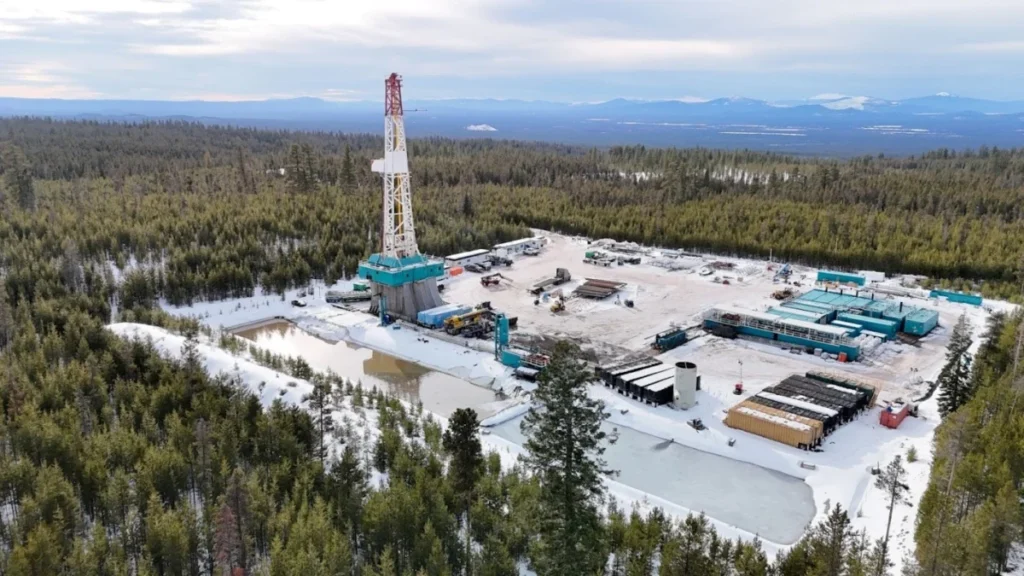
In a significant signal to the global energy sector, geothermal startup Mazama Energy announced on Thursday that it has successfully closed an oversubscribed $135 million Series B funding round. As the race to power the next generation of artificial intelligence data centers intensifies, Mazama is positioning itself as a "dark horse" contender, leveraging advanced drilling techniques to tap into the immense, untapped power of "super-hot" rocks deep beneath the Earth’s crust.
The funding, which includes backing from industry heavyweights and seasoned climate investors, marks a pivotal moment for a company that has moved rapidly from incubation at Khosla Ventures to the forefront of the "Enhanced Geothermal" (EGS) movement. By targeting temperatures once thought commercially inaccessible, Mazama aims to provide the holy grail of grid stability: reliable, 24/7 carbon-free baseload power.
Main Facts: The $135 Million Bet on Deep Heat
The Series B round was led by Centaurus Capital and Doerr Capital, with strategic participation from energy giants ConocoPhillips and Shell Ventures. Existing backers, including the powerhouse firms Khosla Ventures and Gates Frontier, signaled their continued confidence in the startup’s trajectory. New investors, such as SiteGround Capital, H. Barton Asset Management, and the Jeffrey and Marieke Rothschild Foundation, further round out a diverse cap table that bridges the gap between traditional energy expertise and modern climate-tech venture capital.
Mazama’s core value proposition lies in its ability to drill deeper and hotter than traditional geothermal plants. By utilizing horizontal drilling techniques adapted from the oil and gas industry, the company can reach depths of approximately 15,000 feet. At these depths, the rock temperature reaches a staggering 750°F (400°C).
At such extreme heat and pressure, water is transformed into a "supercritical fluid"—a state of matter that is neither fully liquid nor fully gas. This fluid acts as a highly efficient energy carrier, allowing a single Mazama well to generate up to 15 megawatts of electricity—roughly ten times the output of a conventional geothermal well.
Chronology: From Concept to Gigawatt-Scale Ambitions
Mazama Energy’s ascent has been characterized by rapid technical milestones and increasingly optimistic projections regarding its capacity to contribute to the national grid.
- Incubation Period: Born within the ecosystem of Khosla Ventures, Mazama began with a mandate to rethink the mechanical and economic barriers of geothermal energy.
- 2024 Initial Estimates: Last year, the startup made headlines when investor Vinod Khosla projected that their inaugural site in Oregon held the potential to produce 5 gigawatts of electricity.
- 2025 Revision: In a major update, the company has officially revised that estimate upward, stating that the Oregon site is now capable of producing a massive 10 gigawatts of electricity.
- The Present: With the $135 million Series B in hand, the company is preparing to initiate electricity generation as early as next year.
- The Roadmap to 2030: While current efforts are focused on the initial Oregon site, the startup has already secured land for a second development location. The company expects the first site to be fully developed by 2030, with an initial output target of 200 megawatts as it scales toward its multi-gigawatt potential.
Supporting Data: The Physics of Supercritical Power
The allure of super-hot rock geothermal is supported by compelling data from organizations like the Clean Air Task Force and the University of Twente. Their research suggests that tapping into just 1% of the world’s super-hot rock resources could theoretically generate more than 63 terawatts of electricity. To put this in perspective, current global electricity consumption is roughly 2.5 to 3 terawatts.
Mazama’s technical edge is its drilling velocity and precision. In recent field tests, the company successfully drilled past 10,000 feet in just 15 days, a rate that significantly lowers the cost of entry for deep-well projects. By minimizing the time spent on the rig, Mazama is attacking the primary economic barrier of geothermal energy: the high upfront cost of drilling.
Furthermore, the "supercritical" state of the fluid at these depths allows for a much higher thermal-to-electric conversion efficiency. Unlike solar or wind, which require massive battery arrays to manage intermittency, supercritical geothermal provides a consistent, high-density stream of energy that can run indefinitely, making it an ideal candidate to replace retiring coal or gas plants.
Official Responses and Strategic Alliances
The participation of ConocoPhillips and Shell Ventures in this funding round is particularly noteworthy. It underscores a growing trend among "Supermajor" oil and gas companies: the realization that their existing expertise in deep-well drilling, reservoir engineering, and subsurface modeling is directly transferable to the geothermal sector.
"The support from established energy players is not just about the capital," says one industry analyst. "It’s a validation of the engineering approach. When companies like ConocoPhillips sign on, they are essentially saying that the technology is ready for the transition from lab-scale to industrial-scale."
Mazama’s management team has maintained a focused, execution-oriented tone. By leveraging the mentorship and resources of Khosla Ventures, they have successfully navigated the "Valley of Death" that typically plagues capital-intensive climate startups. Their strategy remains clear: prioritize the de-risking of the drilling process first, then scale the infrastructure to meet the voracious power demands of the current AI boom.
Implications: Powering the AI Era
The geopolitical and economic implications of Mazama’s success are far-reaching. As hyperscalers like Microsoft, Google, and Amazon race to build out massive AI data centers, the bottleneck for their growth is no longer just compute—it is the availability of consistent, carbon-free electricity.
Historically, data center operators have looked to natural gas to provide the "always-on" power that renewable sources like wind and solar cannot guarantee without expensive storage. However, the environmental cost of relying on gas is creating friction with corporate sustainability goals.
Enhanced Geothermal is emerging as the "dark horse" in this energy transition. If Mazama Energy can prove that its 15-megawatt-per-well model is replicable at scale, it provides tech companies with a localized, baseload-capable power source that fits neatly into the geography of their data centers.
The Grid of the Future
If the 10-gigawatt potential of the Oregon site is realized, it would represent a massive injection of clean energy into the Western Interconnect. This would effectively turn a region known for its natural resources into a powerhouse for the digital economy.
However, challenges remain. Regulatory hurdles regarding drilling on federal land, the geological complexity of varying rock types, and the need for significant transmission infrastructure to move power from remote geothermal sites to population centers will require years of careful policy and construction work.
Yet, for Mazama Energy, the path forward is illuminated by the $135 million vote of confidence they received this week. In an industry defined by slow, incremental progress, Mazama is betting on a faster, deeper, and hotter future. As they move toward their 2030 targets, the energy sector will be watching closely to see if the heat beneath our feet can truly quench the world’s thirst for electricity.