
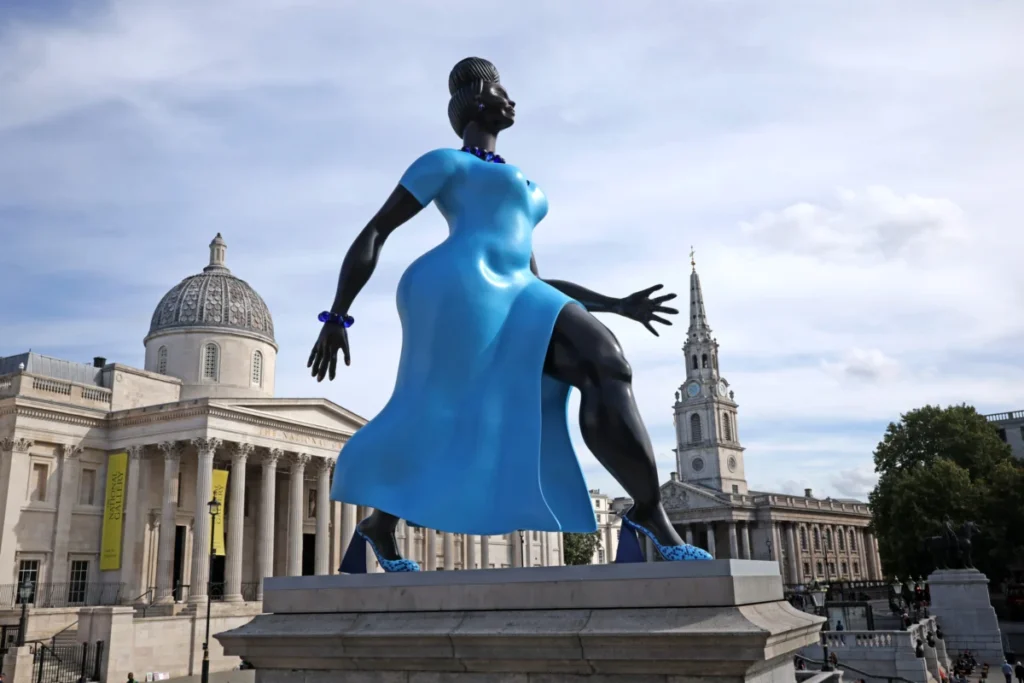
London’s Trafalgar Square, a space dominated by the stoic, imperial bronze of Admiral Nelson and the rigid architectural geometry of the neoclassical era, has once again been interrupted by the kinetic energy of contemporary art. Standing atop the Fourth Plinth—a site originally intended for an equestrian statue of William IV but left vacant for over 150 years—is Lady in Blue, a vibrant, larger-than-life bronze sculpture by New York-based artist Tschabalala Self.
As the 16th commission to grace this iconic stage since 1998, Lady in Blue represents a significant departure from the traditional commemorative statuary that populates the rest of the square. Dressed in a baby blue frock with a daring slit and matching heels, the figure does not command with the rigidity of a general; she strides forward with the casual, rhythmic gait of a city dweller. She is, as the artist suggests, an homage to the invisible labor and vibrant presence of everyday Black women, grounding the lofty aspirations of Trafalgar Square in the relatable, pulsing reality of modern urban life.
The Chronology of an Iconoclast Site
The Fourth Plinth program is arguably the most prestigious and contentious public art commission in the United Kingdom. Since its inception, it has served as a barometer for the nation’s shifting cultural values.
The initiative began in 1998 under the Royal Society for the encouragement of Arts, Manufactures and Commerce (RSA), which invited three artists—Mark Wallinger, Bill Woodrow, and Rachel Whiteread—to showcase temporary works on the vacant plinth. Mark Wallinger’s Ecce Homo (1999), a life-sized, pale figure of Christ, set a precedent for the provocative and existential nature of the works to follow.
In 2005, the narrative shifted toward disability and visibility with Marc Quinn’s Alison Lapper Pregnant, a marble-effect sculpture of the artist who was born with phocomelia. This was followed by a string of diverse interventions: Antony Gormley’s One & Other (2009), which invited thousands of members of the public to occupy the plinth for an hour each; Yinka Shonibare’s Nelson’s Ship in a Bottle (2010), which cleverly recontextualized the square’s naval history; and Katharina Fritsch’s bright yellow Hahn/Cock (2013).
By the time the commission reached the mid-2010s, the platform had become a global stage for social commentary. From David Shrigley’s giant thumbs-up to Heather Phillipson’s eerie, fly-topped THE END, the plinth has consistently challenged the homogeneity of London’s public monuments. Lady in Blue (2026) arrives at a moment when the conversation regarding who gets to be memorialized in bronze has never been more urgent.
Anatomy of the Sculpture: Beyond the Bronze
Lady in Blue is a triumph of both scale and intimacy. While the sculpture is monumental, standing significantly taller than a human, the posture of the figure is inherently humanizing. Her gait—one foot placed decisively ahead of the other—suggests movement, agency, and a refusal to be frozen in the traditional, static mold of civic monuments.
The choice of color is deliberate. The "baby blue" of her dress serves as a striking visual counterpoint to the gray Portland stone of the square and the dark, oxidized bronze of the neighboring statues. It is a color that feels contemporary, almost commercial in its brightness, stripping away the gravitas usually associated with commemorative bronze.
“She is not a remote historic figurehead,” remarked Justine Simons, London’s deputy mayor for culture and the creative industries. “She is a tribute to everyday women. Monumental in scale—but at the same time relatable. London has already fallen in love with her.”
The sculpture does not ask for worship; it asks for acknowledgement. It forces the viewer to engage with the presence of a woman who is, in many ways, the antithesis of the square’s patriarchal history.
Critical Reception: A Polarized Response
Public art in Trafalgar Square is rarely met with total consensus, and Lady in Blue has ignited a fierce debate in the British press and across social media platforms.
The Enthusiastic Chorus
For many critics, the work is a breath of fresh air. Laura Freeman, the chief art critic for The Times of London, awarded the sculpture four out of five stars, celebrating its joyfulness. “This Lady in Blue is a joyful sculpture with a sashay,” she wrote, noting that she walked away from the installation with a literal “spring in my Birkenstocked step.”
Similarly, The Guardian’s Jonathan Jones lauded the piece, also awarding it four stars. Jones observed that the sculpture “fills the fourth plinth with humor and life,” suggesting that the work successfully disrupts the solemnity of the square. The critical consensus among supporters is that Self has succeeded in humanizing a site that often feels weighed down by historical baggage.
The Dissenting Voices
Conversely, the work has faced sharp criticism from traditionalists. The Daily Telegraph dismissed the installation as “yet another artistic dud,” awarding it a meager two stars. The criticism reflects a broader tension in the UK regarding the direction of public art, with some commentators arguing that contemporary works lack the aesthetic rigor or universal appeal of traditional monuments.
On social media, the discourse has been equally heated. Steven Barrett, author of the Public Gallery Substack, expressed a sense of fatigue, noting on X (formerly Twitter) that the aesthetic felt repetitive. “It must be deja vu, but I thought we did this years ago. And it was tacky then,” Barrett wrote.
Some critics have drawn parallels between Lady in Blue and Self’s 2023 work, Seated, which was displayed at the De La Warr Pavilion in Bexhill-on-Sea. That earlier sculpture, which depicted a Black woman, was targeted by vandals who painted it white—a hate crime that highlighted the volatility surrounding representations of Black bodies in public spaces.
The Artist’s Perspective: Resilience and Reality
Tschabalala Self has remained largely unfazed by the polarized discourse. In a candid interview with The Guardian on September 1, 2026, she addressed the potential for backlash, particularly given her previous experiences with vandalism.
“I’m ready for a whole gamut of reactions,” Self stated. “I’m not nervous—I think everyone is entitled to their own opinion of the sculpture. Each will shed light on to some facet of the reality we’re all currently living.”
Self’s response underscores a profound understanding of her role as an artist working in the public domain. By placing a Black woman in the center of London’s most famous square, she is not merely creating an object for observation; she is creating a lightning rod for national identity. Her willingness to invite debate suggests that she views the controversy itself as a component of the artwork—a living, breathing dialogue about belonging and visibility in the 21st century.
Implications: The Future of Public Space
The funding and support for the Fourth Plinth come from a collaboration between the Mayor of London, the Arts Council England, and Bloomberg Philanthropies. This structural support ensures that the program remains a cornerstone of London’s cultural identity, but it also places the project in a position of institutional responsibility.
The arrival of Lady in Blue raises pertinent questions about the evolution of public art:
- Representation: As cities across the world grapple with the legacy of colonialism in their statuary, can modern, temporary interventions serve as adequate replacements for permanent, problematic monuments?
- Longevity vs. Transience: The Fourth Plinth changes every two years. Does this temporary nature dilute the impact of the art, or does it heighten the intensity of the engagement?
- The Role of the Viewer: In an age of social media, the "public" in public art has expanded to include a global digital audience. How does this digital layer change the way we interact with physical objects in a city center?
The success of Lady in Blue will ultimately be measured not just by the number of stars awarded by critics, but by how it shifts the visual vocabulary of Trafalgar Square. It is a work that demands we look at the ordinary with the same reverence we usually reserve for the extraordinary.
As pedestrians navigate the bustling square, dodging tourist groups and protesters, the Lady in Blue stands as a quiet, stylish sentinel. She represents a shift in the demographic and cultural narrative of London—a city that, like the sculpture itself, is constantly on the move. Whether one views the work as a masterpiece or an eyesore, it is undeniable that Tschabalala Self has succeeded in her primary goal: she has ensured that for the next two years, it is impossible to walk through Trafalgar Square without noticing the humanity of the person walking alongside you.
In a world that is increasingly polarized, perhaps the most radical act an artist can perform is to remind us that we are all, in our own way, merely walking through the city, trying to find our place in the frame.