
While the fashion industry’s collective gaze remains fixed on the storied runways of London Fashion Week—which this season is electrified by the return of heavyweights like Alexander McQueen and the Mulberry-Christopher Kane partnership—a conspicuous void has emerged in the British capital’s schedule. Conner Ives, the Central Saint Martins graduate who transformed from a buzzy industry darling into a bona fide cult sensation, is notably absent from the London lineup.
The reason for his departure is not a retreat, but a homecoming. In a move that signals a significant shift in the global fashion equilibrium, the native New Yorker has flown "Across the Pond" to present his latest collection—aptly titled by the same name—on his home turf. For an designer whose identity has been inextricably linked to the grit and glamour of London’s underground scene, this pivot to New York represents more than just a change of venue; it is an interrogation of what it means to be an American designer in an increasingly borderless fashion landscape.
The Chronology of a Relocated Vision
Ives’ journey from an American student in London to a globally recognized talent has been defined by his ability to synthesize disparate cultural threads. Having spent his formative years at Central Saint Martins, Ives has frequently noted that the public often mistakes his nationality for British. This "adopted heritage" reached a thematic peak in his latest collection through a landmark collaboration with Gieves & Hawkes, the historic Savile Row tailor.
The collaboration yielded two banker-style suits, marking a departure for a designer typically known for his fluid, vintage-inspired silhouettes. These garments, characterized by impeccable construction, were styled with a deliberate, chaotic irreverence. Imagine the power-lunch elite at Midtown’s The Grill, but with the polish stripped away: collars popped, trousers tucked haphazardly into socks, and ties worn askew. It was as if the wearer had emerged from an afternoon tryst with no regard for the rigid codes of the boardroom.
This stylistic dissonance served as the perfect vehicle for the collection’s core mantra, which was emblazoned across what is undoubtedly destined to be the season’s most sought-after graphic T-shirt: "Bring back no shame."
Supporting Data: An Anatomy of American Style
In the wake of his presentation, Ives sat down for an intimate post-show discussion to dissect the evolution of his aesthetic. When asked about his decision to return to the United States, Ives admitted that the move forced him to confront the makeup of American style—a concept he previously treated with a degree of intellectual distance.
"Flamboyance," he repeated during the interview, is the word he identifies as his most "American" trait. It is a bold assertion for a designer whose work is often categorized by its sustainable, upcycled origins. Yet, this season, that flamboyance took on a distinctively American vernacular:
- The Western Influence: Embellished denim and pleated skirt sets, adorned with intricate equestrian prints, offered a modern, high-fashion tip of the hat to the American West.
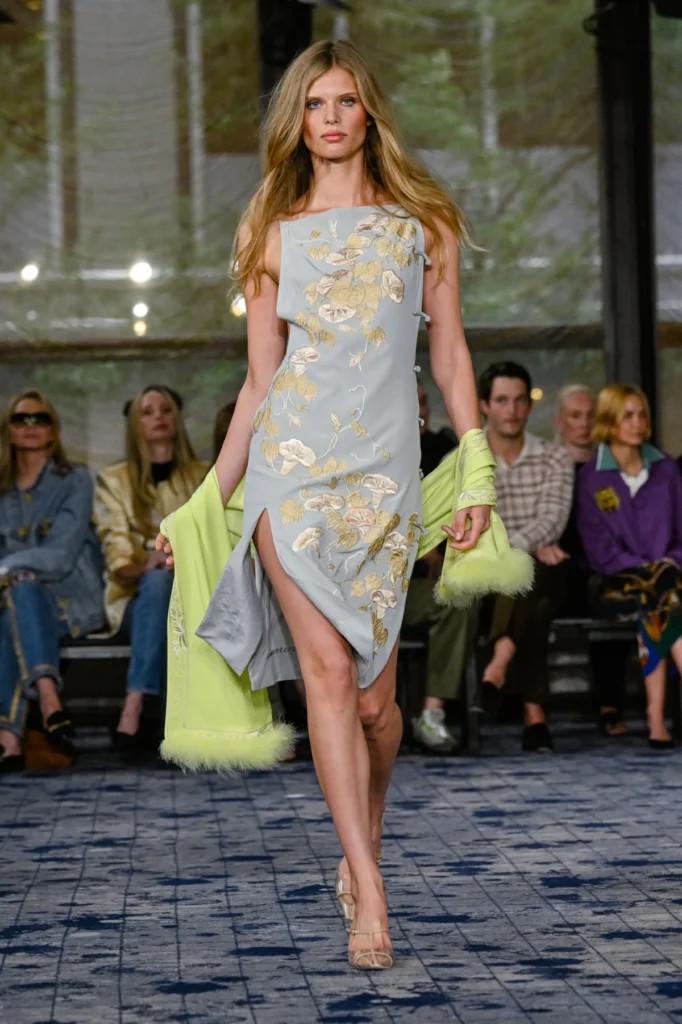
- The Patriotic Palette: The show’s finale featured an ethereal drop-waist chiffon gown, dyed in the distinct oxidized copper hue of the Statue of Liberty, acting as both a visual anchor and a sentimental tribute to his hometown.
- The Global Melting Pot: Beyond domestic tropes, the collection incorporated a dizzying array of influences—flamenco fringe, chinoiserie florals, and European couture draping—all synthesized with that characteristic "no shame" ethos.
"My whole feeling is that everyone is invited to the party," Ives explained. "I think it’s a very American thing as well."
Official Responses and the "It Girl" Phenomenon
The "party" Ives referred to was reflected in the front row and on the runway, which featured the fashion set’s most influential figures. Iris Law commanded the space in a striking red matador catsuit, while Lila Moss modeled a reimagined version of the fur-trimmed Art Deco robe famously worn by Troye Sivan in his music video for "She’s the Best."
The presence of these icons underscores the "Conner Ives girl" archetype: she is vivacious, worldly, and fundamentally in control. As Sivan’s lyrics suggest, the woman in an Ives design is the center of her own universe—a figure so compelling that those around her often struggle to keep pace. By aligning his brand with these cultural touchstones, Ives has successfully positioned his work as more than just clothing; it is a signal of membership in a specific, high-octane social milieu.
Implications for the Industry
The shift of Conner Ives from London to New York carries broader implications for the fashion calendar. As designers increasingly prioritize markets that align with their personal narratives, the traditional "Big Four" cities may find themselves in a constant tug-of-war for talent.
For the New York fashion scene, which has spent recent seasons fighting to retain its relevance against the historical weight of Paris and Milan, the return of a designer like Ives is a vital injection of energy. He brings with him the intellectual rigor of the London education system and combines it with a distinctly American appetite for spectacle.
However, the question remains: is this a permanent relocation? When pressed on whether he is planting a flag in New York permanently, Ives remained characteristically philosophical. "I always say to people, ‘tomorrow is never promised,’ so you never really know what it’s gonna bring," he remarked. "But I love being here."
This uncertainty is, perhaps, the most honest aspect of the brand. In an industry that demands long-term strategy and five-year plans, Ives operates with a sense of urgent spontaneity. He is a designer who values the moment, the mood, and the visceral reaction over the rigid constraints of a corporate trajectory.
The Future of "No Shame"
As the industry looks ahead, the success of Ives’ collection suggests that the "no shame" approach—a refusal to adhere to the traditional boundaries of taste or regional identity—is resonating with a new generation of consumers. They are less interested in the distinction between "high" and "low" culture, or "British" and "American" design, and more interested in the authenticity of the creative vision.
By blending the heritage of Savile Row with the raw, uninhibited spirit of his New York upbringing, Conner Ives has created a blueprint for the modern designer. He has proven that one can honor the traditions of the past while simultaneously dismantling them to make room for something entirely new.
Whether he stays in New York or returns to the cobblestone streets of London for his next outing, the impact of his homecoming is clear. He has challenged the status quo, revitalized the conversation around American identity in fashion, and, most importantly, reminded us that when everyone is invited to the party, the results are rarely anything short of spectacular.
As we await his next move, the industry would do well to take note: the Conner Ives girl isn’t just "that girl"—she is the future of the runway, and she’s arrived at the party without a hint of shame.