The contemporary art world is currently navigating a period of profound transition, marked by a recalibration of historical wrongs, a professionalization of gallery management, and an increased institutional focus on environmental and social consciousness. From the high-stakes auction rooms of London to the non-profit grant cycles of New York and the burgeoning gallery scenes in Mexico City and Tokyo, the industry is witnessing a series of "Industry Moves" that signal where the market’s priorities lie as we approach the mid-2020s.
This report synthesizes several major developments: the $30 million restitution-led auction of a Wassily Kandinsky masterpiece, the announcement of significant grants for environmental and female-led art, and a wave of strategic personnel shifts and representation expansions across the globe.
Main Facts: The Core Developments
1. High-Value Restitution: Kandinsky’s $30 Million Milestone
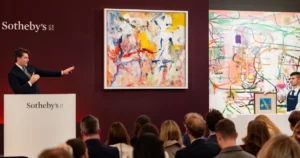
The most significant financial headline involves the upcoming auction of Wassily Kandinsky’s Das bunte Leben (The Colorful Life, 1907). Estimated at $30 million, the painting is set to headline Christie’s London on October 14. This sale follows a landmark restitution in 2023 to the heirs of Albert Lewenstein and Hedwig Lewenstein-Weyermann. The painting’s journey—from a forced sale under Nazi occupation to its long-term loan at the Lenbachhaus in Munich—represents a critical chapter in the ongoing effort to rectify the provenance of artworks displaced during World War II.
2. Institutional Recognition: Mildred Howard and AWAW
On the non-profit front, the Bay Area’s Mildred Howard has been named the recipient of the Artists’ Legacy Foundation 2026 Artist Award, carrying a $25,000 prize. Simultaneously, the organization "Anonymous Was A Woman" (AWAW), in partnership with the New York Foundation for the Arts (NYFA), has announced nearly $500,000 in environmental art grants. These awards underscore a shift toward supporting artists whose work engages with legacy, identity, and the climate crisis.
3. Structural Shifts in the Gallery Sector
Prominent New York gallery P.P.O.W has elevated Trey Hollis to Managing Partner, a move reflecting the increasing complexity of gallery operations and the need for dedicated leadership in art fair strategy. Meanwhile, the global footprint of representation continues to expand, with Galería RGR (Mexico City), Proyectos Monclova (Mexico City), and Kotaro Nukaga (Tokyo) adding major names to their rosters, including César Paternosto and Alexa Kumiko Hatanaka.
Chronology of Events: From 1907 to 2026
To understand the current momentum of the art industry, one must look at the timeline of these developments, which span over a century of history:
- 1907: Wassily Kandinsky paints Das bunte Leben, a seminal work of early abstraction and Russian folklore.
- Late 1950s – 1960s: In Te Aroha, New Zealand, a young Susan Te Kahurangi King begins creating a vast body of drawings, despite being non-verbal and isolated from the mainstream art world.
- 1960s (Late): César Paternosto begins his experiments in abstraction, eventually developing his signature style of painting on the sides of canvases.
- 1972: The Bavarian State Bank purchases the Kandinsky painting at auction, subsequently loaning it to the Lenbachhaus.
- 2016: Trey Hollis joins P.P.O.W, beginning a decade-long rise through the gallery’s ranks.
- 2019: Alexa Kumiko Hatanaka gains international attention at the Toronto Biennial of Art.
- 2023: After years of legal and ethical debate, Das bunte Leben is officially restituted to the Lewenstein heirs.
- 2024 (Current):
- March: Kotaro Nukaga debuts Hatanaka’s work in Tokyo.
- September: The New Yorker publishes a definitive profile of Susan Te Kahurangi King; Philadelphia Museum of Art announces new curatorial hires.
- October: The Kandinsky painting is scheduled for auction at Christie’s London.
- 2026: Scheduled disbursement of the AWAW Environmental Art Grants and the Artists’ Legacy Foundation award to Mildred Howard.
Supporting Data and Financial Analysis
The financial health of the art market is often measured by "Big Numbers," but the underlying data reveals a more nuanced picture of where capital is flowing.
The $30 Million Benchmark
The $30 million estimate for the Kandinsky work is not merely a reflection of the artist’s market value; it is a premium placed on "clean" provenance following restitution. In recent years, restituted works have consistently outperformed their estimates because they offer collectors the rare combination of historical importance and ethical certainty.
Grant Allocation and Philanthropy
The Anonymous Was A Woman (AWAW) grants represent a significant injection of capital into the primary market. By distributing $498,180 across 27 projects, the average grant sits at approximately $18,450. This funding is specifically targeted at:
- Women, transgender, and gender-nonconforming artists.
- Environmental themes: Projects include Mary Mattingly’s "floating food forest" and nomadic structures for Somali ancestral knowledge.
Personnel and Institutional Growth
The Philadelphia Museum of Art’s decision to hire two specialists in Modern and Contemporary art—Joanna Robotham and Colm Peare—indicates a strategic pivot toward contemporary relevance. Robotham’s move from the Tampa Museum of Art suggests a talent drain from regional institutions to major metropolitan hubs, a common trend in the current curatorial landscape.
Official Responses and Industry Sentiment
The announcements from major players in the field highlight a sense of optimism tempered by a focus on organizational stability.
On Gallery Leadership
At P.P.O.W, cofounder Wendy Olsoff emphasized the necessity of managerial excellence in the modern gallery environment. In her statement regarding Trey Hollis, she noted:
"Trey has been an integral part of our growth over the last eight years. He is an exceptional manager who understands the many complexities of running a gallery, from the logistical demands of international art fairs to the delicate nature of artist relations."
On Artistic Legacy
The Artists’ Legacy Foundation, which awarded Mildred Howard, highlighted the importance of "the hand" in contemporary art. Established through a bequest by the late sculptor Viola Frey, the foundation’s mission is to honor painters and sculptors who have made "significant contributions" to their fields. The jury, which included past winner Mary Weatherford, selected Howard for her career-long dedication to exploring the African American experience through installation and mixed media.
On the Power of "Seeing"
In the critical sphere, the New Yorker profile of Susan Te Kahurangi King has sparked a renewed conversation about "outsider" art versus the "Greatest Living Artist" labels. The artist KAWS (Brian Donnelly), an avid collector of King’s work, stated:
"These are some of the best drawings. Period. Her way of seeing the world is entirely unique, unburdened by the traditional art school lens."
Implications for the Future of the Art World
The convergence of these stories points to several key trends that will likely define the remainder of the decade.
1. The "Restitution Premium"
As more European museums and private banks face pressure to return Nazi-looted or coerced-sale artworks, the auction market will see a steady influx of high-quality "restitution masterpieces." These works attract a specific class of ultra-high-net-worth individuals who view the purchase as both a blue-chip investment and a contribution to historical justice.
2. The Professionalization of the "Middle-Market" Gallery
The promotion of Trey Hollis to Managing Partner at P.P.O.W suggests that galleries are moving away from the "founder-centric" model. To survive in a market dominated by mega-galleries like Gagosian and Hauser & Wirth, mid-to-large-tier galleries must adopt corporate management structures that can handle global logistics and complex financial planning.
3. The Decentralization of the Art Market
The representation of César Paternosto by Galería RGR and Guillermo García Cruz by Proyectos Monclova highlights Mexico City’s status as a global art capital. No longer just a regional hub, Mexico City is attracting artists from across the Southern Hemisphere (Uruguay, Argentina) and presenting them to an international audience during events like GAMA Week. Similarly, Kotaro Nukaga’s focus on Alexa Kumiko Hatanaka—who is currently showing at the Venice Biennale—demonstrates how Tokyo galleries are leveraging international biennials to build global careers for their artists.
4. Climate Consciousness as a Funding Priority
The AWAW grants demonstrate that "Environmental Art" is no longer a niche sub-genre. It is becoming a primary focus for philanthropic organizations. By funding projects that deal with food security (Mattingly) and indigenous knowledge (Somali nomadic domes), the art world is positioning itself as a space for climate activism and social engineering.
5. Redefining the "Child Prodigy"
The case of Susan Te Kahurangi King, who produced mature work in her childhood, challenges the traditional academic trajectory of an artist. As the industry looks for fresh perspectives, there is an increasing appetite for artists who operated outside the traditional market structures, leading to a "rediscovery" of older artists whose work feels strikingly contemporary.
In conclusion, the art industry in late 2024 is characterized by a dual focus: looking backward to correct the historical record and looking forward to build more sustainable, professionally managed, and socially conscious institutions. Whether it is a $30 million Kandinsky or a $25,000 grant for Mildred Howard, the common thread is a search for authenticity and enduring value in a rapidly changing world.