In the rarefied world of high-end independent watchmaking, few brands have managed to capture the collective imagination quite like Ressence. Founded by industrial designer Benoit Mintiens, the Belgian horological house has spent the better part of two decades challenging the traditional architecture of the wristwatch. With the release of the Type 11, the brand has finally reached what appears to be its definitive form. Featuring the groundbreaking in-house caliber Werk RW-01, the Type 11 is not merely a new reference; it is the culmination of a twenty-year quest to create the perfect crownless, orbital timepiece.
The Genesis of an Icon: Two Decades in the Making
To understand the gravity of the Type 11, one must first look at the trajectory of the brand. When Benoit Mintiens first conceptualized Ressence, his vision was singular: to liberate the dial from the static limitations of traditional hands and to remove the mechanical intrusion of a crown. This led to the development of the ROCS (Ressence Orbital Convex System), an ingenious display module where discs rotate within discs to provide an incredibly fluid, ever-changing reading of the time.

However, for years, the brand was forced to compromise by marrying these bespoke modules to off-the-shelf mechanical movements. While the results were visually stunning and technically impressive, they were often overly complex, requiring intricate magnetic or oil-based solutions to bridge the gap between the movement and the display. The Type 11 represents the end of this compromise. It is the first Ressence timepiece powered by a purpose-built, in-house movement, designed from the ground up to support the ROCS display system without the need for cumbersome workarounds. This is the watch that Mintiens set out to build twenty years ago, finally unburdened by the technical constraints of legacy movements.
Technical Mastery: The Werk RW-01 Movement
The heart of the Type 11 is the caliber Werk RW-01, a monumental achievement for a boutique brand. Operating at a frequency of 4Hz and offering a 60-hour power reserve across two mainspring barrels, the RW-01 is a testament to the benefits of vertical integration.

Unlike modular movements that rely on "add-on" plates, the RW-01 fully integrates the ROCS 11.1 display system into its primary architecture. This integration allows for a significantly thinner case profile and a more elegant, streamlined internal mechanism. Each movement is individually serialized, underscoring the brand’s commitment to exclusivity and artisanal manufacturing.
One of the most radical departures in the RW-01 is the elimination of the traditional crown. Instead, the watch features a clever, fold-out titanium winding handle integrated into the caseback. This mechanism serves a dual purpose: it winds the mainspring and adjusts the time. Turning the handle clockwise advances the time, while counter-clockwise rotation moves it backward. While some may harbor concerns regarding the long-term durability of such a mechanism, the use of high-grade titanium suggests a robust, albeit sophisticated, engineering solution.

Innovation in Display: The Ceramic Bead Power Reserve
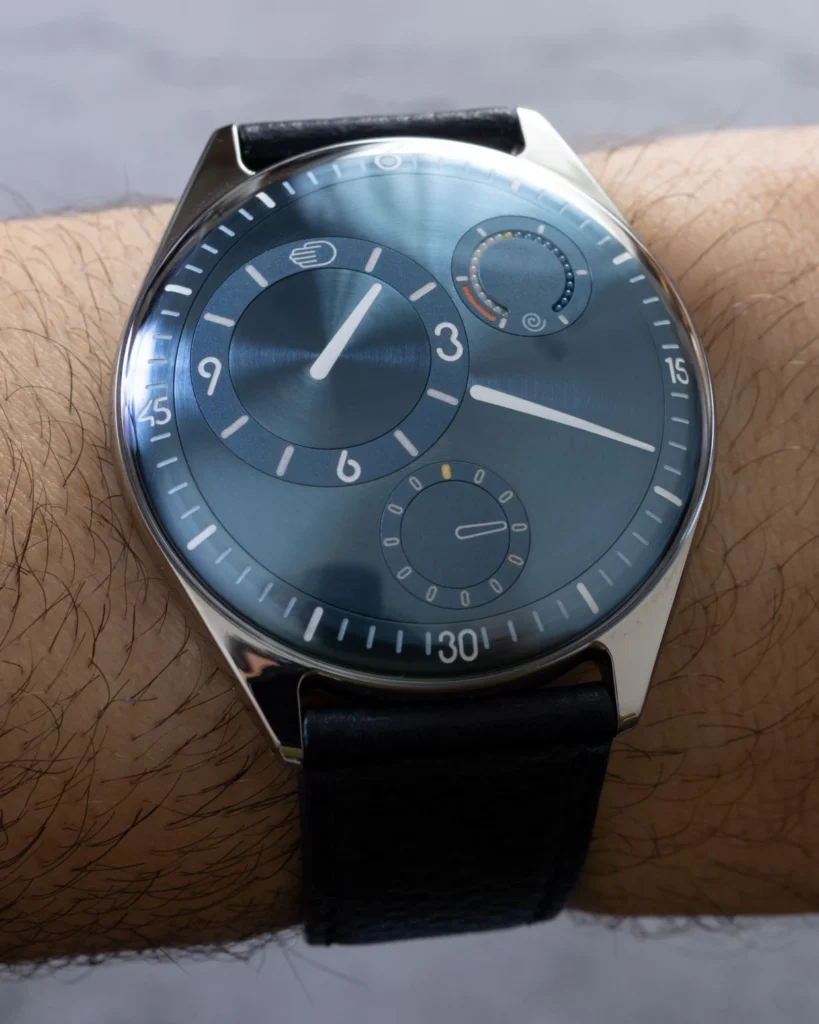
Perhaps the most delightful, and certainly the most unique, feature of the Type 11 is its power reserve indicator. Abandoning the standard needles or discs, Ressence has opted for a system of colored ceramic beads. These beads are housed in a spiral-shaped cavity on the dial. As the movement gains power, a yellow ceramic bead moves clockwise, followed by white beads that fill the scale. As the power reserve wanes, the beads are pushed back, with dark blue ceramic spheres indicating the "low power" zone.
This, combined with the watch’s fully lumed dial, makes for a masterclass in legible, avant-garde design. The convex surface of the dial, while visually complex, remains flush, maintaining the "pebble" aesthetic that has become synonymous with the Ressence brand identity.

Ergonomics and the "Pebble" Philosophy
Measuring 41mm in diameter and 11mm in thickness, the Type 11 is a marvel of wearable design. Inspired by the smooth, organic shape of a river pebble, the case is crafted from grade 5 polished titanium. At a total weight of just 49 grams (including the strap), the watch is almost ethereal on the wrist. It avoids the sharp edges and snagging points of traditional luxury watches, effectively "disappearing" when not in active use.
However, no design is without its minor critiques. The sapphire crystal, while beautifully domed, still suffers from the characteristic glare common to the brand’s models. While this does not hinder the reading of the time, it does present a challenge for enthusiasts wishing to admire the dial’s depth. Additionally, while the titanium buckle is aesthetically pleasing, the accompanying leather strap can be somewhat cumbersome to secure due to the design of the excess strap keepers. For the discerning collector, this is a minor hurdle, easily resolved by sourcing a more supple or practical aftermarket strap.

Industry Context: Where the Type 11 Stands
The Type 11 enters a market crowded with high-complication horology, yet it stands alone in its philosophy. Priced at $31,400 USD, it occupies a fascinating middle ground in the brand’s catalog. It is arguably more technically advanced than some of the more expensive Ressence models, such as the Type 3 or Type 7, which still rely on modular configurations.
Industry analysts suspect that the introduction of the RW-01 marks a broader shift for the company. As the brand scales its manufacturing capabilities, it is highly probable that the RW-01 architecture will become the new baseline for future Ressence collections. This transition signals the maturation of the brand from an ambitious design house into a sophisticated, vertically integrated manufacture.

The Role of Digital Transparency
It is worth noting that Ressence’s approach to customer education is as innovative as its timepieces. In an era where many luxury brands hide behind the "mystery" of their manufacturing, Ressence has invested heavily in detailed technical documentation, interactive diagrams, and transparent explanations of its "Innovation" section on their website. By treating the collector as an informed participant rather than a passive consumer, Ressence is setting a new standard for customer service in the independent sector.
Future Implications
The Type 11 is not merely a watch; it is a declaration of intent. By mastering the production of an in-house caliber that seamlessly integrates with their signature orbital display, Ressence has removed the "ceiling" of what they can achieve. We can expect to see future iterations of the Type 11 with added complications, perhaps taking advantage of the space saved by the streamlined RW-01 movement.

While $31,400 is a significant investment, the value proposition here is not found in traditional materials like gold or platinum, but in the sheer density of intellectual property and engineering innovation. For the collector who values the "how" as much as the "what," the Type 11 is likely one of the most compelling watches released this decade.
In conclusion, the Ressence Type 11 is a triumphant realization of a twenty-year dream. It is a watch that succeeds because it refuses to be a conventional timepiece. From the ceramic bead power reserve to the crownless, gear-driven caseback, every element of the watch speaks to a brand that is, quite literally, moving in its own orbit. For those who have followed Benoit Mintiens’ journey, the Type 11 is not just a milestone—it is the destination.