Main Facts: The Intersection of Victorian Ink and Haute Joaillerie
On Paris’s fabled Place Vendôme, where traditional high jewelry often relies on familiar arrangements of precious stones, Boucheron’s Creative Director Claire Choisne continues to redefine the boundaries of fine craft. For the French maison’s latest Carte Blanche high jewelry unveiling, Choisne has introduced an extraordinary necklace that marries 19th-century body ornamentation with ancient gem-carving techniques.
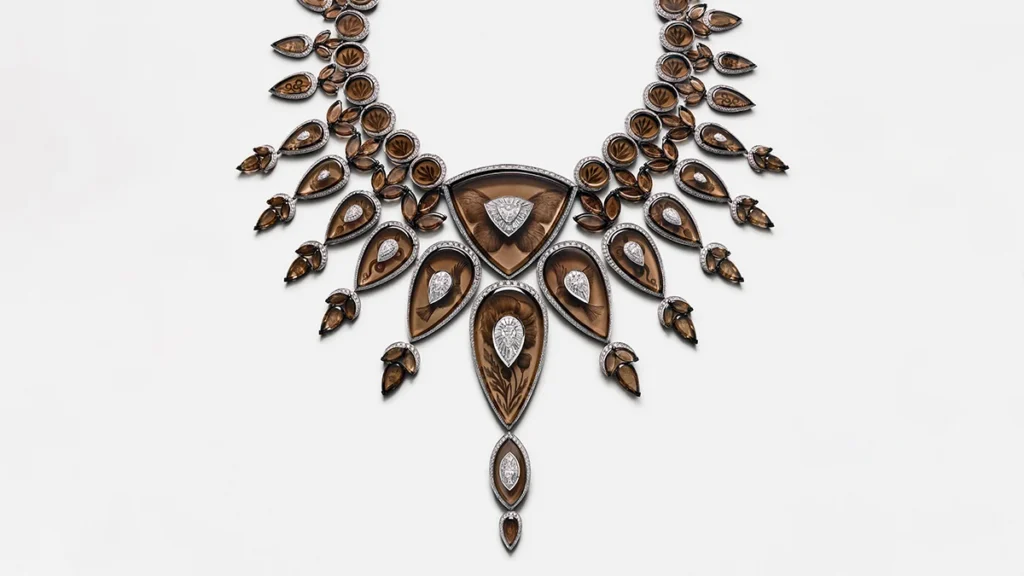
The centerpiece of this creation is an intricate study in glyptic art—the ancient discipline of carving into gemstones—inspired directly by the iconography of Victorian-era tattoos. Rather than employing traditional surface-level engraving, Boucheron’s lapidary masters carved delicate, low-relief illustrations onto the reverse side of 580 carats of custom-cut smoky quartz. Viewed from the front, the motifs appear magically suspended within the stone’s crystalline matrix, reminiscent of prehistoric fossils preserved in translucent amber or delicate ink resting beneath the human epidermis.
+-----------------------------------------------------------------------------------+
|                            BOUCHERON "TATTOO" NECKLACE                            |
|                                                                                   |
|  Total Quartz Weight:     580 Carats (Smoky Quartz)                               |
|  Hero Gemstone:           1.74-Carat Diamond (D Color, VVS1, Troidia Cut)         |
|  Bench Work:              3,220 Hours                                             |
|  Custom Tools Designed:   200+ Lapidary Micro-Instruments                         |
|  Primary Materials:       18-Karat White Gold, Pavé Diamonds                      |
|  Technique:               Reverse Bas-Relief Glyptic Intaglio                     |
+-----------------------------------------------------------------------------------+
The piece incorporates a rich tapestry of flora and fauna drawn from the archives of maison founder Frédéric Boucheron, including poppies, climbing roses, dense foliage, cicadas, serpents, chickadees, and fluttering butterflies. The quartz elements are framed in 18-karat white gold, embellished with pavé-set diamonds, and anchored by a central 1.74-carat D-color, VVS1-clarity troidia-cut diamond. Requiring 3,220 hours of bench time to bring to fruition, the necklace represents one of the most technically ambitious projects executed in the maison’s 168-year history.
Chronology: A 168-Year Lineage of Visionary Disruptions
Boucheron’s contemporary audacity is not a departure from its heritage, but rather a direct continuation of a legacy established during the Second French Empire and the Belle Époque.
1858 ─── Frédéric Boucheron establishes the Maison at the Palais-Royal
1879 ─── Introduction of the clasp-free "Question Mark" (Point d'Interrogation) necklace
1893 ─── Boucheron becomes the first jeweler to open at 26 Place Vendôme
2011 ─── Claire Choisne appointed Creative Director
2020 ─── "Contemplation" collection introduces NASA Aerogel to high jewelry
2026 ─── Unveiling of the Smoky Quartz Victorian Tattoo Necklace
2026 ─── Retrospective: "Boucheron: In Focus—A Monograph of a Visionary" at Christie's NY
The Architectural Foundations of Place Vendôme (1858–1893)
Frédéric Boucheron established his namesake house in 1858 under the arcades of the Palais-Royal, the epicenter of Parisian luxury at the time. A pioneer in technique and marketing, Boucheron consistently challenged the era’s design orthodoxy. In 1879, he introduced the revolutionary Point d’Interrogation (Question Mark) necklace—a clasp-free, asymmetrical neckpiece that wrapped organically around the wearer’s neck, offering women unprecedented independence by allowing them to put on and remove their jewelry without the assistance of a maid.
Recognizing the shift in Parisian high society, Boucheron moved his atelier in 1893 to 26 Place Vendôme, choosing the corner location specifically for its superior exposure to natural sunlight, which illuminated his gemstones to maximum effect. In doing so, he became the very first jeweler to establish premises on what would become the world’s most famous square of high jewelry.
The Modern Era of Material Exploration (2011–Present)
Since taking the creative helm in 2011, Claire Choisne has reignited this founding spirit through Boucheron’s annual Carte Blanche collections. Where traditional high jewelry often restricts its palette to diamonds, sapphires, rubies, and emeralds, Choisne has incorporated:
- Aerogel: A space-grade material composed of 99.8% air, utilized by NASA on Mars rovers to capture stardust, encased by Boucheron in rock crystal.
- Algorithmic Architecture: Mathematical simulations used to engineer diamond-studded, cloud-like ruffs.
- Biomaterials and Holography: Preserved natural flower petals chemically stabilized without polymers, alongside industrial holographic coatings fused directly onto ceramic and quartz matrices.
This design lineage directly informs the 2026 collection, which revisits the house’s historic naturalist motifs through the lens of body modification and reverse intaglio carving.
Supporting Technical Data: Lapidary Physics and Gemological Metrics
The realization of the Victorian-inspired tattoo necklace required Boucheron’s Mains de Lumière (Hands of Light) artisans to overcome severe material constraints.
MATERIAL ATTRIBUTES: SMOKY QUARTZ VS. TRADITIONAL METALS
+------------------------+----------------------+--------------------+
| Material               | Mohs Hardness Rating | Fracture / Cleavage |
+------------------------+----------------------+--------------------+
| Smoky Quartz (SiO2)    | 7.0                  | Conchoidal / Brittle |
| 18K White Gold         | 2.5 – 3.0            | Ductile / Malleable |
| Diamond (Carbon)       | 10.0                 | Octahedral         |
+------------------------+----------------------+--------------------+
The Hardness Dilemma and Tool Engineering
Quartz sits at 7.0 on the Mohs hardness scale—significantly harder than gold, silver, or platinum. Carving reverse bas-relief into the underside of crystalline quartz without causing structural fractures or internal clouding requires extreme precision. Because traditional rotary burrs and standard jewelry chisels quickly dull or cause micro-fissures in brittle silica, Boucheron had to fabricate more than 200 custom micro-tools.
These specialized instruments, fashioned from hardened alloys and diamond-coated tips, were designed to reach tiny interior angles. Due to the abrasive nature of quartz carving, dozens of these bespoke tools wore down completely and had to be continually reshaped and re-hardened throughout the production cycle.
PRODUCTION LABOR BREAKDOWN (3,220 Total Hours)
┌─────────────────────────────────────────────────────────┐
│ [████████████████████] Lapidary & Reverse Glyptics: 45% │
│ [████████████] Gold Mounting & Articulation: 28%       │
│ [████████] Gemological Setting & Pavé: 18%             │
│ [████] Design, Prototyping & CAD: 9%                    │
└─────────────────────────────────────────────────────────┘
Optical Precision and Weight Distribution
- Mineral Weight: 580 total carats of hand-selected smoky quartz, curated for uniform color saturation, optical transparency, and an absence of internal inclusions that would disrupt the visual legibility of the carvings.
- Optical Geometry: Carving on the reverse side required the craftsmen to work in inverted perspective (mirror image and negative relief), anticipating how light refraction through the domed exterior of the quartz would magnify and distort the underlying engraving.
- Central Stone: A certified 1.74-carat troidia-cut diamond (D color, VVS1 clarity), a triangular step-and-brilliant hybrid cut selected to mirror the geometric tension between Victorian romanticism and modern industrial lines.
Official Responses and Curatorial Perspectives
The artistic thesis behind the creation underscores a deliberate philosophical link between the permanence of ink on skin and the eternal nature of carved gemstones.

Claire Choisne on Translating Heritage into Light
Discussing the conceptual origins of the necklace, Claire Choisne emphasized the continuity between self-expression and adornment:
"For this masterpiece, I envisioned a tattoo written in light, where motifs from our heritage seem to emerge directly onto the skin. Tattoos in the Victorian era were deeply personal statements—marks of distinction, memory, and rebellion. By using smoky quartz and reverse glyptics, we are capturing Frédéric Boucheron’s beloved natural motifs—the poppies, the cicadas, the serpents—not as static vintage designs, but as intimate, luminous talismans that belong wholly to the contemporary body."
Choisne noted that the technical struggle was fundamental to the artistic outcome:
"Quartz does not yield easily. When you carve into a stone with this level of hardness, there is no margin for error. A single slip or thermal micro-fracture means discarding hundreds of hours of work. Our artisans had to invent an entirely new mechanical language to translate our botanical and zoological archives into these crystalline capsules."
Upcoming Monograph Exhibition: Christie’s New York
To contextualize this achievement alongside historical archives, Boucheron has partnered with Christie’s New York for a public retrospective titled Boucheron: In Focus—A Monograph of a Visionary, scheduled to run from October 9 through October 18.
Representatives from Christie’s noted that the exhibition will place the new Carte Blanche creation in direct conversation with 19th-century museum pieces, illustrating how Frédéric Boucheron’s original design language continues to be reinterpreted. The curated space will feature archival ledgers, original design gouaches, historic pieces owned by royal dynasties, and modern material experiments from Choisne’s tenure.
Implications: Redefining High Jewelry and Market Dynamics
The debut of the smoky quartz tattoo necklace signals broader shifts across the haute joaillerie sector, affecting collecting behaviors, technical paradigms, and the commercial positioning of heritage brands.
STRATEGIC SHIFTS IN HIGH JEWELRY
┌───────────────────────────────┐     ┌───────────────────────────────┐
│    TRADITIONAL PARADIGM       │     │     CONTEMPORARY PARADIGM     │
├───────────────────────────────┤     ├───────────────────────────────┤
│ • Intrinsic Carat Value       │ ──> │ • Technical & Conceptual Merit│
│ • "Big Four" Precious Gems    │ ──> │ • Hard Minerals & Space-Age   │
│ • Static Form & Classicism    │ ──> │ • Fluidity, Optics & Wear     │
│ • Conservative Collector Base │ ──> │ • Contemporary Art Crossover  │
└───────────────────────────────┘     └───────────────────────────────┘
Elevation of Conceptual Value Over Intrinsic Carat Weight
For decades, high jewelry pricing and prestige were dictated primarily by the intrinsic value of standard precious stones—large diamonds, Burmese rubies, Kashmir sapphires, and Colombian emeralds. Boucheron’s continued emphasis on non-traditional materials (smoky quartz, aerogel, industrial ceramics) shifts the value proposition toward intellectual property, extreme craftsmanship, and sculptural artistic merit.
By investing 3,220 hours of master lapidary labor into smoky quartz—a mineral traditionally categorized as semi-precious—the maison challenges the market to evaluate high jewelry through the lens of fine art rather than raw commodity metrics.
Revitalization of Disappearing Decorative Arts
The creation of over 200 bespoke tools to execute reverse glyptic carving highlights a crucial industrial implication: the preservation and advancement of rare lapidary techniques. As digital design and automated CNC milling become ubiquitous across luxury manufacturing, Boucheron’s commitment to hand-executed intaglio ensures that specialized manual crafts not only survive, but evolve to solve complex modern design problems.
Institutional and Secondary Market Crossover
The staging of Boucheron: In Focus—A Monograph of a Visionary at Christie’s New York demonstrates the deepening relationship between premier high jewelry houses and top-tier fine art auction institutions. High jewelry collections are increasingly curated and collected in the same manner as modern sculpture and contemporary design.
As collectors seek pieces that combine historical pedigree with bold aesthetic experimentation, Boucheron’s Victorian-inspired tattoo necklace stands as proof that a historic maison can honor its foundational past while boldly expanding the definition of wearable art.