The dance of social engagement has always been defined by a delicate equilibrium: the tension between private intimacy and public perception. Throughout history, the "power couple"—that rare alchemy of two magnetic individuals merging their brands, aesthetics, and influence—has served as the ultimate barometer for cultural zeitgeist. Whether caught by the wandering lens of a paparazzi photographer or framed by the curated profiles of a fashion magazine, these unions do more than create headlines; they define eras.
For decades, Women’s Wear Daily has stood as the chronicler of these high-profile partnerships. From the raw, unfiltered energy of the 1970s to the polished, social-media-saturated landscape of the 2020s, WWD has been on the front lines, observing how love and fame intertwine to shape the industry of style.
The Blueprint of Influence: A Historical Perspective
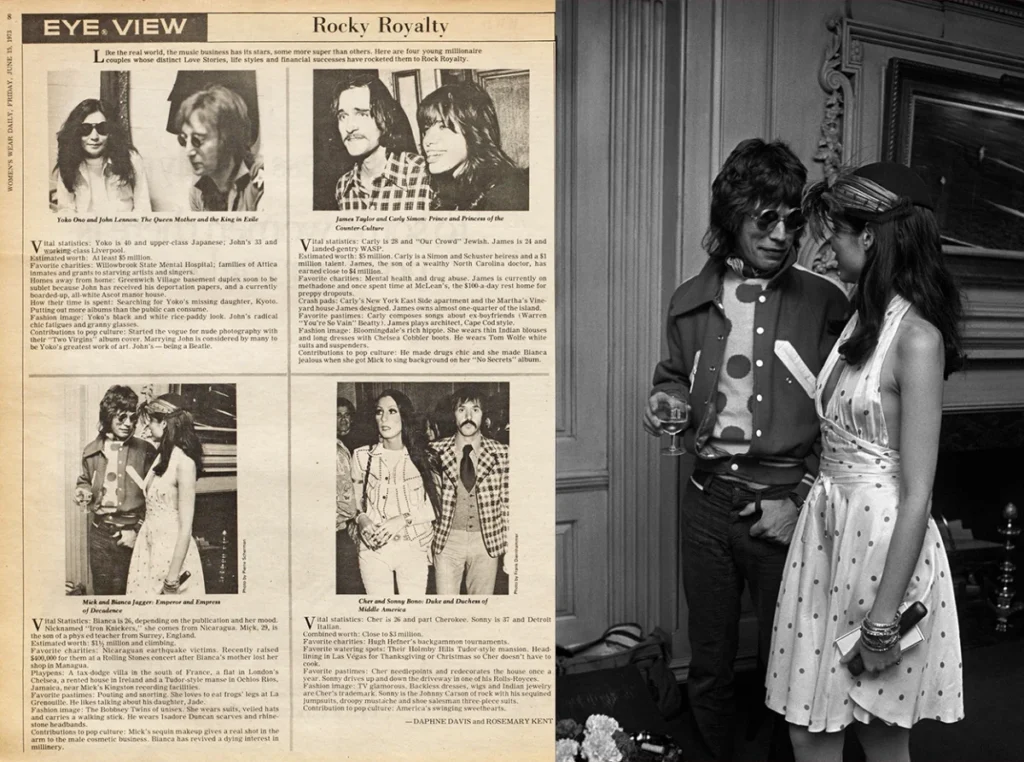
In the 1970s and 1980s, the concept of the "solo celebrity" was increasingly eclipsed by the "iconic duo." It was a time when the personal lives of musicians and actors became inseparable from their commercial viability. To look back at the archives of June 15, 1973, is to witness a fascinating snapshot of "Rock Royalty"—a term coined by editors to describe the millionaires who held the cultural keys to the kingdom.
The figures of that era—Sonny and Cher, Bianca and Mick, Yoko and John, James and Carly—were not merely partners in romance; they were partners in the creation of a visual language. Their "vital statistics," financial status, and lifestyle choices provided a blueprint that is still being utilized today. When we observe the modern fascination with Rihanna and A$AP Rocky, Justin and Hailey Bieber, Taylor Swift and Travis Kelce, or Zendaya and Tom Holland, we are witnessing the modern evolution of that same 1973 phenomenon: the intersection of fashion, entertainment, and the public’s insatiable desire to participate in the lives of the elite.

Chronology of Connection: The Evolution of the "It" Couple
To understand the trajectory of the modern power couple, one must trace the lineage of those who set the standard. The following profiles, extracted from the 1973 WWD archives, illustrate the distinct archetypes of the era.
1. Yoko Ono and John Lennon: The King and Queen in Exile
In 1973, the world looked at John Lennon and Yoko Ono not just as musicians, but as an avant-garde force. With an estimated worth of $5 million, they were the "Queen Mother and King in Exile." Their partnership was a radical departure from the norm, characterized by their political activism and a refusal to adhere to traditional celebrity tropes. Their aesthetic—Ono’s monochrome "rice-paddy" minimalism and Lennon’s fatigues—challenged the consumerist nature of the era, while their marriage became, in the eyes of many, the most provocative art piece of the 20th century.
2. Mick and Bianca Jagger: The Emperors of Decadence
If Lennon and Ono were the activists, Mick and Bianca Jagger were the architects of 1970s glamour. Bianca, with her sharp tailoring and penchant for millinery, and Mick, with his sequined, gender-fluid stage presence, turned the concept of "unisex" into a high-fashion statement. Their influence on the male cosmetics industry and women’s suiting remains a staple in fashion history. They were the epitome of the jet-set lifestyle, moving between tax-haven villas in France and estates in Jamaica, their every move documented by the global press.
3. James Taylor and Carly Simon: The Counter-Culture Aristocracy
Taylor and Simon represented a unique fusion of high-society pedigree and bohemian rock spirit. As a Simon and Schuster heiress and a landed-gentry descendant, they were the "Prince and Princess of the Counter-Culture." Their fashion—the "Bloomingdale’s rich hippie" look—defined the aspirational aesthetic of the mid-70s. Their relationship, marked by the public nature of Simon’s songwriting and Taylor’s architectural pursuits, established the trope of the "relatable but unreachable" celebrity couple.

4. Sonny and Cher: The Duke and Duchess of Middle America
In contrast to the art-house vibes of their peers, Sonny and Cher were the masters of television-era polish. They were the "swinging sweethearts" of Middle America. Cher’s evolution from beaded gowns and wigs to a fashion icon in her own right, paired with Sonny’s kitschy, sequined aesthetic, transformed them into a global brand. Their influence lay in their accessibility; they were the first true "TV royals" who invited the audience into their living rooms every week.
Supporting Data: The Currency of Chemistry
The success of these partnerships, both then and now, relies on a quantifiable "style chemistry." In the 1970s, this was measured by the coverage in trade journals like WWD and the interest of high-fashion houses. Today, the metrics have shifted to social media engagement, red-carpet "moments," and brand ambassadorships.
Financial power remains a key indicator. Just as the 1973 couples were assessed by their "estimated worth" and real estate holdings, modern couples are judged by their collective net worth and their ability to move the needle for luxury brands. When a couple like Zendaya and Tom Holland steps onto a carpet, it is a calculated display of synergy that generates millions in "earned media value." This is not an accident; it is the modern manifestation of the 1973 blueprint—a perfect synthesis of talent, beauty, and business.
Official Responses and Cultural Implications
The industry’s fascination with these pairings is not merely voyeuristic; it is essential to the fashion ecosystem. Industry experts argue that the power couple acts as a "multiplier" for cultural influence. A designer dressing a single celebrity is an endorsement; dressing a power couple is a narrative.

"The resonance of these couples lies in the story they tell," notes a fashion historian. "In the 70s, the story was one of rebellion and decadence. Today, the story is one of alignment, shared values, and aesthetic cohesion. We see couples like Justin and Hailey Bieber, who have turned the ‘streetwear-meets-couture’ look into a billion-dollar conversation. The public isn’t just watching the clothes; they are watching the chemistry."
However, this constant visibility comes at a cost. The scrutiny applied to modern couples is exponentially higher than it was in 1973. Where once a couple could hide behind the walls of a Greenwich Village duplex, today’s stars are constantly "on." The implications of this are profound: the pressure to maintain a "brand-perfect" relationship can often strip away the very humanity that made the 70s couples so magnetic.
The Future: Watching the Blueprint
As we look to the decades ahead, the "dance of social engagement" shows no signs of slowing. If anything, the speed of consumption has intensified. The new generation of icons understands that their partnership is a product, a narrative, and a fashion statement all at once.
We are currently witnessing a shift toward "authenticity-led" branding, where couples are rewarded for showing the behind-the-scenes reality of their lives. Yet, the core requirement remains the same: presence and perception. Whether they are walking the streets of New York, attending a charity gala, or posting a candid moment on social media, the power couple of the future will continue to be the primary drivers of the global style conversation.

In the end, the history of the WWD archives serves as a reminder: the names and the fashion may change, but the allure of the "duo" is timeless. From the radical chic of Lennon and Ono to the red-carpet dominance of today’s stars, the public will always be watching, waiting to see who will be the next to define the style chemistry of their time. The conversation continues, and as the blueprint evolves, so too will our obsession with those who choose to face the world together.