In an era defined by the return of the 36mm dress watch and a widespread obsession with mid-century minimalism, Zenith has chosen a decidedly contrarian path. While the broader horological landscape leans toward the demure and the vintage-inspired, the Le Locle-based manufacture continues to push the boundaries of mechanical bravado with its Defy Extreme collection. The latest iteration, the Zenith Defy Extreme Ultraviolet, is not merely a watch; it is a declaration of intent. By marrying a 45mm, micro-blasted titanium case with a translucent, deep-violet aesthetic, Zenith has created a piece that feels like a nostalgic homage to the “clear tech” design language of the late 1990s, updated with the most sophisticated mechanical engineering of the 2020s.
Main Facts: The Anatomy of the Ultraviolet
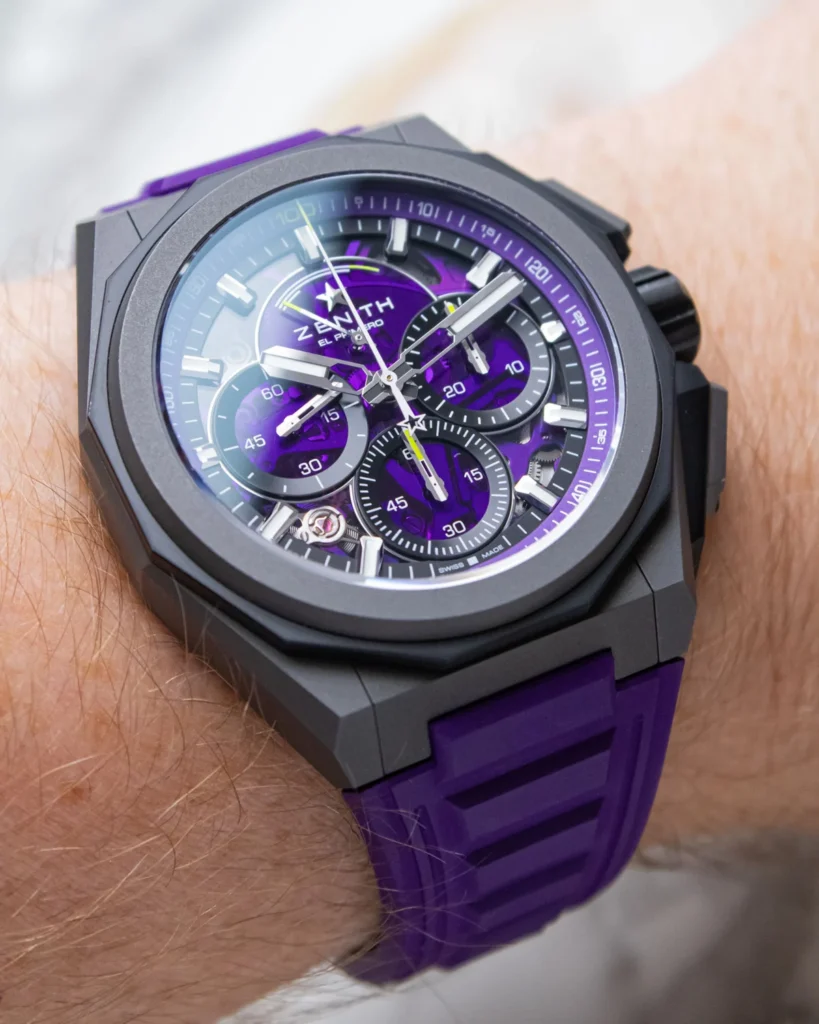
At the heart of the Zenith Defy Extreme Ultraviolet lies a commitment to structural complexity. Measuring 45mm in diameter and 15.4mm in thickness, the watch is undeniably imposing. However, the choice of material—a fully micro-blasted titanium—serves to mitigate the weight typically associated with such substantial dimensions. Unlike the polished stainless steel variants that define much of the Defy line, the micro-blasted finish gives this piece a matte, industrial, and somewhat sinister presence.
The case architecture, characterized by its sharp, angular facets, eschews the traditional gemstone-like geometry of previous models in favor of a look that draws direct inspiration from modern, high-performance automotive design—specifically, the aggressive, folded lines of a Lamborghini. The signature two-tone circle-and-octagon bezel, rendered in muted matte gray and black, grounds the watch, while the wide, protective crown guards and integrated pushers ensure that the timepiece is as functional as it is aesthetic. Despite its skeletonized appearance, the watch remains a powerhouse of durability, boasting an impressive 200 meters of water resistance, proving that "extreme" is more than just a marketing moniker.

A Chronological Evolution: From Concept to Calibration
The Zenith Defy Extreme series has always served as the brand’s sandbox for experimental horology. To understand the Ultraviolet, one must trace the lineage of the El Primero 9004 movement. The journey began with the revival of the high-frequency chronograph, a hallmark of Zenith’s DNA since 1969, but the 9004 took this heritage into the hyper-modern era.
The development of the "Extreme" category was a strategic move by Zenith to reclaim its position as a leader in avant-garde chronographs. Each subsequent release, from the early titanium prototypes to the jungle-inspired iterations, has been a study in balancing raw mechanical power with contemporary material science. The "Ultraviolet" release marks a turning point where the brand has moved beyond purely performance-focused aesthetics and into a realm of deliberate, expressive color theory. By introducing the deep-violet sapphire elements, Zenith is tapping into a cultural zeitgeist—the "clear tech" era of the Nintendo 64 and the first-generation iMac—bridging the gap between the mechanical nostalgia of the late 20th century and the high-precision capabilities of the 21st.
Supporting Data: The Power of the El Primero 9004
The technical prowess of the Defy Extreme Ultraviolet rests entirely upon the shoulders of the in-house El Primero 9004 automatic chronograph movement. To the uninitiated, this is a standard chronograph; to the aficionado, it is a dual-engine machine.

The movement operates on two independent frequency systems. The base movement, responsible for timekeeping, beats at a smooth 36,000 vibrations per hour (vph), providing a standard 50-hour power reserve. However, the chronograph complication is an entirely different beast. It operates at an staggering 360,000 vph—or 100 beats per second—allowing for the measurement of 1/100th of a second.
- Frequency: 36,000 vph (Time); 360,000 vph (Chronograph)
- Chronograph Power Reserve: Approx. 45 minutes of continuous use
- Timekeeping Power Reserve: 50 hours
- Certification: COSC Chronometer Certified
- Winding System: Independent winding for each engine (bi-directional rotor)
This energy-hungry architecture requires a dual-barrel system. Because the chronograph consumes energy at such a violent rate, Zenith has engineered the crown and rotor to distribute torque specifically to the complication, effectively separating the "daily driver" aspect of the watch from its "performance" engine.
The Aesthetic Spectacle: Transparency and Light
The dial of the Defy Extreme Ultraviolet is a masterclass in layered transparency. Zenith utilizes a tinted violet sapphire crystal for the floating sub-dials, which acts as a filter for the intricate mechanical dance occurring beneath. The result is a dial that feels both secretive and revealing. In low light, the deep purple hues dominate, obscuring the movement and providing high contrast for the hands. Under direct sunlight, the violet tint recedes, revealing the industrial skeletonization of the bridges and gear train.

The accents of vivid yellow—found on the chronograph hands, the 1/100th second scale, and the power reserve indicator at 12 o’clock—provide a high-contrast visual tension. This color palette is inherently "punchy," designed to ensure that even with the complexity of the skeletonized dial, legibility remains paramount. The paddle-style hands, treated with generous amounts of luminescent material, ensure that the watch is as usable at midnight as it is at noon.
Official Perspectives and Market Positioning
Zenith’s decision to launch the Ultraviolet at an MSRP of $20,100 USD positions it firmly in the ultra-luxury segment. While some critics argue that the price point for a titanium chronograph is steep, the brand maintains that the value lies in the "extreme" nature of the manufacturing process and the sheer complexity of the dual-escapement 9004 movement.
In official communications, the brand emphasizes that the Defy Extreme is not meant to replace the more traditional Chronomaster series, but to act as a polar opposite. It is designed for the collector who already owns a heritage-inspired timepiece and is now looking for something that challenges the status quo of what a "luxury watch" should look like. The inclusion of three strap options—a black textile strap, an integrated titanium H-link bracelet, and the signature deep-purple rubber deployant strap—allows the wearer to curate the intensity of the watch’s presentation, further justifying its position as a versatile, albeit bold, addition to any collection.

Implications: The Future of "Extreme" Horology
The release of the Zenith Defy Extreme Ultraviolet has significant implications for the luxury watch market. It signals a growing confidence among manufacturers to experiment with bold, non-traditional color palettes. For years, the industry was risk-averse, sticking to safe monochromatic tones. Zenith, however, is betting that the modern enthusiast is ready for more expressive, "fun" luxury.
Furthermore, the focus on "transparent tech" suggests a resurgence of the late-90s industrial design aesthetic. As the millennial and Gen Z demographics become a larger share of the luxury market, watches that evoke a sense of childhood wonder through exposed gears and vibrant, translucent materials will likely see a surge in popularity.
The Ultraviolet is not just a watch for the purist; it is a conversation piece. It is a testament to the fact that high horology does not have to be stuffy, quiet, or reserved to be technically impressive. By leaning into the "shock and awe" factor, Zenith has effectively carved out a niche that few other brands dare to occupy. It is a defiant, unapologetic piece of machinery that refuses to be ignored, serving as a reminder that the most exciting developments in watchmaking are often those that refuse to play by the rules of the current trend. Whether one views it as a futuristic marvel or an over-the-top experiment, the Zenith Defy Extreme Ultraviolet is, at the very least, an undeniable triumph of modern design engineering.