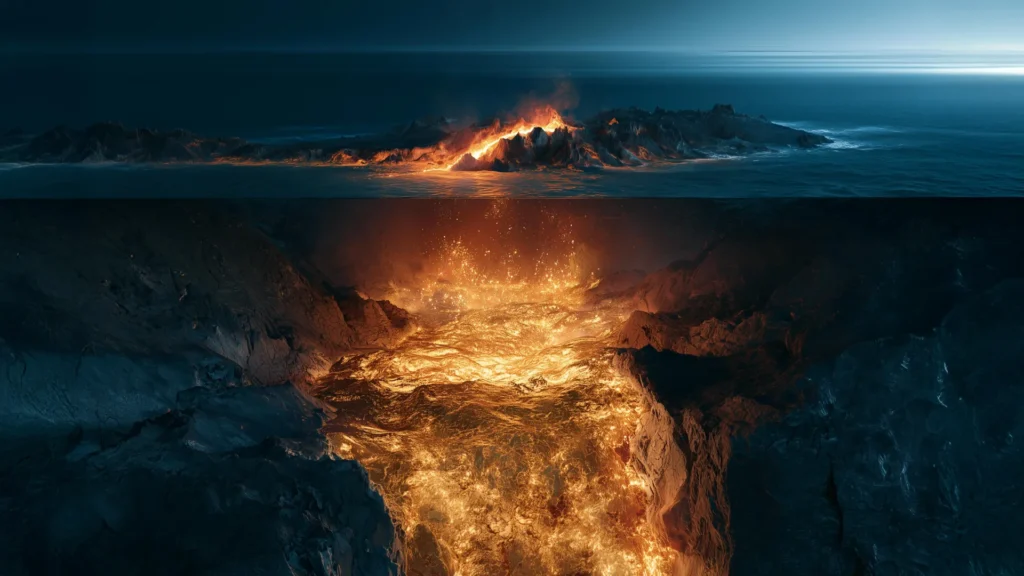
Deep beneath the churning currents of the Pacific Ocean, hidden within the fiery heart of subduction zones, lies a geological "gold kitchen" that has long baffled scientists. Island arcs—chains of volcanic islands that arise where one tectonic plate dives beneath another—are notoriously rich in gold. While miners and geologists have spent decades identifying these deposits on the surface, the precise mechanisms that create this enrichment have remained shrouded in mystery.
A groundbreaking study led by Dr. Christian Timm, a marine geologist at the GEOMAR Helmholtz Centre for Ocean Research Kiel, has finally begun to pull back the curtain on this subterranean alchemy. By analyzing volcanic glass recovered from the depths of the Kermadec island arc, the research team has provided a definitive explanation: the mantle does not merely transport gold; it acts as a sophisticated, multi-stage refining system that progressively concentrates the precious metal long before it reaches the Earth’s crust.
The Chemistry of the Abyss: Analyzing Volcanic Glass
To decode the secrets of the mantle, the researchers turned to a unique geological time capsule: volcanic glass. When lava erupts into the freezing, high-pressure environment of the deep ocean, it cools almost instantaneously. This rapid vitrification prevents the magma from crystallizing, effectively "freezing" its chemical composition at the moment of eruption.
For this study, the team analyzed 66 samples of volcanic glass collected from the seafloor along the Kermadec arc and the adjacent Havre Trough, located north of New Zealand. Among these, the most prized were "primitive glasses"—specimens that preserve the original chemistry of the magma as it existed deep within the mantle, untainted by the complex cooling processes that typically alter igneous rock.
By measuring gold at concentrations measured in mere nanograms per gram, the team compared these samples to other chalcophile ("sulfur-loving") elements, including silver, copper, selenium, and platinum. Because these elements behave predictably during melting, they act as chemical tracers, allowing geologists to reconstruct the thermal and structural history of the mantle source.
Chronology of a Gold-Rich Magma
The research reveals that the journey of gold from the deep mantle to the seafloor is not a single, abrupt event, but a protracted, multi-stage process. The chronology of this "gold enrichment" cycle can be broken down into three critical phases:
1. The Primordial Reservoir
The mantle beneath subduction zones is rarely pristine. Most of the material involved in these volcanic systems has been recycled through previous geological cycles. The team’s data suggests that the mantle beneath the Kermadec arc had already been depleted by ancient melting events, effectively creating a "distilled" source that was already primed for chemical concentration.
2. Water-Triggered Melting
As an oceanic plate descends into the mantle, it carries with it significant quantities of water locked in minerals. This water acts as a chemical catalyst. When it is released into the mantle wedge, it lowers the melting point of the rock. The GEOMAR study demonstrates that this is not merely a passive process; the water facilitates high-degree, repeated melting, which is the essential engine of gold extraction.
3. Sulfide Breakdown and Extraction
Gold in the mantle is primarily hosted within sulfide minerals. During initial, low-degree melting, these sulfides remain stable, trapping the gold within the mantle rock. However, as the mantle melts more extensively—fueled by the water influx—these minerals reach their "sulfide liquidus" and break down completely. This breakdown acts as a "gate-opening" event, releasing the trapped gold into the rising melt. It is this secondary, more intense melting stage that allows for the anomalous concentrations of gold detected in the volcanic glass.
Supporting Data: The Evidence in the Rocks
The figures extracted from the Kermadec samples provide compelling evidence for this multi-stage model. While the concentrations of gold—up to six nanograms per gram of rock—may seem minuscule to the layperson, they are significantly higher than those found in mid-ocean ridge basalts.
Furthermore, the researchers identified gold-to-copper ratios that are strikingly elevated compared to standard fertile mantle models. This "fingerprint" confirms that the magma is not merely absorbing a random mixture of mantle material, but is specifically scavenging gold that has been liberated through the systematic destruction of sulfide minerals.
It is important to note, however, that these rocks are not themselves "ore." As Dr. Timm clarifies, "Despite the elevated values, the rocks do not contain enough gold to be commercially mined. Economically useful deposits would require concentrations several orders of magnitude higher." Instead, these rocks represent the source of the gold, the raw material that must be further concentrated by hydrothermal systems at the seafloor to create the bonanza deposits that human miners seek.
Official Perspectives: Rethinking the Subduction Engine
The findings from Dr. Timm’s team challenge the long-standing assumption that the water released from a descending tectonic plate directly "carries" or "transports" the gold into the magma.
"We initially assumed that water released from the subduction zone directly controlled gold enrichment," says Dr. Timm. "However, our data show that water mainly facilitates mantle melting. The key factor for high gold concentrations is the high—and in part repeated—degree of melting."
This distinction is vital for the field of economic geology. By shifting the focus from the transport mechanism to the intensity of mantle melting, the researchers have identified the true "engine" of gold enrichment. It implies that the geological history of the mantle is just as important as the immediate volcanic activity at the surface. Scientists now understand that the potential for a gold-rich island arc is determined deep within the Earth’s interior, perhaps millions of years before the magma ever breaks through the seafloor.
Global Implications: From the Mantle to the Market
The implications of this study extend far beyond the Kermadec arc. Hydrothermal sulfide deposits—often called "black smokers"—are found throughout the world’s ocean-floor volcanic arcs. These systems are known to host significant concentrations of gold, silver, and copper. By identifying the mantle’s role in this process, the GEOMAR study provides a predictive framework for where these precious metals are most likely to be concentrated.
Predicting Future Deposits
If the gold enrichment is a function of repeated, high-degree mantle melting, then researchers can look for specific geophysical markers that indicate such conditions. By mapping areas where the mantle has undergone extensive "re-melting," geologists may be able to narrow down the search for massive hydrothermal sulfide deposits that have yet to be discovered.
The Life Cycle of Gold
Dr. Timm describes this discovery as viewing the "first step in the life cycle of gold." It is a transformative journey that begins in the deep, solid mantle and ends in the formation of mineral-rich volcanoes. This process underscores the interconnectedness of Earth’s systems: the subduction of an oceanic plate does not just cause earthquakes or volcanoes; it acts as a giant chemical refinery, recycling the Earth’s crust and concentrating its most precious elements.
A Call for Further Research
While the mechanism of mantle-derived enrichment is now clearer, the team acknowledges that the link between this process and the eventual formation of mineable hydrothermal deposits is still a subject of active investigation. The "gold kitchen" creates the raw ingredients, but the "chef"—the hydrothermal plumbing system—must still assemble them into a commercial deposit. Future research will likely focus on how these enriched magmas interact with the seafloor’s plumbing to finally deposit their gold payload.
Conclusion
The research conducted by Dr. Christian Timm and his colleagues at GEOMAR serves as a reminder of how much of our planet’s resource wealth remains hidden in the most inaccessible environments. By deciphering the chemical signals locked within volcanic glass, science has demystified the origin of gold in subduction zones. We now know that the Earth is not merely a collection of static layers, but a dynamic, self-refining machine. The "gold kitchen" deep beneath the Pacific is a testament to the relentless, repetitive, and transformative power of planetary geology—a process that continues to shape the very foundations of the world we live on.