In 2005, the Swiss watchmaking industry was a landscape of tradition and measured evolution. Then came the Hublot Big Bang. With its "Art of Fusion" philosophy, which unapologetically combined rubber straps with precious metals and avant-garde ceramic engineering, it didn’t just enter the market—it detonated it.
Twenty years later, in 2025, Hublot marked this milestone with a series of limited-edition releases that served as a masterclass in horological heritage and technical progression. While these specific anniversary editions have since transitioned into the secondary market, they paved the way for the permanent "Big Bang Original" collection. Today, we revisit two of the most significant pillars of that anniversary celebration: the Hublot Big Bang 20th Anniversary All Black and the elusive Hublot Big Bang 20th Anniversary Red Magic.
Main Facts: A Study in Material Science and Design
The Big Bang 20th Anniversary models are not merely "retro-reissues." Instead, they represent a synthesis of historical aesthetics and cutting-edge 2026 manufacturing capabilities.

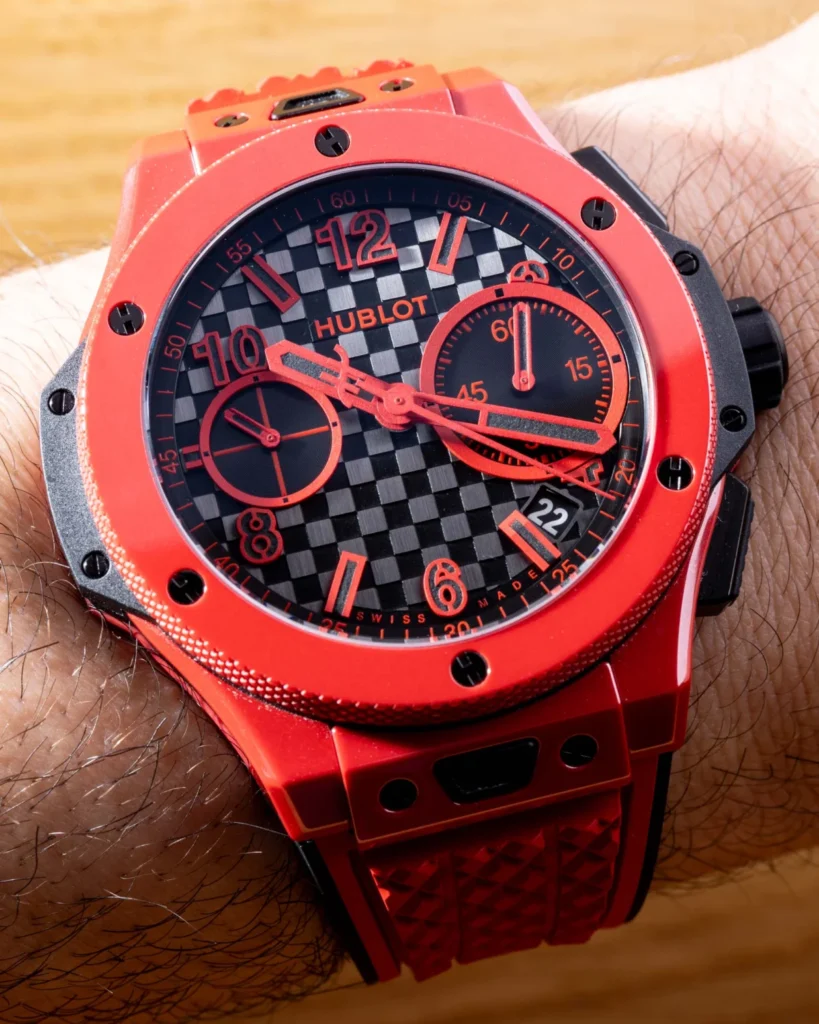
The Big Bang Original All Black (Ref. 431.CI.1340.RX) and the Big Bang Original Red Magic (Ref. 431.CF.1313.RX) serve as living testaments to Hublot’s dominance in ceramic research. The All Black, limited to 500 pieces, is a nod to the trend Hublot single-handedly pioneered, proving that monochromatic palettes do not necessitate a loss of legibility. Conversely, the Red Magic—limited to just 100 pieces—highlights the brand’s mastery over color-sintered ceramics, a feat that remains arguably the most difficult to achieve in the industry.
Both watches are housed in 43mm cases, standing 13.2mm tall and offering 100 meters of water resistance. They feature the modern "One-Click" strap interchangeability system, a testament to the brand’s commitment to user-centric functionality. At the heart of these timepieces beats the caliber HUB1280 UNICO, a column-wheel-controlled automatic chronograph movement that integrates a vertical clutch and silicon escapement, providing a robust 72-hour power reserve.
Chronology: From 2005 to the Modern Era
The trajectory of the Big Bang is the story of Hublot’s rise to prominence.

- 2005: The original Big Bang is launched, shocking purists with its daring fusion of materials and industrial aesthetic.
- 2010s: Hublot solidifies its status as the "King of Ceramic," mastering the challenging chemistry required to produce stable, vibrant colors like red, yellow, and blue.
- 2025: The 20th Anniversary collection is unveiled. These five limited editions were designed to pay homage to the 2005 originals while utilizing the brand’s vastly improved modern construction standards.
- 2026: Hublot transitions the anniversary designs into the ongoing "Big Bang Original" collection, ensuring that the design language of 2005 remains a permanent fixture in the brand’s modern catalog.
The transition from a celebratory limited edition to an "Original" series was a strategic pivot, allowing newer collectors to own a piece of the brand’s history without the exclusivity of a limited run. This move effectively bridged the gap between the brand’s disruptive past and its high-tech present.
Supporting Data: Engineering the "Impossible"
The true value of the Big Bang 20th Anniversary models lies in the material science behind the cases. Sintering colored ceramic is notoriously difficult; the heat and pressure required often lead to cracking, color inconsistency, or structural porosity.
In the case of the Red Magic, Hublot achieved a vibrant, saturated red that was once thought to be chemically impossible at this scale. The brand’s proprietary process involves high-pressure fusion that maintains the material’s extreme hardness—roughly 1,500 Vickers—while ensuring color uniformity.

Furthermore, the "All Black" model demonstrates a sophisticated use of surface finishing. By alternating between bead-blasted, brushed, and polished surfaces, Hublot creates a play of light on the dial that ensures the checkerboard-patterned surface remains legible, even in low-light conditions. This attention to detail is bolstered by the HUB1280 movement, which features a 22k King Gold rotor—a subtle nod to the luxury DNA that underpins the entire collection.
Official Perspectives and Industry Reception
While Hublot has remained characteristically silent regarding the exact composition of the protective composite ring that sits between the ceramic bezel and the case middle, observers of the brand view this as a charming "industrial quirk." It is a remnant of the early Big Bang design, where plastic composites were used to lighten the weight and provide structural shock absorption.
Industry analysts have noted that the Big Bang’s design is a "pendulum" in the world of luxury watches. After years of pastel-colored dials and thinner, minimalist designs across the watch industry, the re-emergence of the "All Black" aesthetic—seen in recent releases from brands like Tudor and others—suggests that the market is swinging back toward the brutalist, monochromatic "cool" that Hublot first championed in the mid-2000s.

Hublot’s leadership has emphasized that the "Original" line is not intended to replace the open-dial UNICO models, which remain the brand’s technical flagship. Rather, it is intended to cater to a demographic of watch enthusiasts who prefer the classic, solid-dial aesthetic of the original 2005 era but demand the precision and reliability of 2026 mechanics.
Implications: The Future of the "Original"
The decision to keep the Big Bang Original in production carries significant weight for the brand’s future. It signals that Hublot is confident enough in its history to let it stand alongside its most advanced innovations.
For the younger generation—those who were not present for the initial 2005 disruption—the Big Bang Original series acts as an entry point into the "Art of Fusion." By maintaining a design that feels both vintage and futuristic, Hublot is attempting to cultivate a new audience that values the brand’s rebellious spirit.

However, the question remains: Can a watch that defined "disruption" twenty years ago still be considered disruptive today?
The answer, it seems, lies in the evolution of the market. The Big Bang is no longer a disruptor in the sense of being an outsider; it is a pillar of the industry. The "Original" collection serves as a reminder that the brand’s core strength is not just its ability to change, but its ability to define the aesthetic of a decade.
As we look toward the next twenty years, the Big Bang Original will likely serve as a constant—a foundational piece of the Hublot puzzle that proves that while trends come and go, the marriage of bold design and superior material science remains the ultimate hallmark of luxury. The secondary market demand for the 20th Anniversary editions suggests that the collectors who grew up with the Big Bang remain as hungry for these pieces as they were two decades ago, solidifying their status as modern classics.

Pricing and Availability Summary:
- Hublot Big Bang 20th Anniversary All Black (Ref. 431.CI.1340.RX): $25,200 USD (Limited to 500 pieces).
- Hublot Big Bang 20th Anniversary Red Magic (Ref. 431.CF.1313.RX): $31,800 USD (Limited to 100 pieces).
Note: These specific limited editions are currently unavailable via primary retail channels, though they appear periodically on the secondary market. Current production models can be viewed via the Hublot official website.