

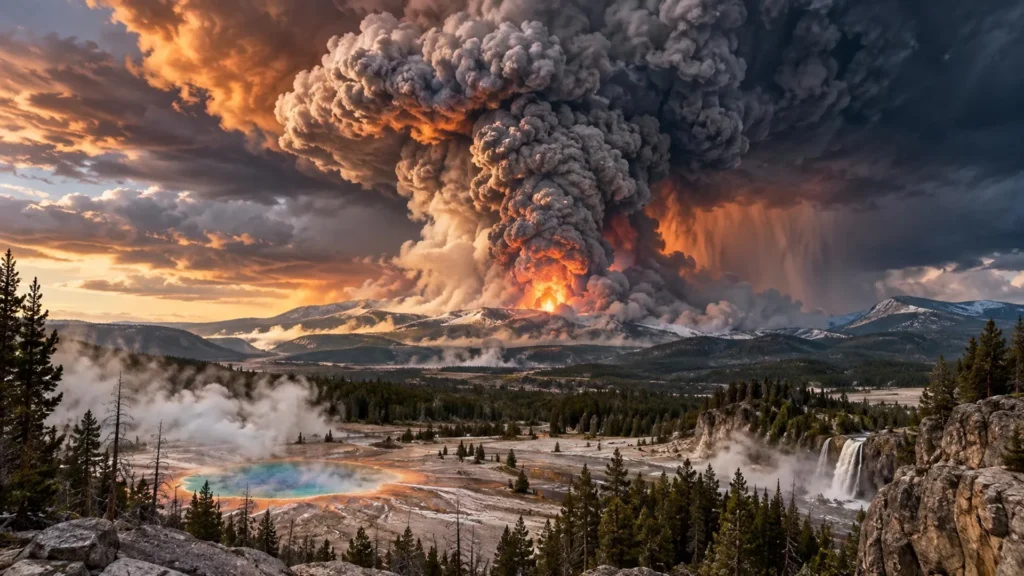
Six hundred and thirty-one thousand years ago—a mere blink of an eye in geological time—a cataclysmic event shattered the landscape of what is now northwestern Wyoming. A super-eruption of the Yellowstone volcanic system unleashed a firestorm that obliterated life within hundreds of kilometers, blanketed North America in ash, and altered global climate patterns. While the early ancestors of humanity may have witnessed the resulting vivid, haunting sunsets from across the oceans, they were spared the direct fury of the blast. Today, the world is vastly different. With a global population of over eight billion and a highly interconnected, fragile technological infrastructure, a modern-day recurrence of this event would be a threat to civilization as we know it.
The Anatomy of the Threat
Yellowstone is frequently mischaracterized as a "sleeping" volcano. In reality, it is a restless, hyper-active geological engine. The Yellowstone Volcano Observatory (YVO) maintains a sophisticated array of sensors—seismometers, GPS stations, strainmeters, and gas-monitoring equipment—that monitor the caldera’s 55-to-70-kilometer expanse around the clock.
Geologists look for "swarms"—clusters of earthquakes that migrate through the crust, often signaling the upward movement of magma or pressurized hydrothermal fluids. While Yellowstone experiences thousands of minor tremors annually, the convergence of seismic activity, accelerating ground uplift, and anomalous gas emissions creates a "worst-case scenario" threshold.
Chronology of a Catastrophe: A Thought Experiment
T-2 Months: The First Tremors
The crisis begins quietly. Analysts at the University of Utah Seismograph Stations observe a sharp, persistent cluster of earthquakes beneath the caldera. Unlike typical seasonal swarms, these tremors are migrating upward. While not a definitive indicator of an imminent eruption, the concentration of events triggers the YVO’s formal response plan. Scientists enter a state of heightened surveillance, sharing data with federal partners to distinguish between hydrothermal shifts and true magmatic intrusion.
T-1 Month: Escalation
Four weeks later, the situation deteriorates. GPS stations indicate significant ground deformation, with satellite radar confirming broad, accelerating uplift. The YVO elevates the alert level from "normal" to "advisory." Media interest peaks, and while volcanologists struggle to manage the balance between public transparency and preventing mass panic, the statistical probability of a major eruption within three months climbs from single digits to over 20%. The Federal Emergency Management Agency (FEMA) begins clandestine contingency planning for a massive, potentially impossible evacuation.
T-2 Weeks: The Point of No Return
As earthquakes become shallower and the ground swells by centimeters within days, the probability of an eruption hits 90%. The YVO issues a "watch" alert, and the USGS raises the aviation color code to orange. Panic ripples through society. Disinformation campaigns flourish alongside genuine fear. World leaders face a binary choice: a coordinated global response or a chaotic, COVID-19-style retreat into national isolation.
T=0: The Rupture
The silence is broken by a violent, phreatomagmatic explosion. Steam, mud, and shattered rock are blasted kilometers into the air as magma forces its way through the hydrothermal system. Within hours, a 30-to-50-kilometer-high eruption column forms. Scorching pyroclastic density currents—mixtures of gas, ash, and rock exceeding 600°C—surge across the landscape, vaporizing everything in their path. The immediate death toll begins to mount as the eruption pulse triggers atmospheric cooling on a hemispheric scale.
T+3 Days to T+4 Months: The Long Shadow
By the third day, the "umbrella cloud" has effectively choked the skies over North America. Billings, Montana, and surrounding regions face meters of ashfall, causing power grids to short-circuit as damp, conductive ash penetrates substations. Supply chains fracture; supermarkets empty, and water treatment plants fail.
As the months progress, the global economic toll becomes clear. The loss of North American agricultural output causes food prices to skyrocket, triggering global recessions. Atmospheric sulfur dioxide forms sulfate aerosols, reflecting sunlight and lowering global temperatures by approximately 1.5°C. While not a "new ice age," this cooling severely disrupts growing seasons in the northern hemisphere.

Supporting Data and Scientific Realities
The scientific community relies on the Volcanic Explosivity Index (VEI) to categorize eruptions. A Yellowstone super-eruption would be a VEI-8 event, the most extreme classification. The last such event occurred 74,000 years ago at Toba, Indonesia.
Recent modeling highlights the long-term health risks posed by the ash. Silica-rich volcanic particles are known carcinogens. In the decade following an eruption, health systems would be overwhelmed by a rise in silicosis, lung cancer, and cardiovascular disease. Furthermore, excess mortality estimates suggest that between 700 million and 1.3 billion premature deaths could be linked to the cascading failures of infrastructure, food security, and medical access.
Official Responses and Strategic Challenges
The primary challenge for authorities is the "refugee crisis" of an unprecedented scale. If the US government and international allies collaborate, they might attempt a mass relocation of the 200,000 residents in the immediate vicinity and the millions displaced by ashfall. However, the logistical burden of housing, feeding, and providing energy to these populations would likely exceed the capacity of most nations.
Most countries would struggle to balance humanitarian aid with the need to stockpile resources for their own domestic stability. The "volcano refugee" would face a world of closed borders and scarce resources, forced into an agrarian existence as the technological age is set back by the collapse of power and transport networks.
Implications: A World Transformed
Ten years post-eruption, the world would look profoundly different. Urban centers would have transitioned to small-scale, vertical, and greenhouse-based food production. Livestock populations would dwindle, replaced by insect farming and intensified fishing. Freshwater access, already a crisis for billions, would become even more precarious as infrastructure for chemical treatment and spare parts fails.
The population might decline as infant and elderly mortality spikes due to the lack of modern medicine. Yet, humanity would persist. The ash would eventually settle, and the sun would return to full strength. The landscape of Wyoming, though scarred, would eventually see the return of grasslands and forests.
The Long View: A Million Years Later
Fast forward one million years. A humanoid explorer from an interstellar civilization scans the Earth. They identify a massive, elliptical depression—the caldera. They contemplate the irony: did this technological civilization perish in the blast, or were they fortunate enough to have evolved and departed before the giant awoke? The geological scar remains, a silent testament to the raw, unyielding power of the planet.
For contemporary humanity, the Yellowstone threat serves as a humbling reminder. While we have mastered the tools of the modern age, we remain inhabitants of a dynamic, volatile planet. A super-eruption remains an "unlikely" event, but its potential to reset the clock on human civilization is an undeniable reality that dictates the necessity of disaster preparedness and global scientific cooperation.



