

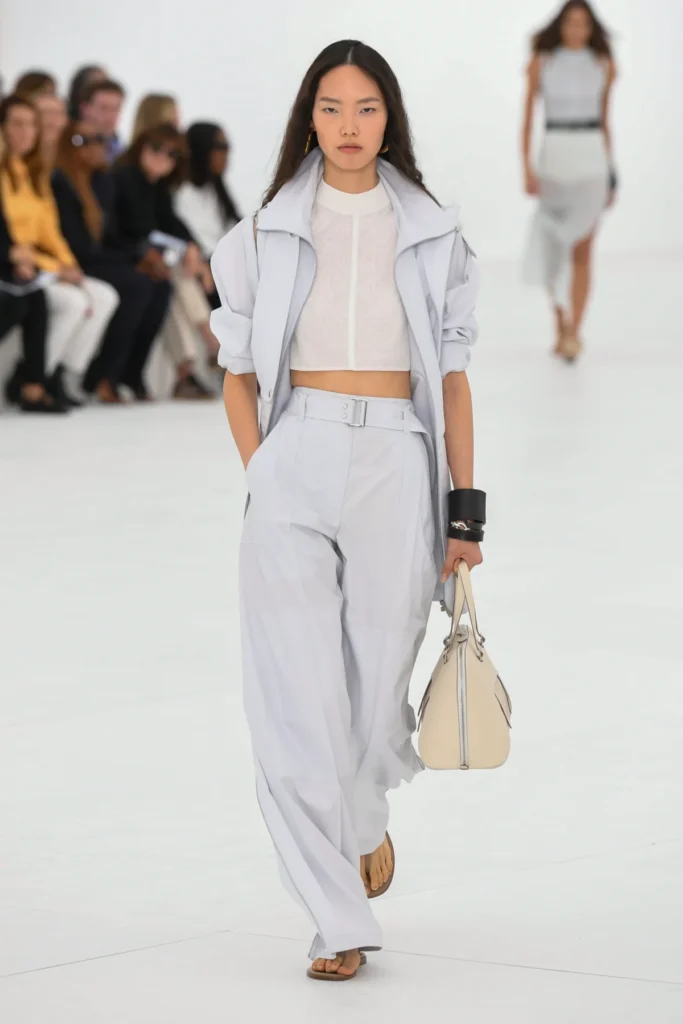
In an era where the climate crisis has moved from scientific projections to the daily lived experience of the global elite, the fashion industry finds itself at a crossroads. How does a house built on the legacy of heavy, artisanal leather reconcile its heritage with the sweltering reality of a planet in transition? For Hermès, the answer lies not in abandoning its DNA, but in literalizing the very element that is becoming the ultimate luxury: air.
During the Fall 2026 showcase in Los Angeles, Nadège Vanhée, the artistic director of women’s ready-to-wear at Hermès, unveiled a collection that served as both a technical triumph and a pragmatic manifesto. By transmuting the weight of calfskin and the density of traditional outerwear into silhouettes that prioritize ventilation and movement, Vanhée has positioned the house at the forefront of a new, climate-conscious aesthetic.
The Genesis of the Concept: Designing for the Anthropocene
The inspiration for the collection did not emerge from a vacuum; it was born from a year of rigorous observation. Vanhée spent the last twelve months traversing the globe, navigating the stifling humidity of Asia, the unpredictable shifts in Europe, and the searing, arid heat of Southern California.
"Air can be perceptible, but also imperceptible," Vanhée noted backstage, explaining the core philosophy behind the collection. "I wanted to convert that idea into a very pragmatic silhouette."
This pursuit of "pragmatic lightness" required a fundamental rethinking of Hermès’ traditional materials. The challenge was to maintain the tactile integrity of the house—the suppleness of leather and the richness of silk—while stripping away the heat-retaining properties typically associated with them. The result was a collection that treated air as a structural component, allowing for garments that breathe with the wearer, regardless of the ambient temperature.
Chronology of a Heat-Stricken Runway
The atmosphere inside the Los Angeles venue was, ironically, a testament to the urgency of the theme. As temperatures soared inside the show space, the irony was not lost on the audience. Before the first model even took to the expansive, square runway, guests including Sofia Vergara were observed using their show notes as makeshift fans.
The show began with a subversion of the most functional of all garments: the parka. While the parka is rarely the first garment associated with the refined Hermès aesthetic, Vanhée used it as the foundational "canvas" for her experiment in air.
- The Opening Sequences: The show debuted with parkas deconstructed into airy, translucent layers. These were transformed into dresses and skirts featuring sheer panels that allowed for maximum airflow.
- The Mechanical Innovations: Vanhée introduced a series of functional zips, allowing the wearer to modify the length and ventilation of the garments in real-time, effectively creating a "dynamic" wardrobe capable of adapting to changing heat levels.
- The Kinetic Mid-Section: The heart of the show featured garments inspired by the geometry of ceiling fans. Long, rectangular leather strips and pleated panels were engineered to swoosh with every step, creating a literal cooling breeze for the wearer.
- The Closing Statements: The finale emphasized the "netted" aesthetic, with open-knit dresses reminiscent of fishing nets, worn over minimalist undergarments, proving that even in the most restricted environments, high fashion can achieve a state of radical breathability.
Material Innovation and Technical Artistry
The technical execution of the Fall 2026 collection represents a significant milestone in textile engineering for the house. Vanhée’s team utilized several key strategies to achieve the desired effect:
- Leather Perforation and Slicing: By taking thin strips of leather and applying them onto lightweight silk mesh, the house created a fabric that possesses the structural durability of hide but the porousness of a weave.
- Layering Dynamics: The use of chocolate suede backed by vibrant yellow silk served two purposes: aesthetic contrast and functional heat management, as the silk acts as a temperature-regulating barrier against the skin.
- Denim Reimagined: Moving away from heavy, indigo-dyed cotton, the house introduced ultra-lightweight denim, treated to feel as fluid as silk, allowing for wide-leg trousers that offer coverage without the suffocating heat of traditional jeans.
- The "Fishnet" Construction: The open-knit dresses were a bold departure. By eschewing traditional solid weaves, these garments offer a sophisticated take on the "naked" trend, perfectly suited for the humid, climate-strained environments of the modern world.
Accessory Design: The Minimalist Shift
Even the accessories were subject to the "cooling" mandate. The footwear for the season was defined by a shift toward the "barely-there." Capri-style sandals with delicate straps dominated the runway, while flat leather boots featured intricate side stitching—not just for decoration, but to allow for subtle expansion and airflow.
Bags, too, were scaled down and ventilated. The collection introduced small, bucket-style bags featuring fishnet detailing, cross-body pouches, and ultra-slim leather clutches. These designs were clearly intended for a consumer who is no longer interested in hauling heavy, oversized leather goods during the heat of summer.
However, the inclusion of thick, stacked leather bracelets proved to be a point of contention. While aesthetically stunning, they served as a reminder of the inherent conflict between traditional luxury adornment and the physiological demands of a warming climate. As the show progressed, the juxtaposition of these heavy accessories against the ultra-light clothing highlighted the lingering tension between historic luxury expectations and the functional demands of the future.
Implications for the Luxury Sector
The Hermès Fall 2026 show is more than a seasonal presentation; it is a signal of the broader changes coming to the luxury sector. As climate change continues to impact where and how people travel, the "seasonal" wardrobe is becoming an obsolete concept.
- The Death of Seasonal Rigidity: The emphasis on "air" and "lightness" suggests that Hermès is moving toward a trans-seasonal model where garments are defined by their thermal properties rather than their place in the Gregorian calendar.
- The Pragmatic Luxury Consumer: The modern Hermès client is increasingly demanding utility. The success of the zippered, adaptable silhouettes indicates that the brand is listening to consumers who prioritize comfort without sacrificing the prestige of the house.
- Climate-Responsive Design as a New Standard: Other luxury houses will likely follow suit, moving away from heavy wools and dense linings in favor of advanced meshes, natural fibers, and structural ventilation.
Official Response and Future Outlook
While Hermès has not issued a formal statement on the ambient temperature of the show venue—which remained a hot topic of conversation among attendees—the design direction speaks for itself. Vanhée’s work demonstrates that the house is willing to confront the physical realities of the climate crisis.
Critics have noted that the collection successfully walks the line between "avant-garde" and "wearable." By keeping the color palette grounded—sunflower yellow, rich chocolate, and the iconic Hermès orange—the house ensured that the technical innovations did not overwhelm the brand identity.
As the industry reflects on the show, the takeaway is clear: the luxury of the future will not be measured by the weight or the excess of a garment, but by its ability to provide relief. As one attendee noted, "Next time, Hermès, please turn up the air con." But perhaps the message was intentional—if the world is getting warmer, the clothes must become the cooling mechanism itself. Hermès has taken the first step toward a wardrobe that treats air not as a void, but as the most essential luxury of all.



