

Introduction: The Invisible Shield of International Trade
The vast expanse of the world’s oceans remains the lifeblood of the global economy, facilitating over 80% of international trade. However, this maritime artery is perpetually threatened by the age-old scourge of piracy and armed robbery. Standing as the primary sentinel against these threats is the International Maritime Bureau (IMB) Piracy Reporting Centre (PRC). Since its inception in 1991, the PRC has evolved from a nascent reporting mechanism into an indispensable global nerve center, operating 24 hours a day to safeguard seafarers, vessels, and the integrity of global supply chains.
As the maritime industry faces increasingly sophisticated threats—from cyber-assisted navigation interference to high-speed tactical boarding—the IMB PRC serves as the critical bridge between ships in distress and the international authorities capable of mounting a response.
Main Facts: The Mandate of the IMB PRC
The IMB Piracy Reporting Centre is a specialized division of the ICC International Maritime Bureau, tasked with a singular, high-stakes mission: to provide a centralized, round-the-clock point of contact for the reporting of piracy and armed robbery at sea.
Core Operational Pillars:
- Immediate Response Coordination: When a distress signal is received, the PRC acts as an information conduit. It does not replace the role of national navies or coast guards; rather, it coordinates with these agencies to ensure that regional authorities are alerted and that appropriate naval assets are deployed.
- Proactive Information Sharing: Beyond reactive measures, the PRC is a proactive intelligence hub. By disseminating warning broadcasts and email alerts to ships operating in high-risk zones, the Center empowers masters and crew to heighten their vigilance and implement hardening measures before an incident occurs.
- Data Analytics and Intelligence: The Center maintains the world’s most comprehensive database on maritime crime. By tracking trends, methods, and hotspots, the IMB provides policymakers, insurance underwriters, and shipping companies with the insights necessary to adjust risk profiles and security protocols.
The efficacy of the PRC rests on a simple yet profound premise: maritime security is a collective responsibility. By providing a neutral, non-governmental platform for reporting, the IMB ensures that even in regions where state presence may be limited, there is a mechanism to document and highlight security failures.
Chronology: Three Decades of Evolution
To understand the importance of the PRC, one must look at the historical trajectory of maritime crime.
- 1991: The Foundation. Amidst a rise in incidents in the Southeast Asian corridor, the ICC International Maritime Bureau established the PRC in Kuala Lumpur. Its early years were focused on creating a standardized format for reporting, which was previously fragmented and often unreported due to bureaucratic hurdles.
- The 2000s: The Somali Crisis. The turn of the century saw the emergence of Somali piracy, which brought the issue to the forefront of global media. During the height of the crisis, the PRC played a pivotal role in the "Best Management Practices" (BMP) framework, which helped vessels navigate the Indian Ocean by providing real-time intelligence on pirate group movements.
- 2010–2020: The Shift to the Gulf of Guinea. As piracy declined in the Indian Ocean, it spiked in West Africa. The PRC’s role shifted toward coordinating with regional maritime centers and advocating for the "Yaoundé Code of Conduct," pushing for greater littoral state involvement.
- 2021–2025: Digital Integration. Today, the PRC leverages advanced satellite communication and data analytics to provide near-instantaneous warnings. The focus has moved toward identifying hybrid threats, where criminals utilize technology to identify cargo values and vessel vulnerabilities before approaching.
Supporting Data: The January–September 2025 Landscape
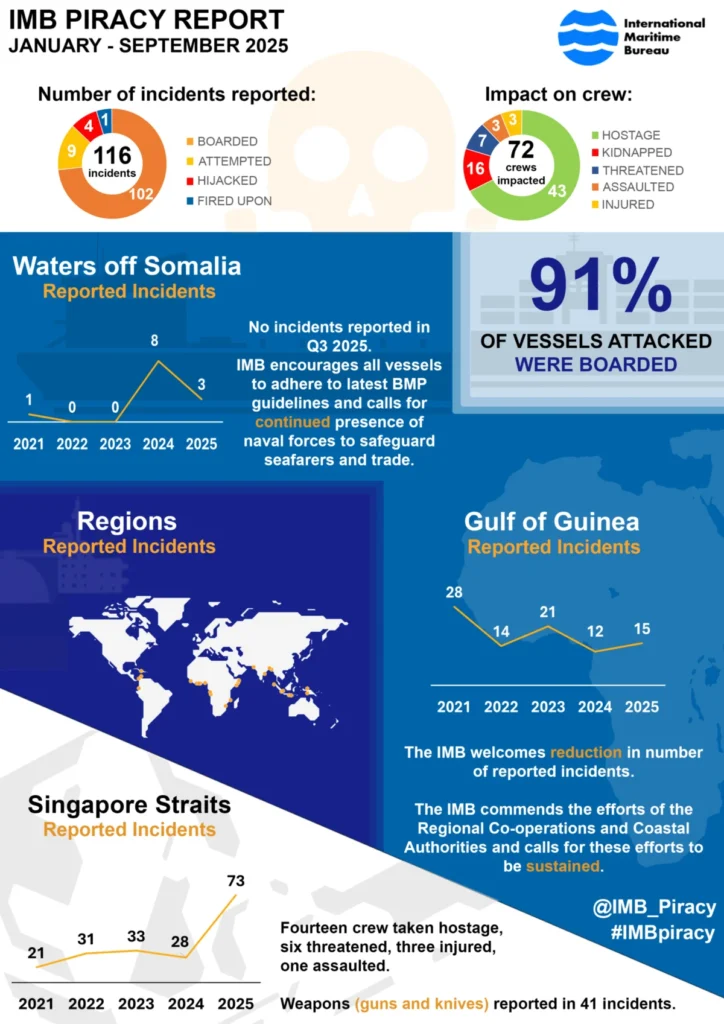
The recently released Piracy and Armed Robbery Against Ships report for the first nine months of 2025 underscores that while the nature of the threat has changed, it has not subsided.
Analysis of Current Trends
The 2025 report serves as a critical barometer for the industry. Data indicates that while "classic" hijackings have seen a marginal decline in certain regions, there is an alarming increase in "opportunistic" armed robberies in anchored vessels, particularly in port areas that are plagued by economic instability.
- Geographic Hotspots: The report identifies specific straits and coastal zones where incident frequency has spiked by 12% compared to the same period in 2024.
- Reporting Ratios: A recurring challenge identified in the data is the "under-reporting" phenomenon. Many owners fear increased insurance premiums or protracted port delays, leading to a failure to report minor boardings. The IMB emphasizes that this lack of data hinders the allocation of state resources, as authorities are less likely to patrol areas where official incident reports are low.
The full report, which provides a granular look at regional vulnerabilities, is available for download through the ICC-CCS portal, serving as a required reading for shipowners and security officers worldwide.
Official Responses and Strategic Collaboration
The IMB Piracy Reporting Centre does not operate in a vacuum. Its authority is bolstered by its deep integration with international maritime bodies, including the International Maritime Organization (IMO) and various regional coast guard forums.
The Stance of the ICC International Maritime Bureau
Michael Howlett, Director of the ICC International Maritime Bureau, has been a vocal advocate for systemic change. In recent statements, Howlett has emphasized that "reporting is not merely a formality; it is a tactical necessity." According to the Bureau, every report filed with the PRC triggers a cascade of alerts that potentially saves lives and protects billions of dollars in cargo.
The IMB encourages shipmasters to prioritize the "Reporting First" protocol. By bypassing local bureaucratic delays and going directly to the PRC, masters ensure that the international maritime community is aware of a threat the moment it manifests.
Implications: The Future of Maritime Safety
The existence of the IMB PRC has profound implications for the future of shipping. As the industry moves toward autonomous vessels and increased digitalization, the security of the maritime supply chain faces new risks.
The Human Element
Despite technological advancements, the human element remains the most vulnerable point. The trauma experienced by seafarers held hostage or subjected to violent boarding is an ongoing humanitarian concern. The PRC’s role in providing support and documentation is essential for the legal and psychological rehabilitation of affected crews.
Economic Impact
Piracy is a "hidden tax" on global trade. When piracy rises, shipping companies increase security measures (such as hiring private maritime security contractors), adjust routes (adding fuel costs), and face higher insurance premiums. These costs are ultimately passed down to the consumer. The IMB PRC’s work in mitigating these risks serves as an economic stabilizer, keeping the cost of goods lower by maintaining the safety of the maritime transit lanes.
Legal and Diplomatic Pressure
The documentation provided by the IMB PRC is often used as evidence in international forums to pressure governments to improve their maritime governance. By shining a light on "ungoverned spaces" at sea, the PRC forces coastal states to take accountability for their territorial waters, often leading to increased naval patrols and the prosecution of perpetrators.
Conclusion: A Call to Vigilance
As we move through the final quarter of 2025, the message from the IMB Piracy Reporting Centre is clear: vigilance is the only deterrent. The sea remains a challenging environment where the rule of law must be constantly enforced. By maintaining a 24-hour watch, providing accurate data, and fostering a global network of communication, the IMB PRC remains an indispensable ally to those who traverse the world’s oceans.
For shipowners, operators, and masters, the path to safety is defined by cooperation. Reporting an incident is not an admission of failure; it is a contribution to the global maritime security architecture.
For more information, inquiries, or to report an incident, please contact:
Michael Howlett
Director, ICC International Maritime Bureau
Tel: +44 207 423 6960
Email: [email protected]
To access the latest intelligence and security reports, visit the official ICC-CCS website.



