The global maritime landscape is currently witnessing a paradoxical trend. While the raw number of reported piracy and armed robbery incidents in several historically volatile maritime corridors has declined significantly during the first nine months of 2024, the underlying risks to human life and operational safety remain acute. New data from the International Maritime Bureau (IMB) highlights a complex picture: a reduction in opportunistic attacks in the Gulf of Guinea and the Singapore Straits, juxtaposed against a resurgence of sophisticated threats off the coast of Somalia.
As global supply chains become increasingly reliant on the stability of these "choke points," the maritime community is re-evaluating its security posture. Despite the positive statistical trends, the human cost—manifesting in kidnappings and hostage-taking—continues to serve as a stark reminder that the seas remain a theater of significant peril.
Main Facts: A Statistical Overview of Maritime Security
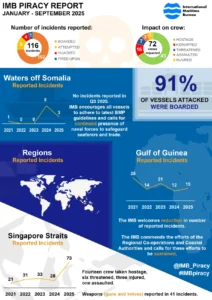
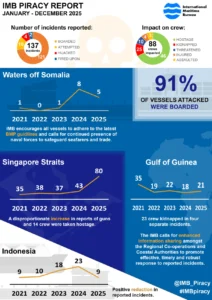
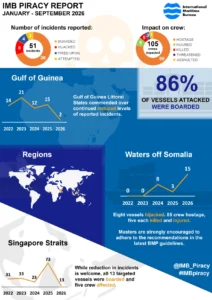
The IMB’s report for the period covering January through September 2024 offers a nuanced narrative of maritime safety. In the Gulf of Guinea, the industry has observed a historic milestone: only 12 incidents were reported, the lowest figure since 1996. This sharp decline suggests that regional naval cooperation and enhanced onboard security measures are yielding tangible results.
Simultaneously, the Singapore Straits—a vital artery for global trade—have seen a notable improvement. Incidents in this region fell to 23, down from 33 during the same period in 2023. However, the data carries a caveat: in 96% of these cases, perpetrators successfully boarded the vessels. This high rate of successful boarding highlights the persistent vulnerability of slow-moving, large-scale commercial vessels to opportunistic attackers.
In contrast, the waters off the coast of Somalia and the Gulf of Aden have emerged as a renewed area of concern. After years of relative dormancy, the region recorded eight incidents, including three vessel hijackings and two instances where vessels were fired upon. These developments suggest a potential re-emergence of piracy networks that many had assumed were largely dismantled.
Chronology: The Evolution of Threats in 2024
First Quarter (January–March): The Somali Resurgence
The year began with a troubling uptick in activity off the Horn of Africa. Following a prolonged period of quiet, the return of hijackings sent shockwaves through the shipping industry. Security analysts pointed to the potential exploitation of the naval focus on the Red Sea crisis as a factor, suggesting that pirates were seizing the opportunity created by the redeployment of international warships.
Second Quarter (April–June): The Gulf of Guinea Shift
During the second quarter, the Gulf of Guinea demonstrated a sustained downward trend. Enhanced patrols by littoral states and a stricter enforcement of the Yaoundé Architecture—a collaborative framework for maritime safety in the region—appeared to suppress the piracy syndicates that had plagued the area for decades. By mid-year, the shipping community felt a cautious sense of optimism regarding the safety of transit through West African waters.
Third Quarter (July–September): Seasonal Lulls and Lingering Risks
As the third quarter progressed, the monsoon season brought a natural, albeit temporary, reprieve to the Somali basin. The IMB confirmed that no incidents were reported between July and September in these waters. While the monsoons physically impede the movement of small skiffs used by pirates, maritime experts caution against interpreting this seasonal lull as a permanent cessation of hostilities.
Supporting Data: Understanding the Human Cost
While aggregate numbers are useful for trend analysis, they often mask the psychological and physical trauma inflicted upon the seafaring community. The 2024 data reveals a disturbing dichotomy: fewer attacks, yet high-stakes violence.
- Kidnappings: 11 crew members have been abducted since the beginning of the year. Abduction is a particularly traumatic form of maritime crime, often involving prolonged captivity and psychological manipulation of the victims’ families.
- Hostage Situations: 21 individuals have been held hostage across various global incidents. These occurrences are frequently categorized as armed robbery rather than piracy, yet the distinction offers little comfort to the crews forced to barricade themselves in citadels while perpetrators roam their decks.
- Success Rates: The 96% boarding success rate in the Singapore Straits is a primary metric of concern. It indicates that despite increased awareness, the physical design and speed of large container vessels make them inherently difficult to defend against small, agile groups operating under the cover of darkness.
Official Responses and Strategic Security Posture
International maritime organizations, including the IMB and the International Maritime Organization (IMO), have responded to these developments with a blend of advocacy and technical guidance.
The IMB’s Stance
The IMB has explicitly urged vessel operators to maintain strict adherence to the latest Best Management Practices (BMP). These practices include the deployment of physical barriers, the maintenance of a constant, vigilant lookout, and the immediate reporting of all suspicious activity. The Bureau emphasizes that complacency is the primary enemy of maritime safety. Even in regions where incident counts are dropping, the Bureau warns that the threat landscape is fluid and can change rapidly due to political instability or economic desperation in coastal communities.
Regional Cooperation
The decline in the Gulf of Guinea is largely attributed to the collaborative efforts of Nigeria and neighboring states. By centralizing reporting and coordinating naval responses, these nations have managed to raise the "cost" of piracy for criminal syndicates. However, the IMB notes that this progress is fragile. Without sustained funding and political will, there is a risk that these criminal elements could regroup as soon as naval presence wanes.
Implications: Navigating a Dangerous Future
The implications of the current maritime security environment are far-reaching, affecting everything from insurance premiums to the mental health of seafarers.
The Risk to Navigation
One of the most profound implications identified by the IMB is the risk that opportunistic, low-level boarding incidents pose to the navigation of massive commercial vessels. A large tanker or container ship, if disrupted by an unexpected boarding while transiting a narrow waterway like the Singapore Straits, can become a hazard to itself and others. If a crew is distracted or forced into a lockdown, the vessel may lose its situational awareness, leading to potential groundings or collisions. In congested waters, this is not just a security issue; it is a critical safety-of-life-at-sea (SOLAS) matter.
The Economic Burden
The resurgence of Somali piracy, even if localized, has a disproportionate impact on the global shipping economy. Insurance premiums for transiting the Indian Ocean have spiked. Furthermore, the necessity of carrying armed guards or taking longer, safer routes increases the cost of freight, which is eventually passed down to the consumer. For the shipping industry, the cost of "security" is becoming a permanent line item that shows little sign of decreasing.
The Human Element
Perhaps the most significant implication is the sustainability of the seafaring profession. The constant threat of being fired upon, hijacked, or kidnapped creates an environment of chronic stress. Many seafarers are choosing to leave the industry, contributing to a global shortage of qualified maritime labor. If the industry cannot guarantee the safety of its workers, the supply chain resilience that the world depends on will inevitably degrade.
Conclusion: A Call to Vigilance
The statistics from the first nine months of 2024 present a mixed message. We are witnessing the effectiveness of coordinated regional action in the Gulf of Guinea and the Singapore Straits, yet we are also seeing the stubborn persistence of piracy as a viable criminal business model in the Horn of Africa.
The maritime industry is currently in a state of "dynamic equilibrium." Security is not a static achievement but an ongoing process. As technology evolves—with the introduction of autonomous vessels and enhanced surveillance—so too do the methods of those who seek to exploit the seas for illicit gain.
For shipowners, captains, and maritime authorities, the message from the IMB remains clear: vigilance is the only reliable defense. The decrease in reported incidents is a cause for cautious celebration, but it should not lead to a relaxation of security protocols. The safety of the crew, the integrity of the vessel, and the security of the global cargo depend on the unwavering application of best practices and international cooperation. As we head into the final quarter of 2024, the maritime community must remain prepared for the unexpected, ensuring that the seas remain open, safe, and secure for all who traverse them.