Since its inception in 2025, Timex Atelier has served as a bold manifesto for the American watchmaking titan. By establishing a premium sub-brand dedicated to Swiss-made craftsmanship, Timex signaled its intent to transcend its historical reputation as the provider of reliable, entry-level timepieces for the masses. Under the visionary direction of Chief Creative Officer Giorgio Galli, the Atelier line has consistently delivered high-end mechanical watches that challenge the industry’s perception of the brand. However, until now, the barrier to entry for this elevated collection remained fixed above the $1,000 threshold.
With the release of the Timex Atelier Chronograph Quartz M1q in September 2026, the brand has finally introduced a bridge between its widely accessible catalog and its luxury-oriented summit. This new timepiece is not merely a "budget" version of the flagship M1a automatic; it is a meticulously engineered alternative that offers a distinct set of specifications, wearability, and aesthetic refinement, all while maintaining the hallmark design language established by the Atelier series.

Main Facts: The Anatomy of the M1q
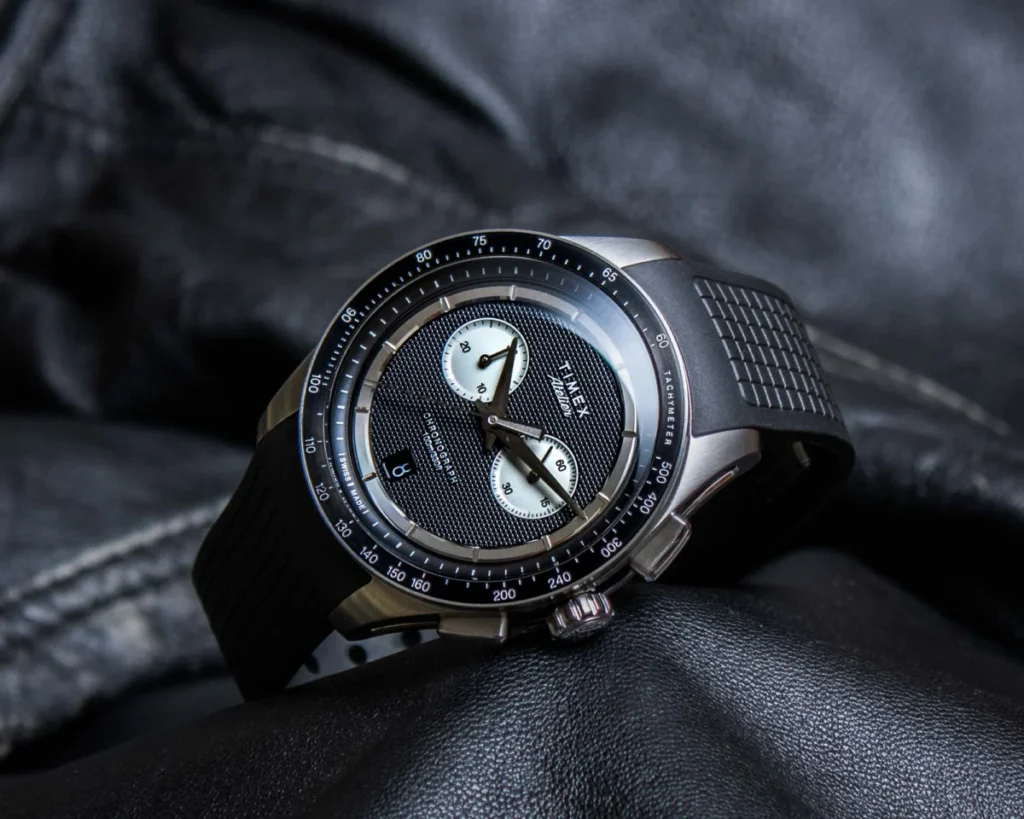
The Timex Atelier Chronograph Quartz M1q is defined by a departure from the titanium construction seen in its automatic predecessors, opting instead for a robust, finely finished stainless steel. Measuring 40mm in diameter and 12.7mm in thickness, the watch presents a more compact and wearable profile than the larger M1a automatic.
The case architecture remains a standout feature, utilizing the skeletonized structure that has become synonymous with the Giorgio Galli design philosophy. This involves a black-finished central case barrel surrounded by an outer steel framework, with deliberate cutouts in the lugs that provide visual depth and structural complexity. Unlike the automatic version, which features an exhibition caseback, the M1q employs a solid, screw-down caseback, contributing to a heightened water resistance of 100 meters—a significant upgrade over the 50-meter rating found on the automatic chronograph.

Chronology: From Giorgio Galli to Atelier
To understand the M1q, one must look at the lineage of Timex’s modern design evolution. The design DNA of the Atelier series is rooted in the Giorgio Galli S2 and S2 Ti series, which first introduced the skeletonized, multi-layered case architecture that has now become a signature.
- 2023-2024: The Giorgio Galli S2 series proves that Timex can compete in the mid-tier market with sophisticated, industrial design.
- 2025: The launch of the Timex Atelier sub-brand cements the transition to "Swiss Made" manufacturing, debuting with the Marine M1a.
- Late 2025: The Timex Atelier Chronograph Automatic M1a Ti arrives, garnering praise for its titanium construction but leaving a gap for those seeking a more compact, quartz-driven, and budget-friendly alternative.
- September 2026: The Timex Atelier Chronograph Quartz M1q is released, marking the first time the brand offers an "Atelier-grade" timepiece under the $800 price point.
Supporting Data: Technical Specifications and Movement
At the core of the M1q is the Swiss-made Ronda Caliber 5021.D. This is not the standard "Swiss Parts" movement often found in high-street watches; rather, it is the premium, 10-jewel, gold-plated version. This choice of movement underscores Timex’s commitment to quality within the Atelier brand, ensuring longevity and reliability that far exceeds the standard battery-powered chronograph.

Key Technical Specs:
- Case Material: Stainless steel with black-finished central case section.
- Dimensions: 40mm diameter; 12.7mm thick; 48.11mm lug-to-lug.
- Crystal: Heavily domed sapphire crystal.
- Movement: Swiss-made Ronda 5021.D (10-jewel quartz).
- Battery Life: Approximately 54 months.
- Water Resistance: 100 meters (screw-down crown).
- Dial: Guilloché pattern with a two-register layout and a 6 o’clock date window.
The chronograph functionality is straightforward, focusing on a centrally mounted seconds hand and a 30-minute totalizer positioned at the 9 o’clock mark. While some purists may lament the lack of a 12-hour register, the layout is balanced, and the inclusion of the guilloché dial texture—a rarity in this price bracket—adds a tactile elegance that prevents the dial from appearing barren.
The Wearability Factor: A Shift in Proportions
For many enthusiasts, the shift to a 40mm case size is the most welcome development. In the world of luxury chronographs, dimensions can often become bloated, especially when mechanical movements are involved. By utilizing a quartz movement, Timex has managed to keep the M1q slim and manageable, particularly for wrists in the 6.5 to 6.75-inch range.

The strap options further reinforce the premium feel. The NBR (nitrile butadiene rubber) strap is a highlight, offering excellent resistance to oils, UV light, and salt water. The integration of quick-release spring bars and a deployant-style folding clasp in brushed stainless steel provides a level of security and convenience that is rarely seen outside of luxury brands.
Implications for the Market
The launch of the M1q at an official retail price of $700 USD (on the rubber strap) has significant implications for the watch market. It effectively disrupts the "luxury-for-the-masses" segment, positioning itself as a direct competitor to mid-range Swiss quartz chronographs from brands like Tissot or Certina.

1. Democratizing the "Atelier" Experience
By lowering the barrier to entry, Timex is inviting a new cohort of collectors into the Atelier ecosystem. These are consumers who appreciate the design language of Giorgio Galli but may not be ready to commit to the premium pricing of a mechanical titanium timepiece.
2. The Quartz Renaissance
While mechanical movements remain the "gold standard" for watch enthusiasts, the M1q proves that there is still significant room for high-end quartz offerings. By emphasizing "Swiss Made" components, gold-plated movements, and superior case finishing, Timex is arguing that the movement type is secondary to the overall build quality and design integrity.

3. A New Benchmark for Timex
The existence of the M1q suggests that Timex is no longer content with being solely a volume-based manufacturer. The Atelier brand acts as a laboratory for the company, allowing it to experiment with complex case architectures and high-end materials without compromising the accessibility of its main catalog.
Official Positioning
Timex has positioned the M1q not as a replacement for its automatic models, but as an essential companion. During the product briefing, representatives noted that the M1q was designed to address feedback from collectors who loved the aesthetics of the M1a but requested something more robust for daily, casual, and aquatic use. The 100-meter water resistance and the use of stainless steel over titanium are direct responses to this desire for a "worry-free" luxury watch.

Conclusion: A Gateway to Luxury
The Timex Atelier Chronograph Quartz M1q is a masterclass in product positioning. It retains the soul of the Giorgio Galli-designed series—the skeletonized lugs, the domed sapphire, and the industrial-chic aesthetic—while stripping away the mechanical complexity that drives up costs.
For the collector who already owns a collection of mechanical pieces, the M1q serves as an ideal "grab-and-go" watch that doesn’t feel like a compromise. For the newcomer, it is a high-quality, Swiss-made entry point into the world of elevated horology. With the M1q, Timex has successfully proven that luxury is not defined by the movement alone, but by the thoughtful integration of design, material science, and the intent behind every finished surface. As Timex continues to refine the Atelier line, the M1q stands as a testament to the brand’s versatility and its enduring commitment to the evolution of the modern wristwatch.