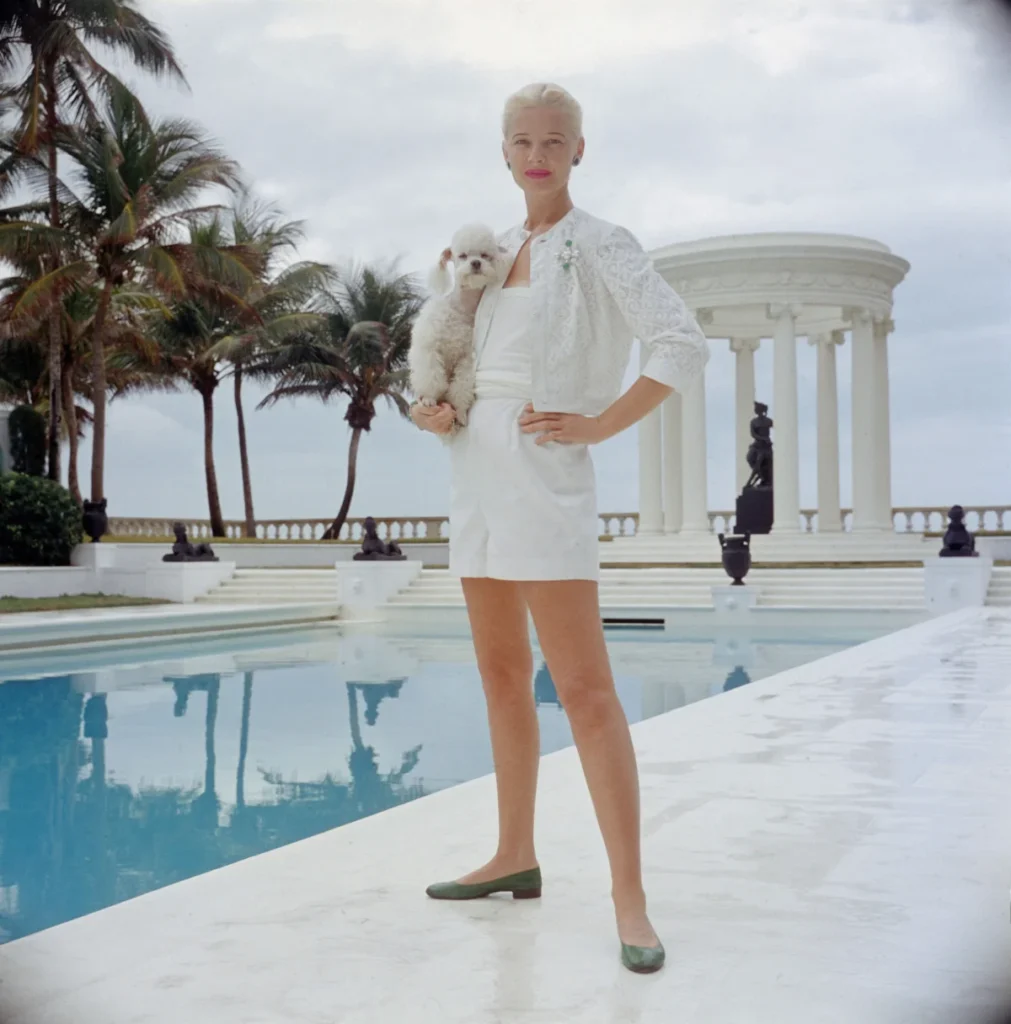
One of Truman Capote’s most legendary "Swans"—the ethereal, impeccably groomed socialites who defined the high-society stratosphere of the 20th century—is making a grand, if quiet, migration south. C.Z. Guest, the woman Capote famously dubbed the "cool vanilla lady," is being immortalized in a sprawling new retrospective.
For the first time, the SCAD FASH Museum of Fashion + Film in Atlanta is dedicating its galleries to the life and wardrobe of this American original. Titled C.Z. Guest: Portrait of an American Style Icon, the exhibition, which opened this Thursday and runs through February 21, serves as both a fashion masterclass and a deep-dive biography into the woman who moved with equal grace through the pages of Vogue and the pastures of her own equestrian estate. Curated in collaboration with Stefano Tonchi and presented by Max Mara—one of the socialite’s favorite ready-to-wear houses—the exhibition is a testament to a life lived in service of effortless elegance.

A Legacy Preserved: The Archive of an Icon
The heart of the exhibition lies in the more than 40 complete ensembles on display. These pieces are not mere museum artifacts; they are personal relics, the "lion’s share" of which were generously donated by Guest’s daughter, Cornelia Guest. These garments are now permanently housed within the SCAD FASH archive, ensuring that the legacy of American sportswear and high-fashion couture remains accessible to future generations of designers.
For Cornelia, the decision to entrust her mother’s collection to an academic institution was deliberate. "I wanted them to be able to see these clothes," she noted during the exhibition’s opening, "to study how everything was created, how they were stitched, the craftsmanship. That was so important to me." By placing the collection at a university-affiliated museum, Cornelia ensures that the construction of the style—the hidden seams and the weight of the fabrics—is as much a part of the history lesson as the public image of the woman who wore them.

A Life in Style: The Chronology of C.Z. Guest
To trace the history of C.Z. Guest’s wardrobe is, in many ways, to trace the evolution of 20th-century fashion. Born Lucy Cochrane in 1920, her ascent into the public eye began early. Voted the "Glamour Girl of Massachusetts North Shore" in a local beauty pageant, the seeds of her public persona were sown long before she reached the stratosphere of New York society. The origin of her iconic nickname, "C.Z.," is a charmingly rugged counterpoint to her polished exterior; it reportedly began when her brother labeled her a "sissy," a moniker that eventually compressed into the punchy, unforgettable initials we know today.
Her journey took a brief, cinematic turn when she moved to Hollywood, securing a walk-on role in the Ziegfeld Follies. However, the spotlight of Tinseltown was fleeting compared to her role as the wife of Winston Frederick Churchill Guest, a polo player and heir whose pedigree was as storied as her own. Their 1947 marriage solidified her place in the upper echelons of the international social circuit, a world where she acted not just as a participant, but as a definitive arbiter of taste.

Throughout the decades, Guest cultivated intimate, working relationships with the greatest designers of her time. The SCAD FASH exhibition highlights this cross-pollination of influences, showcasing pieces from European luminaries like Chanel, Courrèges, and Valentino, alongside New York titans such as Adolfo, Carolina Herrera, and the legendary Mainbocher.
The Mainbocher Influence: Sophisticated Nonchalance
If there is one designer who defined the "C.Z. Guest look," it was Mainbocher. Returning to New York from Paris after World War II, the designer became essential in crafting the image of "sophisticated nonchalance" that became Guest’s signature.

"I like to wear very good suits and his fit so well," Guest once remarked, capturing the essence of her pragmatic approach to luxury. "Besides, everyone doesn’t have them, and that’s important." While the current exhibition may not feature a full suit by the couturier, his spirit is omnipresent through a selection of tailored coats and evening frocks. Most notable is the white gown with intricate gold embroidery that Guest wore to the 2001 Met Gala, an event held to honor her dear friend, Jacqueline Kennedy Onassis.
Thematic Organization: Public Persona vs. Private Reality
Stefano Tonchi, who began the arduous process of curating this collection two years ago after stumbling upon it during a separate project, has organized the exhibition thematically. The galleries open with a photographic study of the duality of Guest’s life. Visitors are greeted by the juxtaposition of Slim Aarons’ sun-drenched, aspirational photography from the Guest estate in Palm Beach, Florida, set against the grit of Tony Palmieri’s paparazzi shots taken for the WWD "Eye" column, which captured her zipping through the frantic, high-stakes Manhattan party circuit.

This duality is mirrored in the clothes. The exhibition oscillates between the "domestic horticulturalist"—the woman seen in Max Mara short shorts or rugged, functional jodhpurs by Huntsman—and the "socialite," draped in floral-embroidered Oscar de la Renta. It was this inimitable range that landed her on the International Best Dressed List in 1959, an honor that recognized not just her clothes, but her ability to wear them with a purpose that felt entirely her own.
Official Perspectives and Personal Memories
For those who knew her, the "socialite" label was always an incomplete description of her character. Cornelia Guest is vocal about wanting visitors to see beyond the gala gowns. "I hope people really realize that my mother was not just a socialite," she said. "Yes, she was very social, but her heart belonged in the country with her family and her horses in her garden."

Cornelia fondly recalls their time in Middleburg, Virginia, where the equestrian life served as a foundation for their relationship. "We would spend a lot of time in Middleburg, going cross-country riding and she would teach me so much about the rivers and all the animals, so that was a very special time between the two of us." These anecdotes provide a necessary, grounding context for the exhibit, turning the "vanilla lady" into a human being with dirt under her fingernails and a deep reverence for the natural world.
Implications for Modern Fashion
Sixteen years after her death from ovarian cancer, C.Z. Guest remains a vital, relevant reference point for contemporary designers. In an era where "personal branding" is the currency of the digital age, Guest’s approach serves as a masterclass in authenticity.

"As designers focus on the many facets of a woman’s personality, C.Z. becomes a natural reference," Tonchi observed. "She was able to adapt every fashion to her style. She always dressed with a purpose and never to impress. Her wardrobe choices are never fashion statements, but, in a much more contemporary way, self-statements."
The implication for modern observers is clear: style is not about the consumption of the latest trend, but the curation of a wardrobe that reflects one’s own life and values. By honoring her history through this exhibition, SCAD FASH is not merely preserving the clothes of the past; it is preserving a philosophy of self-expression that remains, in the truest sense, timeless.

C.Z. Guest: Portrait of an American Style Icon is currently on display at the SCAD FASH Museum of Fashion + Film. It is a mandatory pilgrimage for anyone interested in the intersection of American biography, the history of couture, and the enduring power of a well-lived life.