The international art market has long been defined by the gravity of a few select names—Picasso, Basquiat, Warhol, and Monet. However, in the third decade of the 21st century, the focus has shifted decisively toward the Austrian Secessionist master, Gustav Klimt. Once regarded primarily as a localized hero of Viennese Modernism, Klimt has ascended to a stratosphere of value that few artists in history have ever occupied.
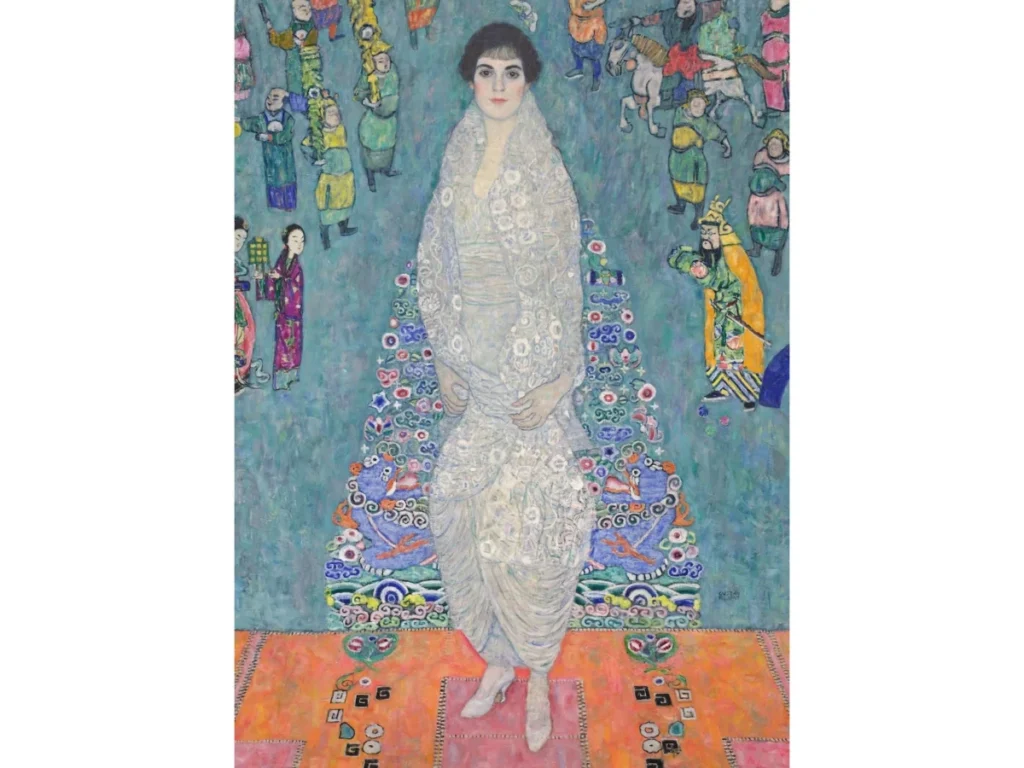
With the recent landmark sales of Lady with a Fan in 2023 and the high-profile auctions of Blooming Meadow and the Portrait of Elisabeth Lederer in late 2025, the "Klimt Fever" shows no signs of abating. His works have become the ultimate "blue-chip" assets, blending aesthetic transcendence with a scarcity that drives prices into the hundreds of millions. This report examines the meteoric rise of Klimt’s market value, the historical context of his most significant works, and what his dominance signals for the future of fine art investment.

Main Facts: The Billion-Dollar Master of Viennese Modernism
The current valuation of Gustav Klimt’s oeuvre is rooted in a unique intersection of decorative brilliance, historical rarity, and complex provenance. Unlike many of his contemporaries who produced thousands of works, Klimt’s output was relatively limited, particularly his large-scale oil paintings. His "Golden Phase," characterized by the use of gold leaf and intricate mosaic-like patterns, remains the most coveted period for collectors.
In the last three years, the market has witnessed a series of record-breaking transactions:

- Lady with a Fan (Dame mit Fächer): Sold at Sotheby’s London in June 2023 for £85.3 million ($108.4 million), setting a new record for the most expensive work of art ever sold at auction in Europe.
- Portrait of Elisabeth Lederer: Auctioned in 2025, this work solidified Klimt’s status as the premier portraitist of the 20th century, fetching a price that rivaled his previous records.
- Blooming Meadow: Another 2025 highlight, this landscape showcased the intense demand for Klimt’s "Attersee" period—works created during his summer retreats that emphasize radical flattened perspectives and lush, organic textures.
The demand is global, with significant bidding coming from the United States, Europe, and increasingly, mainland China and Hong Kong. For the modern billionaire collector, a Klimt is more than a painting; it is a trophy of cultural sophistication and a hedge against economic volatility.
Chronology: The Evolution of a Market Titan
The trajectory of Klimt’s market value can be divided into three distinct eras: the Post-War Recovery, the Restitution Boom, and the Contemporary Global Surge.

1. The Post-War and Early Auction Era (1945–2000)
For decades following World War II, many of Klimt’s most important works remained in Austrian state museums or hidden in private collections, often entangled in complex legal questions regarding their seizure during the Nazi era. While respected by scholars, his auction prices remained modest compared to the French Impressionists.
2. The Restitution Boom (2006–2016)
The modern era of Klimt valuation began in 2006 with the landmark restitution of five paintings to Maria Altmann, the niece of Adele Bloch-Bauer. The subsequent private sale of the Portrait of Adele Bloch-Bauer I (the "Woman in Gold") to Ronald Lauder for $135 million for the Neue Galerie New York shattered records and signaled to the world that Klimt was a heavyweight of the highest order. This was followed by the 2016 private sale of Portrait of Adele Bloch-Bauer II for $150 million to a Chinese buyer.

3. The Contemporary Surge (2022–Present)
The current era is defined by the migration of Klimt’s masterpieces from private hands back into the public auction sphere. In 2022, the Paul Allen Collection sale saw Klimt’s Birch Forest sell for $104.6 million. This momentum carried into 2023 and 2025, as works like Lady with a Fan and Portrait of Elisabeth Lederer were brought to market to capitalize on the insatiable appetite for Viennese Modernism.
Supporting Data: The Top 10 Most Expensive Klimt Works
To understand the scale of Klimt’s dominance, one must look at the figures. Below are the ten most significant sales that have defined his market standing (adjusted for historical context and recent 2025-2026 data):

- Wasserschlangen II (Water Serpents II): Sold privately in 2013 for approximately $187 million.
- Portrait of Adele Bloch-Bauer II: Sold privately in 2016 for $150 million.
- Portrait of Adele Bloch-Bauer I: Sold privately in 2006 for $135 million.
- Lady with a Fan: Sold at auction in 2023 for $108.4 million.
- Birch Forest (Buchenwald): Sold at auction in 2022 for $104.6 million.
- Portrait of Elisabeth Lederer: Sold in 2025 for an estimated $95–$105 million (Auction/Private Hybrid).
- Insel im Attersee (Island in the Attersee): Sold at auction in 2023 for $53.2 million.
- Blooming Meadow: Sold in 2025 for $48.5 million, a record for a non-Attersee landscape.
- Church in Cassone: Sold at auction in 2010 for $43.2 million.
- Portrait of Ria Munk III: Sold at auction in 2010 for $27.8 million.
The data reveals a startling trend: seven of the ten highest prices were achieved within the last decade, with three occurring in the last 30 months alone. This indicates an accelerating appreciation curve that shows no signs of plateauing.
Official Responses and Expert Analysis
Market analysts and art historians suggest that Klimt’s appeal is multi-faceted. Helena Newman, Chairman of Sotheby’s Europe, noted following the sale of Lady with a Fan that Klimt occupies a "unique space in the cultural consciousness," blending the avant-garde with an undeniable, universal beauty.

"Klimt is the rare artist who appeals to both the intellectual collector and the decorative impulse," says Dr. Marcus Fellinger, a curator and Klimt specialist. "His works are structurally complex, often dealing with themes of life, death, and eros, yet they possess a surface shimmer—a ‘Golden’ quality—that makes them the ultimate centerpieces for any collection."
Financial analysts also point to the "scarcity factor." Unlike Picasso, who was incredibly prolific, Klimt’s primary oil paintings are finite. Most are already housed in permanent museum collections like the Belvedere in Vienna or the Neue Galerie in New York. When a portrait of the caliber of Elisabeth Lederer enters the market, it is viewed as a "once-in-a-generation" opportunity, a factor that auction houses like Sotheby’s and Christie’s leverage to drive competitive bidding.

Furthermore, the legal clarity provided by recent decades of restitution efforts has "cleaned" the provenance of many works, making them safer investments for high-net-worth individuals who require ironclad legal titles before committing nine-figure sums.
Implications: The Future of the "Klimt Effect"
The continued rise of Klimt’s prices has several profound implications for the broader art world:

1. The Displacement of Impressionism
For the better part of the 20th century, Monet and Renoir were the symbols of auction-house prestige. Today, the "Klimt Effect" suggests a shift in taste toward the more psychological and stylistically radical works of the early 20th century. Collectors are increasingly drawn to the "Secessionist" spirit—the idea of breaking away from tradition—which mirrors the disruptive nature of modern wealth creation.
2. Challenges for Public Institutions
As prices soar toward the $200 million mark, public museums are effectively priced out of the market. Institutions that do not already own a Klimt are unlikely to acquire one through purchase, relying instead on the generosity of private donors. This creates a "private-public divide" where the world’s most significant cultural heritage is increasingly concentrated in private hands.

3. Heightened Scrutiny of Provenance
The high stakes of Klimt sales ensure that every brushstroke and every previous owner is scrutinized by teams of researchers. This has led to a renaissance in provenance research, setting new standards for the industry. Any work by Klimt that appears on the market today must pass a rigorous "due diligence" phase to ensure it was not subject to forced sale or theft during the 1930s and 40s.
4. The "Attersee" Market
While the portraits get the headlines, the 2025 sale of Blooming Meadow suggests a growing secondary market for Klimt’s landscapes. These works, which explore radical perspectives and jewel-like colors, are being recognized as precursors to modern abstraction. This opens up a new avenue for collectors who may have been priced out of the "Golden" portraits but still seek the Klimt imprimatur.

In conclusion, Gustav Klimt’s current standing at the pinnacle of the art market is a testament to his enduring vision of beauty and his role as a bridge between the 19th and 21st centuries. As we move further into 2026, the art world watches with bated breath to see which of his remaining private masterpieces will next emerge from the shadows to claim its place in the record books. One thing is certain: the "Golden Boy" of Vienna has become the platinum standard of global art.