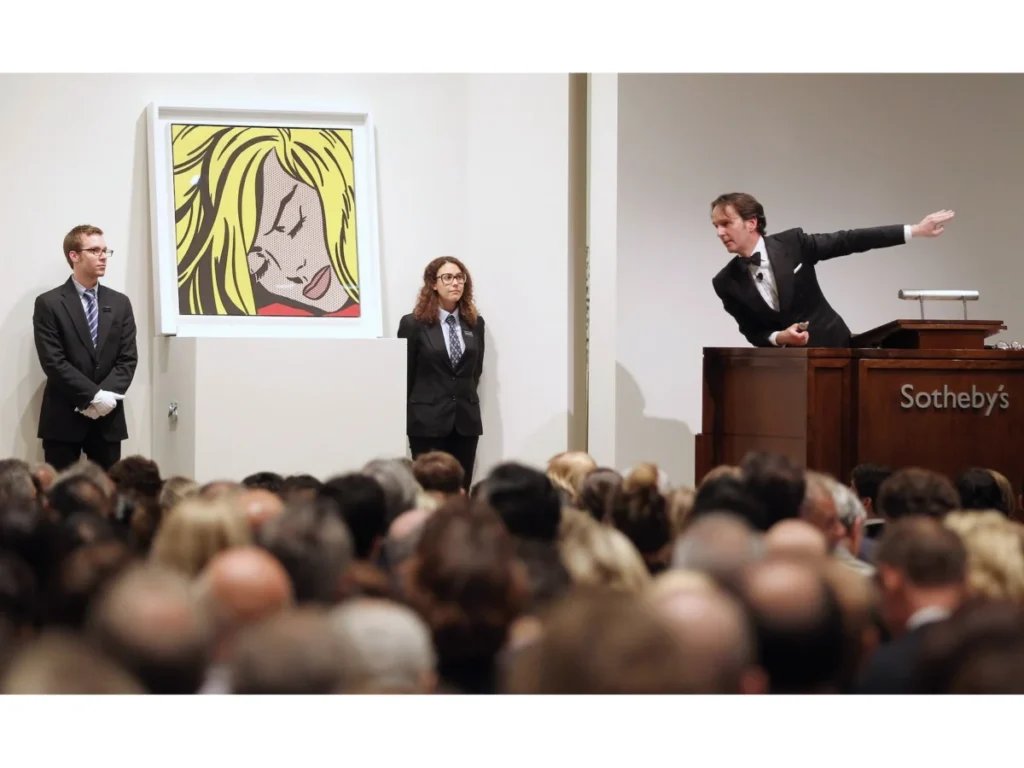
NEW YORK — In the high-stakes arena of blue-chip contemporary art, few names command as much reverence or financial firepower as Roy Lichtenstein. Once dismissed by critics in the early 1960s as a "copycat" or, as Life magazine infamously posited in 1946, "one of the worst artists in America," Lichtenstein has undergone a posthumous transformation into a cornerstone of the global art economy. Today, his signature Ben-Day dots and comic-book aesthetics are not merely stylistic choices; they are symbols of an asset class that rivals gold and real estate in its stability and appreciation.
The recent recalibration of Lichtenstein’s market value—highlighted by the staggering $165 million private sale of his 1962 painting Masterpiece—underscores a broader trend in the art world: the canonization of Pop Art as the definitive visual language of the 20th century. As auction houses prepare for the next cycle of contemporary sales, Lichtenstein remains the "gold standard" for collectors seeking a fusion of historical significance and aesthetic impact.

Main Facts: A Market Defined by Records
Roy Lichtenstein (1923–1997) currently sits in the pantheon of the "Hundred Million Dollar Club," an elite group of artists whose works have crossed nine-figure thresholds. While his public auction record is held by the 1964 work Nurse, which fetched $95.4 million at Christie’s New York in 2015, his private market performance suggests an even higher ceiling.
The 2017 acquisition of Masterpiece by hedge fund billionaire Steven A. Cohen for $165 million remains one of the highest prices ever paid for a single work of art. This sale was not just a financial transaction but a cultural milestone. The seller, legendary philanthropist Agnes Gund, utilized the proceeds to launch the Art for Justice Fund, an initiative dedicated to criminal justice reform. This act effectively linked Lichtenstein’s commercial peak with a profound social legacy, illustrating how the valuation of "low-brow" comic imagery can drive high-stakes social change.

Lichtenstein’s market appeal is rooted in his technical precision. Unlike the expressive, often chaotic brushwork of the Abstract Expressionists who preceded him, Lichtenstein utilized a cool, detached method. By employing stencils to create Ben-Day dots—a printing technique used in cheap comic books and newspapers—he bridged the gap between mechanical reproduction and fine art. This "industrial" quality has made his work particularly appealing to modern collectors who value clean lines, bold colors, and the ironic deconstruction of American consumer culture.
Chronology: From Parody to Pantheon
The trajectory of Lichtenstein’s career is a study in the persistence of vision against critical headwinds.

The 1960s: The Breakthrough
The "Pop" explosion began in earnest in 1961 when Lichtenstein produced Look Mickey, a work inspired by a challenge from his son. This piece marked his departure from Abstract Expressionism and his first foray into the world of Disney and pulp fiction. By 1962, he had his first solo show at the Leo Castelli Gallery, which sold out before it even opened. It was during this period that he produced his most iconic "war and romance" works, such as Whaam! and Drowning Girl.
The 1970s and 80s: Diversification
After establishing his comic-strip style, Lichtenstein began to apply his dot-pattern technique to more "sophisticated" subjects. He created the Brushstrokes series, which parodied the "heroic" gestures of artists like Jackson Pollock. He also began his Mirrors series and his Entablatures, moving into architectural and abstract forms while maintaining his trademark graphic clarity.

The 1990s: The Final Masterworks
In the years leading up to his death in 1997, Lichtenstein turned his attention to large-scale interiors and a series of "Nudes." These works, such as Nude with Yellow Flower (which sold for $46.2 million in 2020), revisited the comic-book heroines of his youth but with a new sense of spatial complexity and painterly maturity.
Post-2000: The Secondary Market Surge
Following his death, the scarcity of his 1960s masterpieces drove prices into the stratosphere. As major museums like the Tate Modern and the Art Institute of Chicago held retrospective exhibitions, the "trophy hunter" class of collectors began to view Lichtenstein as an essential component of any world-class collection, leading to the record-breaking sales of the 2010s.

Supporting Data: The Top Public Auction Sales
While private sales often remain shrouded in non-disclosure agreements, Lichtenstein’s public auction history provides a transparent look at his rising value. The following works represent the apex of his public market:
- "Nurse" (1964): Sold for $95.4 million at Christie’s in 2015. This work is considered the quintessential Lichtenstein "heroine," embodying the melodrama of mid-century pulp fiction.
- "Woman with Flowered Hat" (1963): Sold for $56.1 million at Christie’s in 2013. This painting is a Pop Art reimagining of a Pablo Picasso portrait, showcasing Lichtenstein’s ability to "translate" art history into his own vernacular.
- "Nude with Joyous Painting" (1994): Sold for $46.2 million at Christie’s in 2020. This late-career masterpiece proved that the artist’s 1990s output could compete with his 1960s "Golden Era" works.
- "Sleeping Girl" (1964): Sold for $44.8 million at Sotheby’s in 2012. A classic example of his romance-themed works, featuring the bold yellow hair and primary colors that define his brand.
- "I Can See the Whole Room! … and There’s Nobody in It!" (1961): Sold for $43.2 million at Christie’s in 2011. This work is historically significant as one of the earliest examples of his comic-inspired style.
Official Responses and Historical Context
The art world’s "official" response to Lichtenstein has shifted from skepticism to total embrace. In his early years, Lichtenstein was often accused of plagiarism by the comic book illustrators whose work he used as source material. However, art historians have since argued that his work was a transformative critique, not a mere copy.

Andy Warhol, the other titan of Pop Art, famously acknowledged Lichtenstein’s superiority in the comic-book genre. Warhol had experimented with his own Batman and Superman paintings but abandoned them after seeing Lichtenstein’s work at the Castelli Gallery. Warhol told curator Henry Geldzahler, "Roy was doing comics so well," a rare admission of defeat from an artist who was notoriously competitive.
The late Leo Castelli, Lichtenstein’s long-time dealer, often remarked on the artist’s "radical humility." Castelli noted that while Lichtenstein’s work was loud and aggressive on the canvas, the man himself was quiet and scholarly. This duality—the "gentle iconoclast"—has helped maintain the artist’s reputation as a thoughtful intellectual rather than a mere provocateur.

Current museum curators emphasize Lichtenstein’s role in "democratizing" art. By elevating the mundane and the commercial to the level of the "Old Masters," he challenged the elitism of the art gallery. As a spokesperson for the Roy Lichtenstein Foundation recently noted, "Roy’s work continues to resonate because it speaks the language of our visual culture—a culture that is increasingly mediated by screens, dots, and pixels."
Implications: The Future of the Lichtenstein Market
The continued rise of Lichtenstein’s prices has several implications for the broader art market and cultural landscape:

1. The "Trophy" Effect
Lichtenstein’s works have become "trophy assets." For ultra-high-net-worth individuals, owning a Lichtenstein is a signal of both immense wealth and cultural literacy. This "trophy" status ensures that even in economic downturns, the demand for his top-tier 1960s works remains insulated from market volatility.
2. The Bridge Between High and Low Culture
Lichtenstein’s success paved the way for contemporary artists like Jeff Koons, Takashi Murakami, and KAWS. By proving that "commercial" imagery could be sold for record prices, he redefined the boundaries of what is considered "fine art." The current boom in digital art and NFTs can trace its lineage directly back to Lichtenstein’s embrace of mechanical reproduction.

3. Philanthropic Potential
The sale of Masterpiece by Agnes Gund set a new precedent for "art for social good." It demonstrated that the massive appreciation in art values can be harnessed for philanthropy. As more aging collectors look to liquidate their holdings, we may see more Lichtenstein works being used to fund foundations and social initiatives, turning 20th-century pop culture into 21st-century social capital.
4. Conservation and Legacy
As his works age, the Lichtenstein Foundation faces the unique challenge of preserving paintings made with "Magna"—a brand of acrylic resin paint that Lichtenstein favored. The technical preservation of his pristine surfaces and precise dots is now a multi-million dollar industry in itself, ensuring that his visual "noise" remains crystal clear for future generations.

In conclusion, Roy Lichtenstein’s work is no longer just a parody of the American dream; it is a central pillar of the American art canon. Whether viewed through the lens of a $165 million price tag or the intricate patterns of a Ben-Day dot, his influence is indelible. As long as there is a market for bold ideas and iconic imagery, Lichtenstein’s "Sleeping Girls" and "Nurses" will continue to command the world’s attention—and its highest prices.