

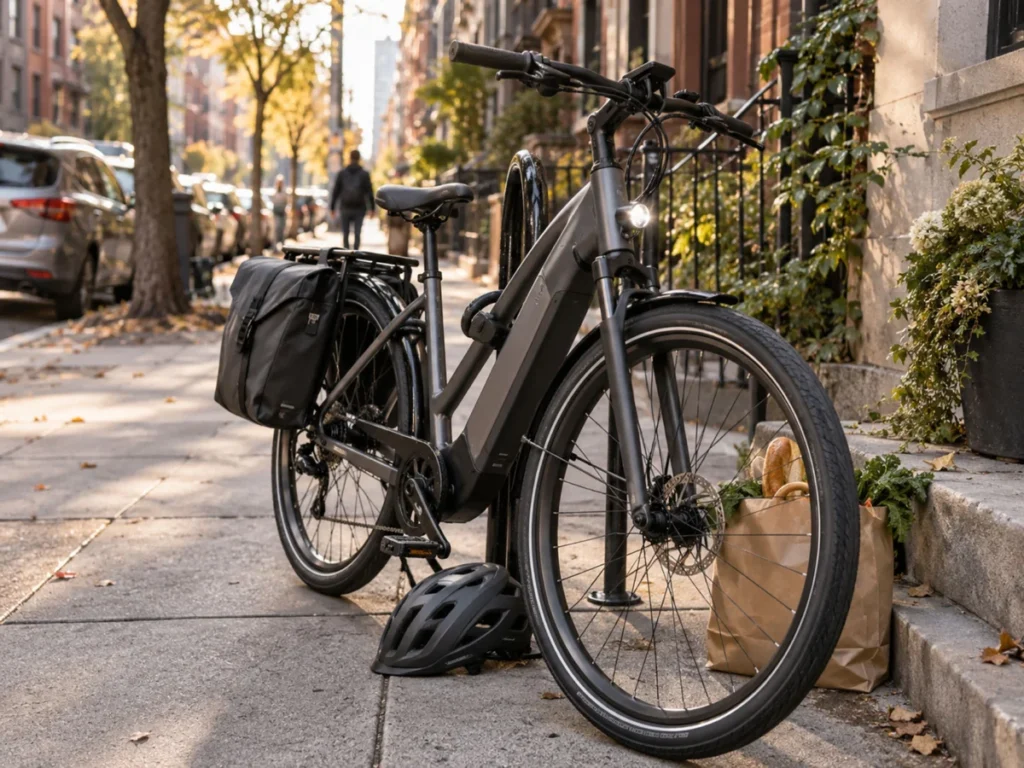
For millions of city dwellers, the personal automobile has become a paradox: it is the most expensive tool they own, yet it remains the least utilized. It sits idle for 95% of the day, yet it demands a constant drip of capital through insurance, tax, maintenance, and the hidden, escalating cost of urban parking. As metropolitan congestion reaches record levels and fuel costs remain volatile, a quiet revolution is taking place on city streets. The e-bike is moving from a niche hobbyist item to a legitimate, high-utility alternative to the traditional car.
While an e-bike cannot replace a vehicle for a cross-country family holiday, it is proving to be a formidable challenger for the everyday urban commute. The arithmetic is compelling, the time savings are tangible, and the environmental implications are profound.
The Economic Realities: A Tale of Two Vehicles
To understand the shift toward electric mobility, one must look at the "hidden" economics of car ownership. Most drivers calculate the cost of a trip based on the price of fuel. However, this ignores the massive "fixed cost" anchor of a vehicle. Even when parked, a car loses value through depreciation, requires insurance, and often necessitates expensive residential parking permits.
Comparative Annual Cost Analysis (Estimates)
| Cost Item | Typical Car (Per Year) | Typical E-Bike (Per Year) |
|---|---|---|
| Purchase / Financing | €4,000 – €8,000 | €800 – €1,500 (One-off) |
| Insurance | €400 – €1,200 | €50 – €150 (Optional) |
| Fuel / Electricity | €800 – €2,000 | €10 – €30 |
| Maintenance | €400 – €1,000 | €50 – €150 |
| Parking | €200 – €1,500 | Free / Minimal |
Note: These figures are based on European market averages. Variable costs such as road tolls and urban congestion charges are excluded.
The data indicates that running an e-bike costs roughly 90% less per kilometer than operating a mid-sized passenger car. For the average commuter, the initial purchase price of a high-quality electric bike is often recouped within the first 12 to 24 months through savings on parking fees and fuel alone.
Chronology of the Shift: From Novelty to Necessity
The transition toward e-bike adoption has not happened overnight. It has been a decade-long evolution driven by three distinct phases:
- The Early Adoption (2015–2018): E-bikes were primarily viewed as recreational equipment for the elderly or mountain biking enthusiasts. Technology was limited by heavy lead-acid or early-generation lithium-ion batteries with short ranges.
- The Infrastructure Pivot (2019–2021): Many major cities began reallocating road space to accommodate cycling lanes. Simultaneously, advancements in motor efficiency and battery energy density allowed for lighter, more capable frames.
- The Mainstream Integration (2022–Present): With the rise of "micro-mobility" and cargo-capable e-bikes, the vehicle moved from a "fun way to get to work" to a "utility vehicle for the household." Companies like Pixar Bikes have pushed the envelope, offering load-rated frames that can handle up to 250kg, finally making the "car-free" lifestyle a practical reality for families.
Supporting Data: Why Speed is a Relative Concept
A common objection to the e-bike is the assumption that a car is inherently faster. While a car’s top speed is significantly higher, "door-to-door" travel time tells a different story in urban environments.
In high-density cities, traffic congestion and the "parking hunt"—the time spent circling blocks to find a space—often negate the speed advantages of an automobile. Studies in major European cities show that for trips under 8–10 kilometers, the e-bike is consistently faster. By utilizing dedicated cycle lanes and skipping gridlock, the average e-bike rider maintains a steady speed of 20–25 km/h, arriving at their destination with the precision of a clock.
Furthermore, the "range anxiety" often associated with e-bikes is largely overstated. With modern 500–650 Wh batteries, a rider can comfortably traverse 40–80 kilometers on a single charge. For the vast majority of citizens, whose daily commute is under 15 kilometers, an e-bike provides more than enough overhead for multiple trips without needing to plug in.
Official Responses and Policy Implications
Urban planners and municipal governments are increasingly shifting their support toward e-bike infrastructure. In several European capitals, city councils have introduced direct subsidies for e-bike purchases, citing the potential for reduced noise pollution, improved air quality, and lower infrastructure wear and tear.
"The goal is not to eliminate the car, but to right-size the vehicle for the task," says an urban transport policy analyst. "If you are moving one person and a laptop, a two-ton steel cage is an inefficient tool. We are seeing policy shifts that treat e-bikes not as ‘bicycles,’ but as essential transit assets."
However, challenges remain. Safety on roads shared with heavy vehicles and the lack of secure bike storage in older housing developments are frequently cited by local authorities as the next hurdles to overcome. Several cities are now trialing "bike-parking hubs" and mandatory infrastructure requirements for new commercial developments to address these concerns.
Practical Implications: Is the Switch Right for You?
Making the switch requires a shift in mindset. It is not about a total abandonment of the automobile, but rather a hybrid approach to mobility.
The Two-Week Test
Before selling a vehicle, experts recommend a two-week audit. Track every trip made:
- The Daily Commute: Can it be done on a bike?
- The Grocery Run: Could a rear rack or front basket handle the load?
- The Rare Trip: Are there instances—moving large furniture, heavy weather, or 50km+ journeys—where a car is essential?
For most, the audit reveals that 60–80% of their weekly driving could be handled by an e-bike. The remaining 20% can be managed through a combination of public transport, car-sharing services, or rental vehicles. This "hybrid" model is where the highest financial gains are realized, as it allows the owner to dispose of a second family car entirely.
Addressing the "Gaps"
- Cargo Capacity: For families, the "long-tail" or "front-loader" cargo e-bike is a game-changer. These bikes are designed to carry two children and groceries, effectively replacing the school run vehicle.
- Weather and Fitness: Modern commuter e-bikes come with mudguards, integrated lighting, and robust electrical systems designed to withstand rain. Furthermore, the pedal-assist nature of the bike ensures that the rider arrives at work without the sweat associated with traditional cycling, making it a professional-grade transport solution.
- The "Folding" Advantage: For those who rely on trains, a folding e-bike offers a unique, seamless door-to-door experience. It bridges the "last mile" gap that public transport often fails to cover.
The Hidden Value: Health and Quality of Life
Beyond the balance sheet, there is the undeniable impact on personal well-being. Research consistently demonstrates that individuals who switch to active commuting—even with electric assist—report higher levels of physical activity than those who commute by car. This uptick in daily movement correlates with better cardiovascular health, lower stress levels, and increased productivity at work.
Moreover, the psychological "parking stress"—that recurring anxiety of finding a spot—is eliminated. The ability to park directly in front of an office or a store fundamentally changes the rhythm of a person’s day, replacing a tense, congested commute with a predictable, outdoor-adjacent experience.
Final Words: A Rational Path Forward
The argument for the e-bike is not an ideological one; it is a mathematical one. As urban centers become more crowded and the cost of maintaining a private, fossil-fuel-dependent vehicle rises, the utility of the e-bike becomes impossible to ignore.
By choosing the right tool for the right job, modern citizens can unlock thousands of euros in annual savings while simultaneously contributing to a quieter, cleaner, and more efficient city. The future of urban mobility is not necessarily about the total death of the car, but rather the death of the unnecessary car. For the 60–80% of trips that dominate our lives, the answer is already here—it’s electric, it’s efficient, and it’s waiting on the rack.



