For the past 50 years, the concept of luxury has acted as a compass for the modern world, signaling not just what we desire, but what comes next. It is a landscape defined by radical shifts in technology, aesthetics, and lifestyle. When Ferrari unleashed the Testarossa, it redefined the visual language of speed. When the Concorde bridged continents in a matter of hours, it shrank the globe. Fashion houses like Giorgio Armani and Brunello Cucinelli dismantled the rigid structures of the past to offer a new, fluid silhouette of elegance, while the Patek Philippe Nautilus proved that true prestige could be found in stainless steel rather than just precious metals.

From the high-stakes world of fine art auctions—where a single painting can command nearly half a billion dollars—to the quiet, secluded retreats of the world’s most exclusive villas, these 74 objects, people, and experiences have done more than simply occupy our wish lists. They have fundamentally changed how we live, travel, consume, and perceive the world around us.

The 1960s and 1970s: The Dawn of Modern Status
The Rolls-Royce Silver Shadow (1965)
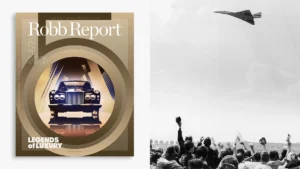
Following the austerity of the post-World War II era, the art of coachbuilding began to fade as mass-market efficiency took hold. Rolls-Royce defied this trend in 1965 with the introduction of the Silver Shadow. Eschewing the traditional separate chassis for a modern monocoque construction, the Silver Shadow offered a lighter, more spacious, and more comfortable ride. It was a technological leap that remained the gold standard of luxury for over a decade, famously gracing the inaugural cover of Robb Report in 1976.

The Judgment of Paris (1976)
On May 24, 1976, the wine world was irrevocably altered at the InterContinental Paris. British merchant Steven Spurrier organized a blind tasting pitting the best of Bordeaux and Burgundy against rising Californian vintages from Napa Valley. The expectation was a French romp; the reality was an upset that shattered the myth of European wine supremacy. By placing Chateau Montelena and Stag’s Leap Wine Cellars at the top of their categories, the event put Napa Valley on the global map and democratized the hierarchy of fine wine.

Studio 54 (1977)
In the annals of nightlife, no name carries more weight than Studio 54. Opened in a former television studio in Manhattan, the club was a masterclass in the economy of desire. Co-founders Steve Rubell and Ian Schrager turned the "door policy" into a high-stakes psychological game, where access itself was the ultimate luxury. It was a chaotic, beautiful, and unapologetically excessive petri dish of celebrity, sexuality, and disco, proving that the most valuable commodity in a city of millions is the right to get inside.

The 1980s: Ambition, Excess, and the Digital Pivot
Giorgio Armani’s Unstructured Suit (1980)
Giorgio Armani didn’t just design clothing; he dismantled the sartorial patriarchy. By removing shoulder pads and stiff linings, he introduced a languid, flowing silhouette that prioritized ease as the ultimate form of elegance. The look reached its apotheosis in the 1980 film American Gigolo, where Richard Gere’s wardrobe became as iconic as his performance. Armani turned the T-shirt-under-a-jacket look into a global uniform, bridging the gap between red-carpet formality and lounge-like comfort.

The Motorola DynaTAC 8000X (1984)
Before smartphones were in every pocket, the Motorola DynaTAC 8000X—the "Brick"—was a bulky, $3,995 badge of power. It offered just 30 minutes of talk time after a 10-hour charge, yet for the executive of the 1980s, it was essential. It served as a loud signal that the bearer’s time was too valuable to be tethered to an office desk. As Gordon Gekko famously barked in Wall Street, "Money never sleeps," and the DynaTAC ensured you didn’t have to either.

The Hermès Birkin Bag (1984)
The genesis of the world’s most exclusive handbag is now the stuff of legend: a chance meeting between actress Jane Birkin and Hermès chairman Jean-Louis Dumas on a flight from Paris to London. After Birkin’s belongings spilled, she expressed a need for a bag that was both practical and chic. The resulting design is perhaps the most potent status symbol in fashion, with a secondary market value that often eclipses high-performance sports cars.

The 1990s: Technological Breakthroughs and Cultural Shifts
The McLaren F1 (1992)
Gordon Murray’s 1992 masterpiece remains the high-water mark for the supercar. With its three-seat cockpit, central driving position, and a naturally aspirated V-12 engine, it reached a staggering 240 mph—a record that stood for years. The F1 was not just a car; it was an engineering manifesto that proved performance could be achieved through obsessive lightweight design and purity of purpose.

The Infinity Pool (Early 1990s)
While the Hotel du Cap-Eden-Roc had long been a fixture of the French Riviera, the Oetker family’s decision in the early 1990s to transform its saltwater pool into an "infinity" edge was a stroke of architectural genius. It created the illusion of water dissolving into the Mediterranean, a visual trick that became a prerequisite for every five-star resort thereafter. Today, the infinity pool is the ultimate Instagram-ready trope, but its roots lie in the quiet, sun-drenched glamour of the Côte d’Azur.

The 2000s and Beyond: The New Frontier of Luxury
Noma (2003)
René Redzepi’s Noma did more than serve food; it initiated a culinary philosophy that swept the globe. By championing "New Nordic" cuisine—foraging, extreme seasonality, and complex fermentation—Redzepi challenged the hegemony of French technique. While the restaurant’s later years have been clouded by controversy regarding its labor practices, its impact on the modern fine-dining experience is undeniable, turning the plate into a map of the local landscape.

The Rise of the Supervilla (2020s)
If the pandemic taught the ultra-wealthy anything, it was that total control over one’s environment is the ultimate luxury. The emergence of the "supervilla"—rentable mansions with the service and amenities of a five-star hotel—has become the preferred choice for those seeking safety and privacy. Properties like the House at Lizard Island offer the solitude of a private estate with the refined infrastructure of a world-class resort, marking a permanent shift in high-end hospitality.

Chronology: A Half-Century of Innovation
- 1965: Rolls-Royce Silver Shadow introduces monocoque construction to the marque.
- 1976: The Judgment of Paris disrupts the global wine market.
- 1976: Concorde enters commercial service, halving transatlantic flight times.
- 1977: Studio 54 opens in New York, setting the standard for nightlife exclusivity.
- 1980: Giorgio Armani’s unstructured suit changes men’s fashion forever.
- 1982: Jean-Michel Basquiat breaks out at Documenta.
- 1984: Motorola DynaTAC 8000X launches.
- 1984: The Hermès Birkin is sketched on a sickness bag.
- 1992: The McLaren F1 is unveiled.
- 1997: The Guggenheim Bilbao opens, creating the "Bilbao Effect."
- 2003: Rolls-Royce Phantom VII launches under BMW ownership.
- 2005: Bugatti Veyron 16.4 sets new hypercar standards.
- 2013: The hybrid supercar trio—P1, LaFerrari, and 918 Spyder—arrive.
- 2017: Supreme x Louis Vuitton marks the final merger of streetwear and luxury.
- 2019: REV Ocean is revealed as the world’s largest research and expedition yacht.
- 2021: Patek Philippe x Tiffany & Co. Nautilus Ref. 5711/1A-018 shatters auction records.
Supporting Data and Market Implications
The evolution of these luxury icons reflects broader economic shifts. The surge in secondary market values for items like the Patek Philippe 5711 or the "Paul Newman" Daytona highlights a transition from traditional investment vehicles (stocks, bonds) toward "passion assets." Watches, in particular, have seen a 300% increase in average auction values over the last decade, as scarcity and provenance drive prices far beyond original retail.

Similarly, the hospitality sector’s shift toward villas and "buyout" properties represents a response to the shrinking trust in public luxury. The premium now lies in the ability to exclude, rather than just include.

Official Responses and Industry Legacy
Industry leaders have long acknowledged this shift. When Tom Ford took the reins at Gucci in 1995, he famously noted, "Luxury is about control." This sentiment has echoed through the subsequent decades, from the exclusive membership tiers of Soho House to the strict, allocation-based purchasing models of brands like Patek Philippe and Ferrari.

The legacy of these 74 moments is a luxury industry that is more self-aware, more technologically integrated, and more conscious of its cultural influence than ever before. Whether it is a titanium museum in Spain or an electric air taxi in California, the definition of luxury remains what it has been for 50 years: the ability to redefine the possible.