BRITISH COLUMBIA, CANADA – Spanish Mountain Gold Ltd. (TSX-V: SPA; FSE: S3Y; OTCQB: SPAUF) has reached a significant milestone in its ongoing development of the Spanish Mountain Gold project, located in the heart of British Columbia’s historic Cariboo Gold Corridor. The company recently released assay results for 28 diamond drill holes, providing a fresh look at the geological potential of the Main Deposit as the firm races toward a finalized feasibility study by the first half of 2028.
As the company pushes forward with its 60,000-meter 2026 Feasibility Drill Program, these latest results offer more than just raw data; they represent a tactical advancement in the company’s efforts to optimize the resource model, refine metallurgical understanding, and secure the necessary geotechnical data to move toward a construction decision.
The Core Objective: Infill and Expansion
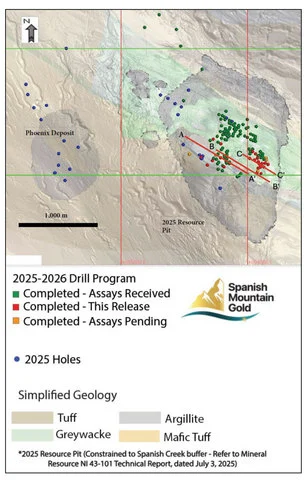
The 2026 drill program, which commenced in March, is fundamentally designed to transition the Spanish Mountain project from an advanced exploration asset to a shovel-ready mining operation. To date, the company has successfully completed approximately 33,353 meters of the planned 60,000-meter campaign.
The 28 holes reported in this latest update (26-DH-1391 through 26-DH-1418) are part of a broader, multi-faceted strategy. Beyond simple resource expansion, the drilling is intended to provide critical information on condemnation zones, geotechnical integrity, metallurgical characteristics, and groundwater dynamics. By integrating these datasets, Spanish Mountain Gold aims to de-risk the project for future stakeholders and demonstrate the economic viability required for a positive production decision in 2028.
Chronology and Data Synthesis
The current reporting period highlights the methodical nature of the 2026 campaign. With 25 additional drill holes currently undergoing laboratory analysis, the market remains in anticipation of further results.
The data released highlights several intercepts that underscore the continuity and grade consistency of the Main Deposit. Notably, hole 26-DH-1391 returned a massive intercept of 340.00 meters grading 0.36 g/t Au, featuring high-grade pockets such as 48.00 meters at 0.64 g/t Au and 146.00 meters at 0.54 g/t Au. These long-interval intercepts are indicative of a bulk-tonnage project, which is a key focus for the company’s current mining model.
Further notable results include:
- 26-DH-1399: A high-grade spike of 7.48 g/t Au over 1.00 meter within a broader 118-meter zone of 0.55 g/t Au.
- 26-DH-1400: 15.00 meters at 1.61 g/t Au.
- 26-DH-1403: A standout interval of 3.30 meters at 2.30 g/t Au, situated within a broader 95.75-meter mineralized zone.
- 26-DH-1414: A substantial 295.50-meter zone grading 0.54 g/t Au, including a high-grade core of 107.00 meters at 0.93 g/t Au.
These results are not merely numbers; they are the validation of a complex geological model. The company’s focus on the "Main Deposit" suggests a concentration of capital and effort to ensure that the initial stages of any future mining operation are supported by high-confidence resource estimations.
Rigorous Quality Assurance and Modern Methodology
In an era where mining transparency is paramount, Spanish Mountain Gold has leaned into modern analytical techniques to ensure that its data is beyond reproach. The company utilizes the Chrysos PhotonAssay™ method, a cutting-edge, non-destructive, and fully automated technique that uses gamma rays to detect gold content in samples.
The process is rigorous: drill core is logged for recovery, lithology, and vein intensity before being sawn in half. One half is sent for analysis while the other remains in secure storage. The company’s Quality Assurance and Quality Control (QAQC) program is robust, with at least 20% of all samples consisting of blanks, certified reference materials, and duplicates. By employing both internal and external platforms, such as the MxDeposit™ software, the company ensures that its data management is fully compliant with modern industry standards.
The use of PhotonAssay™, which allows for the analysis of up to 1 kilogram of material, significantly reduces the "nugget effect" often associated with traditional fire assays, providing a more accurate representation of gold distribution throughout the ore body.
The Path to 2028: Financial and Operational Implications
Spanish Mountain Gold’s trajectory is bolstered by a clear, well-funded financial strategy. In May 2026, the company secured a landmark $55 million US dollar agreement with Wheaton Precious Metals, selling a 1.5% Net Smelter Return (NSR) royalty on the project. The receipt of the first $22.5 million installment has provided the necessary liquidity to execute the current, aggressive drill program without the immediate need for dilutive equity financing.
This financial cushion is vital for the company’s "Relentless Pursuit of Better Gold"—a corporate philosophy that emphasizes sustainable and socially responsible mining. The company is not only focused on gold extraction but on creating a blueprint for a modern, low-impact mining operation in British Columbia.
Implications for the Cariboo Gold Corridor
The success of the Spanish Mountain project has wider implications for the Cariboo region. As one of the most promising development-stage projects in Canada, its progression serves as a bellwether for investment interest in the corridor. If the company maintains its current pace, the 2028 feasibility study will likely serve as the definitive catalyst for a formal production decision.
The integration of multi-elemental analysis (using four-acid digestion) into the 2026 campaign further suggests that the company is looking beyond just gold. By understanding the full geochemical footprint of the deposit, the company can better optimize its metallurgy, potentially reducing processing costs and environmental footprints—factors that are increasingly important for securing the "social license to operate" in modern British Columbia.
Management Outlook
Peter Mah, President and CEO of Spanish Mountain Gold, has repeatedly emphasized that the current exploration phase is about more than just finding gold—it is about defining the project’s future viability. The company’s board and management team are under pressure to ensure that the feasibility study meets the high standards of global financial markets, particularly as they look toward a construction decision in 2028.
The inclusion of independent oversight, such as the verification processes conducted by the company’s Qualified Person, Dr. Mathew Ball, provides a layer of assurance to investors that the technical information disseminated is accurate and reflects the true potential of the site.
Conclusion: A Project at a Crossroads
As the 2026 Feasibility Drill Program moves into its second half, Spanish Mountain Gold finds itself in an enviable position. With a strong treasury, advanced analytical techniques, and consistent results from the drill bit, the company is systematically ticking off the boxes required to bring the Spanish Mountain Gold project to fruition.
For investors, the next 18 months will be defined by the remaining drill results and the subsequent integration of that data into the feasibility model. As the company continues to explore the nuances of the Main Deposit, the potential for a new, long-life gold mine in the Cariboo region becomes increasingly tangible. With the industry shifting toward higher ESG standards and more transparent reporting, Spanish Mountain Gold’s approach to the project serves as a compelling case study for junior mining companies aiming to navigate the transition from exploration to production in the modern era.
As the company prepares to announce further findings from the remaining 25 holes, the market will be watching closely to see if the high-grade consistency demonstrated in the latest batch holds across the broader, untapped sectors of the deposit. For now, the "Relentless Pursuit of Better Gold" continues, and the foundations for a major British Columbia gold project appear stronger than ever.