

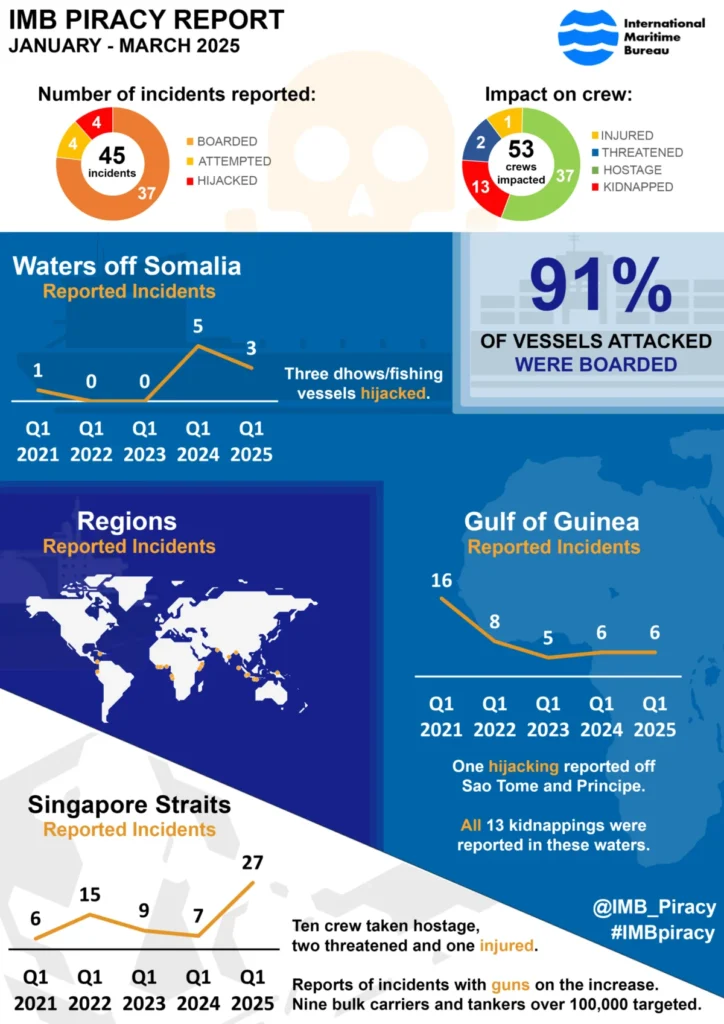
In the vast, ungoverned stretches of the world’s oceans, the threat of maritime piracy remains a persistent and evolving danger. From the strategic choke points of the Gulf of Guinea to the high-traffic lanes of the Singapore Strait, merchant vessels continue to face the risks of armed robbery, kidnapping, and cargo theft. Standing as the frontline defense against these maritime crimes is the International Maritime Bureau (IMB) Piracy Reporting Centre (PRC). Since its inception in 1991, the PRC has functioned as the global maritime community’s primary intelligence hub, providing 24-hour support to crews under duress and acting as a conduit for critical safety data.
The Mandate of the IMB Piracy Reporting Centre
The IMB Piracy Reporting Centre was established in response to a surge in maritime crime during the early 1990s, when authorities lacked a centralized, real-time mechanism to track and respond to piracy incidents. Today, the PRC serves as an indispensable pillar of maritime security. Its mission is two-fold: immediate tactical response and long-term intelligence gathering.
By operating a 24-hour hotline, the Centre ensures that when a ship is under attack or observes suspicious activity, a direct line of communication is opened immediately. This allows the PRC to coordinate with local response agencies, initiate warning broadcasts to ships in the vicinity, and disseminate vital email alerts that can prevent other vessels from sailing into a trap. This proactive approach has proven to be a decisive factor in saving lives and protecting international trade routes.
Chronology: Three Decades of Maritime Vigilance
To understand the current state of maritime security, one must examine the evolution of the IMB PRC’s operations since its founding in 1991.
The 1990s: Establishing the Baseline
In the early 1990s, piracy was largely viewed as a localized, opportunistic nuisance. The PRC began by standardizing the reporting of incidents, which was previously fragmented across national maritime authorities. By creating a unified global database, the IMB allowed the shipping industry to visualize the true scale of the problem for the first time.
The 2000s: The Rise of Somali Piracy
The early 2000s saw a paradigm shift. Piracy evolved from petty theft to high-stakes organized crime. The rise of Somali piracy, which saw hundreds of crew members taken hostage for multi-million dollar ransoms, pushed the PRC to its limits. During this era, the Centre became a critical node for information sharing between the private shipping industry and the international naval coalitions (such as EUNAVFOR) that were deployed to the Horn of Africa.
The 2010s to Present: Diversification of Threats
The current decade has seen the decentralization of piracy. While the threat in Somalia has been significantly contained through naval presence and the widespread adoption of Best Management Practices (BMP), new hotspots have emerged. The Gulf of Guinea has become the world’s most dangerous region for kidnapping, while the Singapore Strait has seen a marked increase in opportunistic armed robberies. The PRC’s role has shifted toward real-time tactical warning, utilizing modern satellite communication to warn vessels of “drifting” or “suspicious” small craft in high-risk zones.
Supporting Data: Why Reporting Matters
The IMB often emphasizes a sobering reality: official statistics represent only the tip of the iceberg. Many incidents go unreported due to fears of increased insurance premiums, potential delays in port, or the perception that local authorities will fail to investigate.
The data gathered by the IMB serves as the foundation for global risk assessment. Insurance companies, maritime underwriters, and port authorities rely on the PRC’s annual reports to determine the "High Risk Areas" (HRA) for global shipping. When shipmasters report an incident—whether it is a successful boarding, an attempted robbery, or even the sighting of a suspicious vessel—they are contributing to a dataset that informs where naval assets are deployed.
Data from the 2024 Piracy and Armed Robbery Against Ships report reveals that despite technological advancements in ship security, the human element remains the most vulnerable point. The PRC’s records underscore a correlation between periods of economic instability in coastal nations and the frequency of maritime robberies. By documenting these trends, the IMB provides the evidence necessary for international bodies, such as the International Maritime Organization (IMO), to pressure sovereign states into enhancing their maritime domain awareness and coastal patrols.
Official Responses and Strategic Collaboration
The effectiveness of the IMB PRC is inherently linked to its collaborative framework. The Centre does not act in isolation; it functions as a bridge between the private sector and public authorities.
Cooperation with Law Enforcement
The PRC works closely with national maritime authorities and coast guards. When a report is received, the PRC immediately contacts the relevant regional maritime security center. By providing precise coordinates and the nature of the threat, the PRC ensures that response agencies are not operating in the dark.
Industry-Led Initiatives
The IMB also advocates for the "Best Management Practices" (BMP). This set of guidelines, which includes the hardening of vessels (such as the installation of razor wire, water cannons, and the creation of a "citadel" or safe room), is promoted through the intelligence gathered by the PRC. Official feedback from the industry indicates that ships following these protocols are significantly less likely to suffer a successful hijacking.
The Role of International Advocacy
Director Michael Howlett and his team at the ICC International Maritime Bureau continuously engage with international forums to highlight the economic impact of piracy. Maritime security is not merely a safety issue; it is an economic imperative. The cost of piracy—through ransom payments, insurance surcharges, and the rerouting of vessels—runs into the billions of dollars annually. By providing transparent reporting, the IMB holds coastal governments accountable for the security of their territorial waters.
Implications for the Future of Global Trade
The implications of the IMB’s work extend far beyond the deck of a container ship. The global supply chain is a fragile, interconnected network. As witnessed during recent global logistics disruptions, any delay or threat to a primary transit lane can cause ripple effects that impact consumer prices and manufacturing timelines globally.
Technology as a Double-Edged Sword
As ships become more technologically advanced, so do the pirates. The use of drones for reconnaissance and the potential for cyber-interference with navigation systems are emerging threats. The IMB PRC is currently evolving to incorporate these digital dimensions into its reporting structure, recognizing that the future of maritime crime will likely involve a hybrid of physical violence and digital exploitation.
The Human Element
Perhaps the most significant implication of the IMB’s work is the protection of the seafarer. Beyond the cargo and the vessel, the PRC represents a lifeline for the thousands of men and women who spend months at sea. The trauma associated with being held at gunpoint or kidnapped is a profound human rights issue. By advocating for improved reporting and faster response times, the IMB ensures that the maritime industry does not lose sight of the people behind the trade statistics.
Conclusion: A Call to Action
The IMB Piracy Reporting Centre remains the world’s most effective tool for mitigating the threat of maritime violence. However, its efficacy is entirely dependent on the participation of the global shipping community. As the IMB explicitly states, reporting is a vital first step. Shipmasters and owners who choose to remain silent in the face of an attempted robbery are inadvertently contributing to a climate of impunity for criminal syndicates.
To remain informed and prepared, stakeholders are encouraged to consult the latest intelligence. The 2024 Piracy and Armed Robbery Against Ships report is an essential document for any vessel operator navigating international waters. It provides a granular analysis of regional threats, specific vessel vulnerabilities, and recommendations for security hardening.
For further information, assistance, or to report an incident, the IMB Piracy Reporting Centre remains available 24/7. Engagement with the Bureau is not just a regulatory requirement; it is a commitment to the safety of the global maritime commons.
Contact Information:
For inquiries, data requests, or reporting, please reach out to the IMB:
- Michael Howlett, Director, ICC International Maritime Bureau
- Tel: +44 207 423 6960
- Email: [email protected]
- Report Access: Request the 2024 Piracy and Armed Robbery Against Ships report here.



