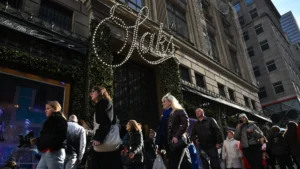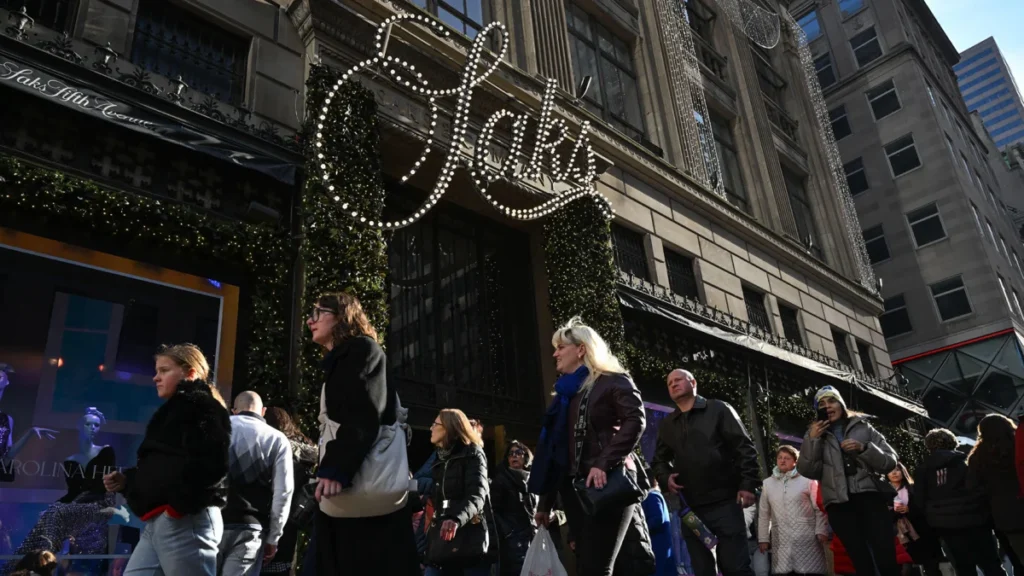
Long before the era of predictive algorithms and personalized digital feeds, the experience of luxury was defined by a physical address: Saks Fifth Avenue. For generations, the brand served as the ultimate arbiter of elegance, a bastion of high-end retail where glamour was not just sold, but curated. As Donatella Versace once famously noted within the hallowed halls of its Midtown Manhattan flagship, "Saks is New York." Yet, for decades, its influence stretched far beyond the borders of Manhattan, with its opulent stores acting as the commercial hearts of major cities across the United States.
However, the prestige that once made Saks a mandatory stop for any serious fashion enthusiast has, in recent years, faced an unprecedented crisis. Following a turbulent period of debt-fueled expansion and a high-profile merger, the retail giant found itself navigating the treacherous waters of bankruptcy. Now, as the entity rebrands as Exemplar Luxury Group, the retail world is watching closely to see if a storied institution can reclaim its luster—or if the era of the grand department store has irrevocably passed.
A Legacy of Indulgence
At its zenith, the Saks experience was a sensory journey. From the precision-tailored suits of Armani and Zegna to the ethereal gowns of Oscar de la Renta, the store offered an exhaustive catalog of desire. It was the place where one could find snakeskin Gucci loafers alongside Montblanc fountain pens, and where the classic Chanel 2.55 handbag was displayed with the same reverence as a piece of fine art.

The footwear department, in particular, became the stuff of legend. In 2007, the Manhattan flagship’s eighth-floor shoe salon was so massive and iconic that the United States Postal Service granted it its own dedicated zip code: 10022-SHOE. "It was a destination," recalls Julia Stedman, a New York-based brand-strategy consultant who shopped there for decades. "Every luxury brand was there. You knew you could find whatever you wanted, and the floors were always bustling."
In the 2008 film The Women, the character played by Annette Bening famously declared, "Nobody. Hates. Saks." At the time, that sentiment was nearly universal. It was a reliable, shimmering cathedral of commerce that felt untouchable.
The Anatomy of a Collapse: A Chronology
The decline of Saks was not a sudden event, but a slow erosion of operational integrity. The roots of the crisis are deeply intertwined with the 2013 acquisition of Saks by the Hudson’s Bay Company (HBC), a legacy retailer with a history dating back to 1670. The transition introduced a complex layer of real-estate-focused management that often prioritized property value over the nuances of luxury retail.

Key milestones in the descent included:
- 2014: The Manhattan flagship is mortgaged for approximately $1.2 billion, saddling the retailer with significant monthly financial obligations.
- 2016: The company acquires off-price retailer Gilt Groupe for $250 million, a move aimed at bolstering its "Off 5th" division, but which ultimately failed to provide the necessary fiscal cushion.
- 2024: The acquisition of Neiman Marcus—a move intended to create a luxury powerhouse—serves as the final catalyst. The combined entity, Saks Global, struggled under the weight of $3.4 billion in debt.
- January 2026: The company files for Chapter 11 bankruptcy protection as the reality of its debt-to-income ratio becomes untenable.
- June 2026: The company emerges from restructuring, rebranded as Exemplar Luxury Group, with a reduced physical footprint and a mandate to overhaul its operations.
Financial Missteps and the "Cash Vacuum"
The primary grievance of vendors and industry observers was the disconnect between the retailer’s corporate strategy and the reality of the sales floor. As debt mounted, the company fell behind on payments to the very designers who supplied its racks.
"You could smell that something was going on," says Daniel Wingate, founder of the luxury label Wingate. "The people in the stores were in and out, unhappy, and the rumors about the Neiman Marcus purchase began to circulate. Then, the inventory just disappeared."

For many brands, the situation became a "cash vacuum." Independent labels, in particular, were devastated. One beauty brand executive reported that the company was owed six figures, forcing them to lay off staff and cancel marketing initiatives. "You’re looking at your people, your programs, your photo shoots—everything has to be cut," the executive explained. "For small businesses, this is an existential threat."
The frustration was compounded by the company’s decision to route vendor communication through administrative hubs in Bengaluru, India. Many designers felt that the representatives they spoke with had no understanding of the luxury market. "In one email, they didn’t even spell our brand name correctly," one designer noted. "It felt like a bureaucratic stunt to delay payments."
The "Real Estate First" Strategy
Critics have frequently pointed to Richard Baker, the former executive chairman of Saks Global, as the architect of the downfall. With a background primarily in real estate rather than fashion, Baker’s approach to the department store model was viewed by many as cynical.

"There was a lot of head-scratching about how Richard Baker handled the company," says Lorenzo Marinuzzi, a partner at the law firm Morrison Foerster, which represents major unsecured creditors including Chanel and LVMH. "He didn’t really have the background for this kind of retailer. People didn’t trust management, and they didn’t trust the direction."
When the company announced its restructuring, it explicitly touted its "portfolio of prime real estate," signaling to investors that the value of the company lay more in its buildings than its boutiques. For the loyal luxury consumer, this was a clear signal: the store was no longer about the art of the sale, but the value of the square footage.
The Human and Operational Cost
The fallout was visible on the shop floor. By 2025, stores that were once bastions of service had become hollowed-out versions of themselves. Salespeople, often the bridge between the brand and the client, were leaving in droves.

"My floor looked so bad," says Anita Berger, a former senior salesperson at the St. Louis location. "Customers would come in and ask if we were closing. It looked like a discounter. There was nothing new because they couldn’t get any inventory."
Babatunde Fakuade, a former Neiman Marcus salesperson in Atlanta, echoes this. "We didn’t get a full size run of dresses for months at a time. It was impossible to do the job."
The Path to Recovery: Is "Day One" Possible?
Following the emergence from Chapter 11, Exemplar Luxury Group has made aggressive moves to stabilize. An infusion of $1.75 billion in new capital has allowed the company to settle many outstanding debts and resume relationships with nearly 600 brands. Recent reports suggest that sales are trending upward compared to 2025.

However, Aaron Cheris, a partner at Bain & Company, warns that financial restructuring is only half the battle. "It’s hard to come out of that with both your brand partners and your consumers intact," he says. "It creates a doom loop. The challenge is: can you convince both sides that there is a ‘new day one’?"
For many, the damage to the brand’s reputation is profound. Industry insiders suggest that the vacuum left by Saks has created an opening for competitors like Bloomingdale’s and Nordstrom to capture the market share that Saks once held exclusively.
Conclusion: A Cautionary Tale for Modern Retail
The saga of Saks Global is more than a story of bankruptcy; it is a case study in the decline of the traditional department store model in a digital age. When Saks stopped prioritizing the relationship between the product, the salesperson, and the shopper, it lost the "magic" that had sustained it for over a century.

As Exemplar Luxury Group attempts to rebuild, it faces a skeptical audience. The modern shopper has moved toward direct-to-consumer websites, social media-driven discovery, and curated luxury platforms. To survive, the new entity must do more than just restock the shelves; it must prove that it still has a reason to exist in a world that no longer views the physical department store as a mandatory destination.
For now, the approach of many high-end shoppers remains one of cautious observation. "It’s going to take a while to rebuild my trust," says Julia Stedman. "What made Saks special was that it was a constant. Right now, it’s just a question mark."