

Introduction: The State of Global Maritime Security
The global maritime industry, the lifeblood of international trade, is currently navigating a complex period of security fluctuations. According to the latest data from the International Maritime Bureau (IMB) covering the first nine months of 2024, the maritime domain is witnessing a paradoxical trend: while the aggregate number of reported piracy and armed robbery incidents has shown a downward trajectory in historically volatile corridors, the threats to crew safety and the operational integrity of global shipping lanes remain acute.
As the industry moves into the final quarter of the year, stakeholders are analyzing these statistics not as a signal of total stability, but as a call for sustained vigilance. The Gulf of Guinea, the waters off Somalia, and the congested Singapore Straits—three regions that have historically dominated the global piracy risk map—are presenting unique, evolving challenges that require nuanced responses from both the public and private sectors.
Main Facts: The 2024 Landscape
The first nine months of 2024 have been marked by a significant decline in the frequency of reported maritime attacks in several critical regions. However, the qualitative nature of these incidents—specifically those involving the abduction and hostage-taking of crew members—remains a source of grave concern for maritime unions and international safety organizations.
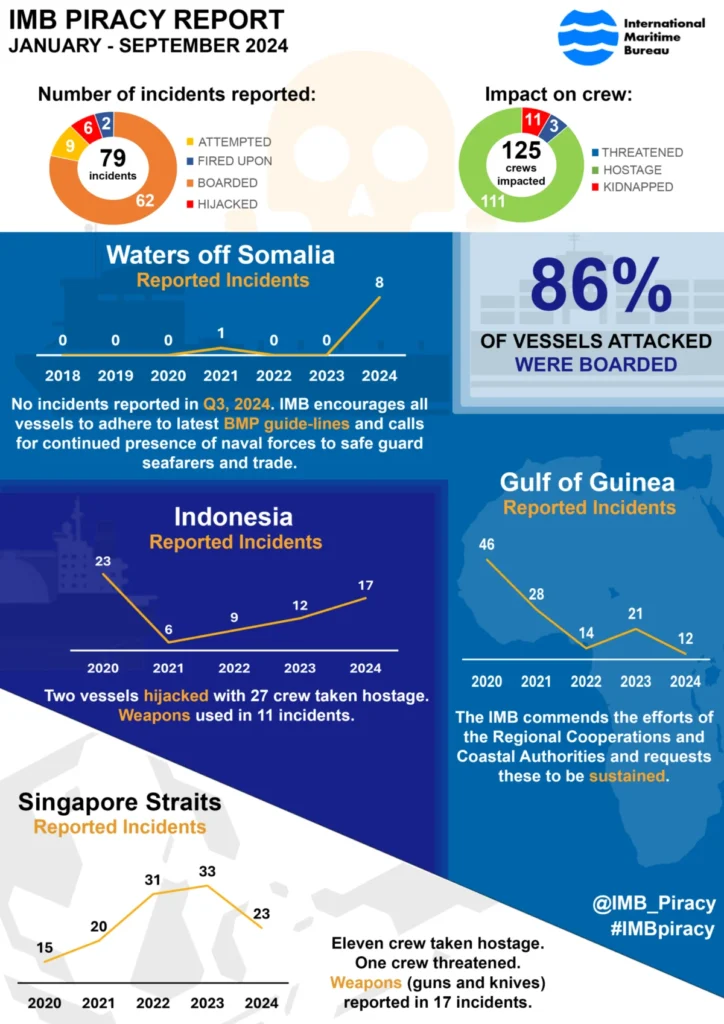
The most notable shift has occurred in the Gulf of Guinea. Once considered the global epicenter of maritime piracy, the region recorded only 12 incidents between January and September 2024. To put this figure in historical perspective, it represents the lowest number of reported incidents in the region since 1996. While this statistical drop is an undeniably positive development for the shipping industry, it is tempered by the human cost: 11 crew members were kidnapped, and 21 were taken hostage during this period.
Simultaneously, the Singapore Straits, a vital maritime artery connecting the Indian and Pacific Oceans, saw a reduction in incident reports, falling to 23 from 33 during the same period in 2023. Yet, the tactical success rate of perpetrators in this region remains alarmingly high, with boarding attempts succeeding in 96% of recorded cases.
Chronology: A Quarter-by-Quarter Breakdown
Understanding the temporal nature of these maritime threats is essential for risk mitigation.
Q1 and Q2: The Resurgence of Somali Piracy
The first half of 2024 was characterized by a worrying resurgence of piracy in the waters off Somalia and the Gulf of Aden. After years of relative quiet, the region saw eight reported incidents. These were not merely petty thefts; the incidents involved three hijacked vessels and two instances where ships were fired upon. This signaled a potential return to the high-stakes piracy that plagued the region in the late 2000s.
Q3: The Impact of Seasonal Weather
The trajectory changed significantly during the third quarter (July–September). During this period, the IMB received zero reports of maritime piracy in the waters off Somalia and the Gulf of Aden. Analysts largely attribute this lull to the prevalence of monsoon weather conditions. The harsh sea states associated with the monsoon season naturally hinder the ability of small skiffs to launch attacks and board larger vessels. However, the IMB cautions that this is a seasonal reprieve rather than a long-term security solution, as criminal syndicates often wait for favorable sea states to resume operations.
Supporting Data: Analyzing the Regional Trends
The Gulf of Guinea
The decline in the Gulf of Guinea is the result of years of concerted effort by regional navies, international task forces, and the adoption of more robust onboard security protocols. However, the persistence of kidnapping indicates that criminal networks have not been dismantled; they have merely shifted their tactics. The shift from large-scale vessel hijacking to more targeted abductions of crew members for ransom remains a lucrative, albeit lower-profile, criminal enterprise.
The Singapore Straits: High Boarding Success Rates
The Singapore Straits present a different tactical challenge. With 23 incidents reported, the sheer volume of traffic in these narrow, congested waters provides ample opportunity for opportunistic criminals. The 96% success rate in boarding vessels highlights a significant security vulnerability. Because the vessels transiting these waters are often large, slow-moving, and operate with limited freeboard, they are highly susceptible to small, fast-moving craft that strike under the cover of darkness.
Somali Waters: A Fragile Equilibrium
The eight incidents recorded in Somali waters serve as a reminder of the fragility of maritime stability. The success of hijacking attempts early in the year highlights the vulnerability of vessels that may have lowered their guard during the "quiet years."
Official Responses and Strategic Implications
IMB’s Stance on Navigational Safety
The IMB has raised a critical point regarding the "opportunistic" nature of piracy in the Singapore Straits. While these incidents are often classified as "low-level" robberies, the IMB warns that they pose an existential risk to navigation. In narrow, high-traffic channels, an unexpected boarding incident can cause a distraction on the bridge, potentially leading to collisions or groundings. When a crew is preoccupied with repelling intruders, their primary duty—the safe navigation of the vessel—is compromised, creating a chain reaction of risk for all nearby ships.
Adherence to Best Management Practices (BMP)
The IMB’s primary message to the industry is one of unwavering compliance. The current Best Management Practices (BMP5) remain the gold standard for vessel security. These guidelines emphasize:
- Hardening of vessels: Utilizing razor wire, water cannons, and reinforced bridge protection.
- Situational Awareness: Maintaining 24/7 bridge watches and utilizing radar to detect unauthorized small craft.
- Reporting: Promptly communicating suspicious activity to regional centers, such as the IMB Piracy Reporting Centre.
The IMB stresses that the security of a vessel is a collaborative effort. While ship owners provide the equipment and policies, the human element—the crew—remains the first line of defense. Training crews to recognize the early warning signs of an attack and ensuring that they are prepared to retreat to a secure "citadel" if necessary can be the difference between a successful deterrent and a traumatic hostage situation.
The Broader Implications: What Lies Ahead?
The data from the first nine months of 2024 suggests that the maritime security environment is evolving rather than disappearing. The decline in the Gulf of Guinea is a testament to the effectiveness of coordinated regional security, but the persistence of kidnappings shows that criminal motivation remains high.
The Technology Gap
One of the emerging discussions in the maritime sector is the role of technology in countering piracy. As pirates use more sophisticated communication and navigation tools, the shipping industry must accelerate its adoption of non-lethal deterrents and satellite monitoring. Furthermore, the role of intelligence sharing between merchant vessels and naval patrols is more critical than ever. When vessels share real-time data on suspicious movements, the window of opportunity for attackers shrinks.
The Economic Cost of Security
Security measures are not without cost. Increased insurance premiums, the expense of private maritime security contractors, and the diversion of vessels to avoid high-risk zones all contribute to the final cost of goods transported by sea. If regional instability continues to fluctuate, these costs will continue to be passed down the supply chain, affecting global inflation and the cost of living.
Conclusion: Sustained Vigilance
The 2024 IMB report serves as both a progress report and a warning. We have seen that consistent, high-level cooperation can drive down piracy rates, as evidenced by the historical lows in the Gulf of Guinea. However, we have also seen that these gains are precarious. The return of piracy in Somali waters and the persistently high boarding success rates in the Singapore Straits remind us that the sea is an expansive and difficult domain to police.
The maritime industry must resist the urge to grow complacent. The seasonal nature of the monsoon should not be mistaken for a permanent reduction in the threat level. Ship operators, masters, and crews must continue to treat security as a fundamental operational requirement rather than an administrative burden. By adhering to the latest BMPs, maintaining rigorous lookout protocols, and fostering a culture of constant, transparent reporting, the global maritime community can ensure that the gains made in 2024 are not only sustained but expanded upon in the years to come.
As the world continues to rely on the sea for over 80% of global trade, the safety of those who traverse these waters remains a non-negotiable imperative. The journey toward a safer maritime environment is ongoing, and as the 2024 statistics prove, it is a journey that requires constant course corrections and unwavering attention to detail.



