

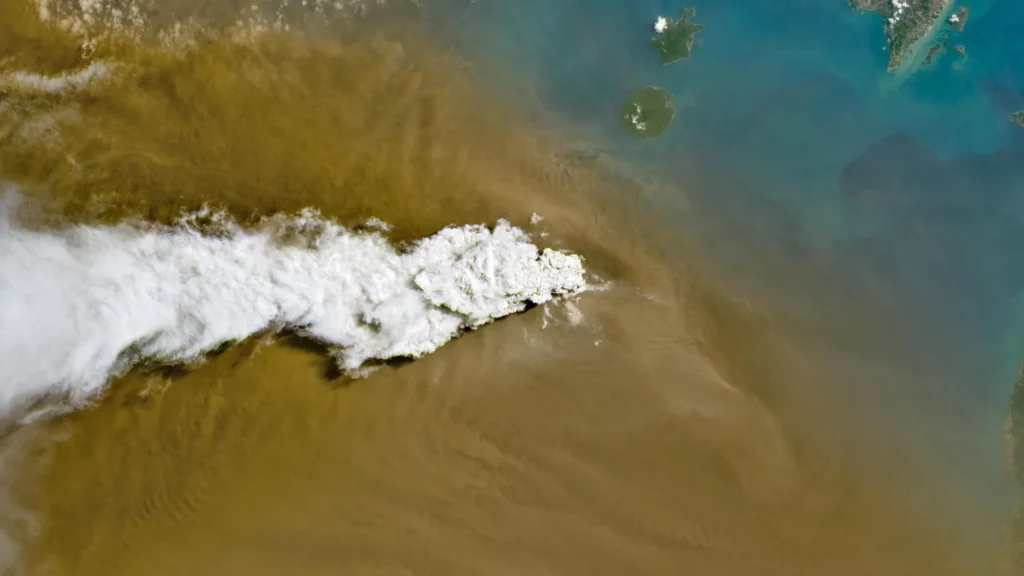
The Sunda Strait, a vital maritime corridor connecting the Java Sea to the Indian Ocean, became the epicenter of a natural crisis in early September 2026. Anak Krakatau, the volatile "child" of the legendary 1883 Krakatoa, launched a sustained, high-intensity explosive eruption that paralyzed aviation across the Indonesian archipelago and blanketed major urban centers, including Jakarta, in a layer of fine, abrasive volcanic ash.
The event, which spanned more than 24 hours of continuous explosive activity, served as a stark reminder of the unpredictable nature of the Pacific Ring of Fire. While Anak Krakatau is known for its frequent, minor outbursts, the September eruption represented a significant escalation, necessitating the closure of major transportation hubs and triggering widespread health warnings across the densely populated islands of Java and Sumatra.
Chronology of a Volcanic Surge
The crisis began in earnest on September 5, 2026, when the volcano—which had been under a heightened alert status since July—shifted from its typical Strombolian activity into a prolonged, powerful eruptive phase.
September 5: The Atmosphere Ignites
By the morning of September 5, satellite observations confirmed that the volcano had breached the threshold of moderate activity. The OLI (Operational Land Imager) aboard the NASA-USGS Landsat 8 satellite captured a striking visual: a bright white plume of water vapor and volcanic gases venting violently into the stratosphere, topped by a darker, ominous brown cloud of dense ash. As the day progressed, the intensity of the eruption increased, with the VIIRS instrument on the Suomi NPP satellite mapping a vast volcanic footprint spreading across the Sunda Strait.
September 6: The Peak of the Plume
The situation reached a critical juncture on September 6. Indonesia’s meteorological agency, the BMKG, released data indicating that the ash column had attained staggering altitudes. To the east, ash reached 6,000 meters (20,000 feet), while the western trajectory saw particles pushed as high as 15,000 meters (50,000 feet) into the atmosphere. This distribution pattern, governed by prevailing high-altitude winds, dictated the severity of the fallout across Java and Sumatra.
September 7–8: De-escalation and Normalization
By the late hours of September 6, the sustained explosive force began to wane. The volcano retreated from its continuous venting phase back into a rhythmic pattern of Strombolian bursts—intermittent, energetic explosions of incandescent material and ash. By September 8, authorities deemed the air quality and visibility sufficient to reopen major transport nodes, though the volcano itself remained at the second-highest alert level, signaling that the threat of further eruptions remains imminent.
Satellite Insights and Scientific Observation
The 2026 eruption provided volcanologists with a masterclass in atmospheric monitoring. By utilizing a multi-satellite approach, researchers were able to discern the composition of the plumes in real-time.
NASA Earth Observatory images highlighted the complexity of the eruption. The contrast between the steam-heavy white plumes and the particulate-dense ash clouds provided essential data for meteorological models attempting to predict the drift of volcanic pollutants. The wide-angle views provided by the Suomi NPP satellite allowed regional emergency planners to visualize the "ash shadow"—a geographic area where aviation and outdoor activities would be strictly prohibited for the duration of the event.
The data gathered during this period is currently being used to refine evacuation and flight-path adjustment protocols, ensuring that the next time Anak Krakatau roars, the response from the aviation sector is more predictive than reactive.
The Aviation Crisis: A Logistical Nightmare
The most immediate and far-reaching impact of the eruption was the paralysis of the Indonesian aviation industry. With ash particles acting as microscopic glass shards—capable of melting inside jet engines and causing catastrophic mechanical failure—the decision to close airports was non-negotiable.
The Closure of Critical Hubs
Eight international and regional airports across Java and Sumatra were shuttered as a precautionary measure. This decision triggered a cascade of delays and cancellations that rippled through global travel networks. Nearly 3,000 flights were grounded or diverted, trapping thousands of passengers in airports and causing severe economic friction for the region’s tourism and logistics sectors.
Lessons from the Tarmac
The speed at which the ash cloud migrated highlighted the vulnerability of Southeast Asian flight paths. As the ash dispersed, air traffic controllers were forced to reroute long-haul flights entirely, incurring significant fuel costs and scheduling complications. The reopening of airports on September 8 was a phased process, relying heavily on meteorological clearance and the monitoring of "ash concentration zones," a practice that has become increasingly sophisticated since the 2010 Eyjafjallajökull eruption in Iceland.
Public Health and the "Double Hazard"
As the ash settled over communities in West Java and the capital city of Jakarta, public health officials moved quickly to address the risks. Volcanic ash is chemically distinct from other forms of atmospheric pollution, and the government was careful to distinguish this event from the seasonal haze caused by peatland fires.
Health Risks: Ash vs. Smoke
The Indonesian Humanitarian Coordination Platform (IHCP) issued clear directives to the public. Unlike the carbon-heavy smoke from forest fires, volcanic ash consists of pulverized rock, minerals, and volcanic glass. These particles are physically abrasive and can cause:
- Respiratory Distress: The fine particles can penetrate deep into the lungs, exacerbating conditions like asthma or chronic obstructive pulmonary disease (COPD).
- Ocular Irritation: The jagged edges of volcanic glass can cause severe corneal abrasions.
- Dermatological Issues: Prolonged skin contact with acidic ash can lead to irritation and contact dermatitis.
The government’s public awareness campaign emphasized the use of N95-grade masks and the necessity of keeping indoor air filtration systems running, providing a starkly different set of safety guidelines than those used during wildfire seasons.
Official Responses and Future Readiness
The response to the September 2026 eruption was characterized by a high degree of coordination between the Indonesian government, meteorological agencies, and international scientific partners.
The Role of the BMKG
Indonesia’s Meteorology, Climatology, and Geophysics Agency (BMKG) remained the primary source of truth throughout the crisis. By providing real-time updates and maintaining the alert status at the second-highest level, the agency prevented panic and allowed for a measured, safe evacuation of residents in the immediate vicinity of the Sunda Strait.
The Persistent Threat
Despite the calming of the eruption, experts warn that Anak Krakatau remains in a state of high unrest. Having held its current alert status since July 2026, the volcano is demonstrating a long-term shift in its eruptive behavior. The geological community remains focused on the "volcanic edifice"—the structure of the island itself—which has shown signs of instability following years of rapid growth and frequent collapse.
Implications for a Volcanic Nation
Indonesia, an archipelago situated at the meeting point of several tectonic plates, lives in a state of constant, managed risk. The September 2026 event serves as a microcosm of the challenges facing a nation that must balance the presence of over 120 active volcanoes with the needs of a rapidly modernizing economy.
The disruption to nearly 3,000 flights and the subsequent health interventions have sparked a national conversation about the necessity of more robust early-warning systems and improved infrastructure resilience. As satellite technology improves, the ability to predict, monitor, and respond to these events is growing, yet the sheer force of a volcanic eruption remains a humbling reminder of nature’s dominance.
For now, the skies over Jakarta have cleared, and the airports have resumed their daily cadence. But the rumble of Anak Krakatau remains a persistent, low-frequency reminder that in the Sunda Strait, the earth is always in motion, and the next eruption is not a question of "if," but "when."
Data and imagery provided by the NASA Earth Observatory, in collaboration with the U.S. Geological Survey and the NASA EOSDIS LANCE/GIBS/Worldview teams.



