

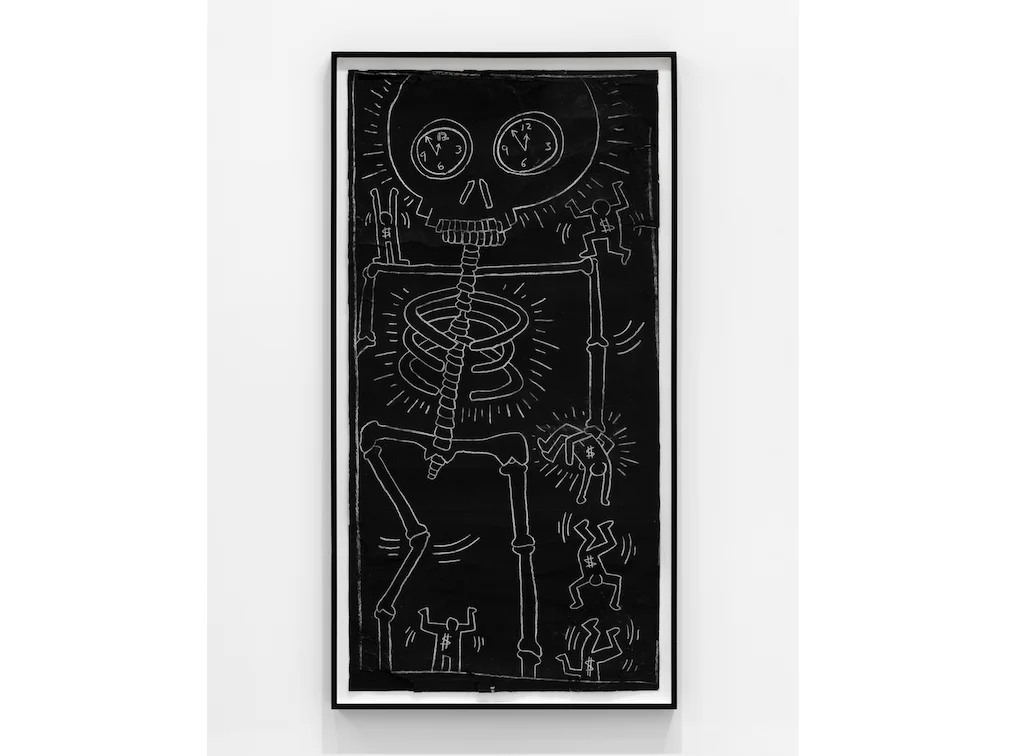
NEW YORK — In the high-stakes world of boutique auctions, the "guerrilla" firm Fair Warning has carved out a reputation for unpredictability and prestige. After a record-breaking foray into the world of vintage haute couture, the auction house, founded by former Christie’s heavyweight Loïc Gouzer, is returning to the gritty, asphalt-and-steel roots of the New York City art scene. On October 1, Fair Warning will offer a monumental Keith Haring subway drawing from 1984, a work that encapsulates the ephemeral genius of the 1980s street art movement.
The upcoming sale represents a sharp pivot from the glitz of the runway to the literal underground. Estimated at $700,000 to $900,000, the untitled chalk-on-paper work stands as a rare survivor of Haring’s prolific, yet largely destroyed, public interventions.
Main Facts: A Rare Relic of the 1980s Underground
The centerpiece of the October 1 auction is an untitled drawing measuring 80 by 40 inches. Executed in white chalk on matte black paper, the work features one of Haring’s more macabre yet rhythmic compositions: a towering skeleton whose eyes have been replaced by ticking clocks. This central figure is surrounded by Haring’s signature dancing figures, creating a scene that vibrates with the frantic energy of 1980s Manhattan.
The work is a primary example of Haring’s "subway drawings," a body of work created between 1980 and 1985. During this period, Haring noticed the black paper used by the Metropolitan Transportation Authority (MTA) to cover expired advertisements. He saw these blank panels as a "laboratory" for his evolving lexicon of symbols.
Key Details of the Upcoming Sale:
- Artist: Keith Haring
- Untitled (Subway Drawing)
- Date: 1984
- Medium: Chalk on black paper
- Dimensions: 80 x 40 inches
- Estimate: $700,000 – $900,000
- Auction Date: October 1
- Platform: Fair Warning (App-based/Boutique Auction)
This specific drawing arrives with a robust provenance, a rarity for subway works which were often torn down by commuters or destroyed by transit workers. According to Fair Warning, the piece passed through a private collection in New York and the Martos Gallery before being acquired by a collector in Los Angeles. Its historical importance is bolstered by its inclusion in major exhibitions at the Fondazione Triennale di Milano (2005–06) and Martos Gallery (2025), and it is officially recorded by the Keith Haring Foundation.
Chronology: The Evolution of Haring’s Public Art
To understand the significance of the $900,000 estimate, one must look back at the chronology of Haring’s career and the specific timeline of the subway drawings.
1980–1981: The Discovery
Keith Haring, then a student at the School of Visual Arts, began to seek ways to make art accessible to the public, bypassing the "white cube" gallery system. He discovered the MTA’s black advertising panels and realized that chalk was the perfect medium: it was temporary, easily visible against the black background, and allowed him to work quickly to avoid arrest for vandalism.
1984: The Peak of the Subway Period
By 1984—the year the present work was created—Haring was an international sensation, yet he continued to draw in the subway. He viewed these works as a gift to the city. "The whole beauty of the drawings is that they were so simple," Haring once remarked. "They told a story that you could see from a moving train and you could get it."

2005–2025: Institutional Validation
While many subway drawings were lost to time, the surviving pieces began to enter the institutional circuit. The work being offered by Fair Warning was featured in the seminal 2005 Milan retrospective, cementing its status not just as street art, but as a pivotal chapter in contemporary art history.
Present Day: The Fair Warning Acquisition
Loïc Gouzer, known for his ability to source high-demand "trophy" pieces, had been tracking this specific drawing for years. Its appearance on the Fair Warning app follows a period of intense negotiation, with Gouzer describing it as the "numero uno Subway drawing" in existence.
Supporting Data: The "White-Glove" Precedent of the Couture Sale
The Haring announcement comes on the heels of Fair Warning’s "The Impossible Couture Collection," a sale that demonstrated the house’s ability to drive massive prices through curated, celebrity-linked events. Held at Peter Brant Jr.’s Upper East Side carriage house, the auction was a "white-glove" event, meaning every single lot was sold.
Auction Performance Highlights:
The couture sale brought in a total hammer price of $3.2 million for just 23 lots. The data from this sale provides a clear indication of the momentum Fair Warning currently enjoys:
- Alexander McQueen (Spring/Summer 2010): An ensemble from the "Plato’s Atlantis" collection, previously owned by Naomi Campbell, sold for $1.3 million. This far exceeded its $600,000 low estimate. The lot included the iconic "Armadillo" boots, which have become symbols of McQueen’s final creative output before his death in February 2010.
- Yves Saint Laurent (1965–66): The famous "Mondrian" cocktail dress hammered for $600,000, beating its $500,000 high estimate. The dress was rumored to have belonged to the Belgian royal family, adding a layer of historical mystique to its architectural design.
- Azzedine Alaïa: A gown worn by Rihanna fetched $140,000.
- John Galliano: A sequined dress worn by Madonna in the "Take a Bow" music video and later by Kylie Jenner sold for $110,000.
The success of these lots suggests that Fair Warning’s audience is not just looking for blue-chip paintings, but for "cultural relics"—items that sit at the intersection of history, celebrity, and artistic innovation.
Official Responses: Loïc Gouzer on the Market’s Future
Loïc Gouzer’s strategy with Fair Warning has always been to treat the auction process as a curated experience rather than a bulk clearinghouse. Speaking after the couture sale, Gouzer expressed his belief that the market for historically significant "non-traditional" art is in its infancy.
"I think people are going to be astonished by these prices," Gouzer told Artnet News. "They seem big for fashion, but then you compare it to art and this is clearly just the beginning."
Regarding the Haring drawing, Gouzer’s excitement was palpable. In a statement to ARTnews, he emphasized the rarity of the 1984 piece: "It’s the numero uno Subway drawing, one I’ve been trying to get for years—and we finally got it!"

The Fair Warning founder’s comments suggest a broader philosophy: that the digital-first, app-based auction model can sustain the same—if not higher—levels of competition as the traditional auction rooms of London or New York. By focusing on single, high-impact lots like the Haring drawing, Gouzer maintains a sense of urgency and exclusivity.
Implications: The Blurring Lines of Value
The transition from a $1.3 million McQueen dress to a $900,000 Haring drawing highlights several emerging trends in the global art market.
1. The Institutionalization of the Ephemeral
Haring’s subway drawings were never meant to be permanent. They were performance art as much as they were visual art. The fact that a chalk drawing on fragile paper now commands nearly a million dollars reflects the market’s obsession with "the moment of creation." Collectors are no longer just buying an object; they are buying a piece of 1984 New York.
2. Fashion as Fine Art
The success of "The Impossible Couture Collection" suggests a major shift in how collectors view high fashion. Gouzer’s assertion that fashion prices are "just the beginning" compared to fine art indicates that we may see more crossover auctions. If a McQueen dress can sell for the price of a Basquiat work on paper, the boundaries between the closet and the gallery wall are effectively dissolved.
3. The Power of Provenance
In both the Haring sale and the Couture sale, provenance is the primary driver of value. For the Haring piece, the verification by the Keith Haring Foundation and its exhibition history are essential to its $900,000 estimate. For the couture items, the "Naomi Campbell" or "Rihanna" association added hundreds of thousands of dollars to the hammer price.
4. The Digital Disruptor
Fair Warning’s success proves that the "guerrilla" auction model—operating outside the traditional calendar and utilizing mobile technology—is a viable threat to the duopoly of Sotheby’s and Christie’s. By creating "drop-style" auctions, Fair Warning mimics the scarcity-driven marketing of the fashion and sneaker worlds, a tactic that clearly resonates with a younger generation of high-net-worth collectors.
As the art world looks toward October 1, the Haring sale will be a litmus test for the strength of the street art market. If the "skeleton with clock eyes" reaches its high estimate, it will further solidify the status of Keith Haring’s subway interventions as some of the most significant—and valuable—public art of the 20th century.



