

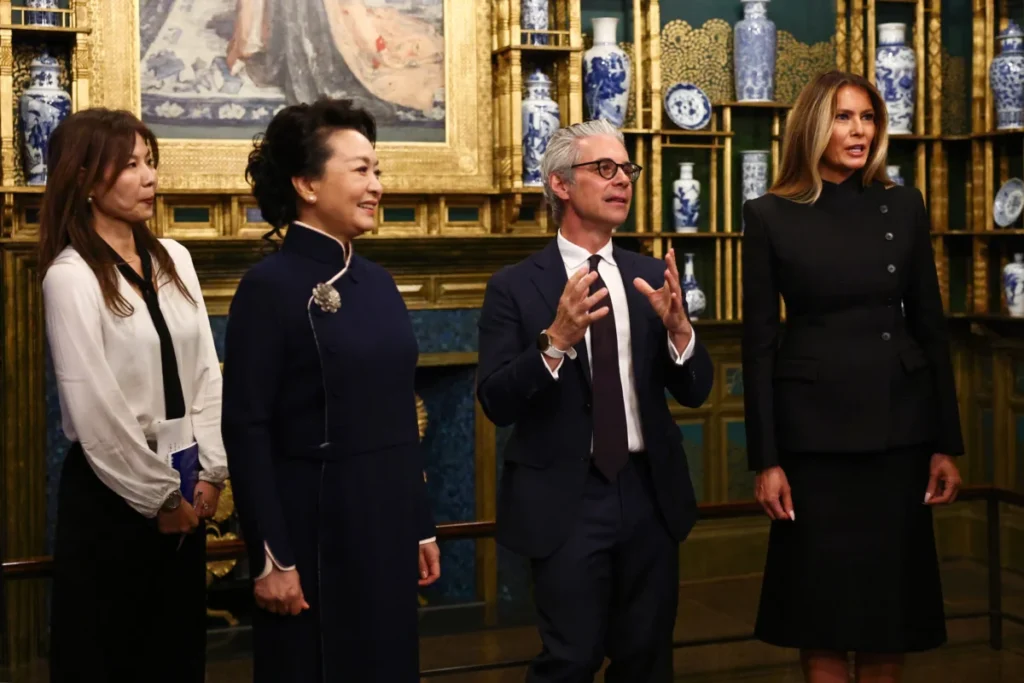
In the intricate theater of international relations, where high-stakes policy discussions often dominate the headlines, the softer side of diplomacy—cultural exchange—frequently serves as the essential scaffolding for bilateral cooperation. On a crisp Thursday in Washington, D.C., this tradition of "soft power" was on full display as First Lady Melania Trump hosted her Chinese counterpart, Peng Liyuan, for an exclusive, curated tour of the Smithsonian’s National Museum of Asian Art.
The visit, which spanned 45 minutes of quiet exploration amidst centuries of artistic heritage, was more than a mere social engagement. It was a calculated, symbolic gesture designed to highlight the long-standing, complex, and often beautiful historical intersections between the United States and China. Against the backdrop of high-level state discussions, the museum served as a neutral yet poignant stage, reminding both nations of their shared appreciation for aesthetic excellence and historical preservation.
A Chronology of the Visit: From Gallery Halls to State Protocol
The itinerary for the day was meticulously planned to mirror the weight of the broader state visit. The two First Ladies arrived at the Smithsonian’s National Museum of Asian Art, a landmark institution that houses one of the world’s most comprehensive collections of Asian art, to a reception befitting their roles.
For 45 minutes, the pair moved through the hushed, climate-controlled halls, accompanied by museum staff and security details. The tour was specifically structured to focus on works that bridge the gap between East and West. Central to their experience was the legendary "Peacock Room," an iconic interior space that has captivated visitors for over a century. Within this space, the duo engaged with a collection of exquisite Chinese porcelain, a testament to the centuries-old global trade and appreciation for Chinese craftsmanship.
Following the museum visit, the focus shifted from the cultural to the ceremonial. Later that evening, the center of gravity moved to the White House for the state dinner. During the exchange of gifts—a ritual rooted in ancient diplomatic history—President Donald Trump presented President Xi Jinping with a sculptural representation of the American bald eagle. The choice of gift was deliberate, symbolizing the “free and soaring spirit of America,” a nod to the national identity of the United States.
The Peacock Room: A Nexus of 19th-Century Cross-Cultural Interaction
To understand the significance of the First Ladies’ visit, one must look at the history of the Peacock Room itself. Built between 1876 and 1877 by the celebrated American painter James McNeill Whistler, the room is a masterclass in the "Aesthetic Movement."
The room’s journey to Washington is a story of global ambition. It was purchased and relocated to the United States in 1904 by the American industrialist and art collector Charles Lang Freer. Freer, a man whose personal evolution mirrored the American fascination with the East, deepened his expertise through a transformative trip to China between 1910 and 1911. His acquisition of Chinese antiquities was not merely an act of collecting; it was an act of bridging worlds.
Chase Robinson, the director of the museum, emphasized that the choice of venue was far from accidental. "What better place to introduce the two first ladies to our museum on the occasion of high-level conversations and discussions between our two countries?" Robinson noted in an interview with the South China Morning Post. He further remarked on the palpable engagement of the guests: "I think they were both intrigued by the scale of 19th-century interaction between China and the United States."
Sartorial Diplomacy: The Language of Fashion
In the world of high-profile state visits, fashion is rarely accidental. Every sartorial choice is scrutinized for its geopolitical subtext. Melania Trump’s ensemble on Thursday provided a masterclass in subtle, diplomatic communication. She opted for a black McQueen tweed jacket, characterized by an asymmetrical collar that evoked the silhouette of the traditional Chinese qipao. This stylistic nod was widely interpreted by fashion critics and diplomatic observers as a mark of respect for Chinese heritage. She paired the jacket with a matching skirt and black Christian Louboutin heels, creating a look that was at once modern, professional, and culturally sensitive.
Peng Liyuan, a renowned figure in her own right as a celebrated soprano and a public advocate for the arts, complemented the aesthetic theme of the visit. She wore a modest, elegant navy qipao. The coordination between the two women—one honoring Chinese design, the other embodying it—created a visual narrative of mutual respect that resonated far beyond the confines of the museum walls.
Official Responses and Diplomatic Intent
The official sentiment surrounding the visit was one of warmth and shared purpose. While the public rarely sees the granular details of the conversations held between world leaders, these cultural excursions are designed to provide the “human touch” that keeps diplomatic channels open during turbulent policy negotiations.
The Smithsonian Institution, by hosting such high-profile figures, reinforces its role as a vital organ of the American diplomatic apparatus. By showcasing the depth of Chinese influence on American art—from Whistler’s Peacock Room to the broader collections of Asian design—the museum framed the U.S.-China relationship not as one of rivalry, but as one of long-standing intellectual and aesthetic partnership.
President Trump’s gift of the bald eagle sculpture at the state dinner further cemented the day’s message. By presenting a symbol of the American landscape and spirit, the administration signaled a desire to showcase American identity while acknowledging the presence of the Chinese delegation.
Implications: The Long Game of Cultural Engagement
Why does a museum tour matter in the context of trade deficits, geopolitical tensions, and global security? The implications of such visits are found in the subtle shifts in tone that they facilitate.
- Humanizing the Adversary/Partner: International relations are often conducted by bureaucrats and officials who rarely meet. When heads of state and their spouses spend time together in informal, cultural settings, it breaks down the monolithic perception of "the other."
- Historical Continuity: By focusing on the 19th-century interaction between the U.S. and China, the visit reminded both delegations that the current era of friction is merely a chapter in a much longer, multi-century narrative of exchange.
- Symbolic Soft Power: The choice of the Peacock Room—a space born from an American’s deep admiration for Chinese artistry—is a powerful counter-narrative to the current political climate. It suggests that, at a foundational level, the two nations have been "in dialogue" for over a century.
As the state visit concluded, the lasting image was not of press conferences or policy white papers, but of two women walking through a room filled with porcelain and gold leaf, discussing the nuances of an art form that has traveled across oceans and centuries.
In an era where diplomatic relations are often volatile, these curated moments of cultural reflection serve as a necessary anchor. They remind us that while governments may clash over policy, the cultural heritage of our respective nations remains a bridge that, with careful maintenance, can withstand the pressures of modern politics. Whether this visit will yield immediate policy shifts remains to be seen, but as an exercise in diplomatic goodwill, it was an undeniable success—a quiet, calculated, and elegant reminder of the power of cultural diplomacy on the world stage.



