

In the evolving landscape of contemporary menswear, few designers have managed to reconcile the rigid demands of classic tailoring with the fluid, deconstructive ethos of modern design as effectively as Luca Lin. His latest collection serves as a definitive statement on this balance, offering a masterclass in pattern making that treats traditional wardrobe staples as raw materials for structural experimentation. By breathing new life into deadstock fabrics and subverting the proportions of heritage garments, Lin has cemented his reputation as an architect of the wearable.
The Foundation: A Technical Evolution of Staples
At the heart of Lin’s design philosophy lies a deep-seated obsession with the mechanics of garment construction. For this season, the designer turned his focus toward the quintessential building blocks of a man’s wardrobe: the crisp dress shirt and the structured blazer. However, in Lin’s hands, these items are never merely functional; they are subjects of geometric inquiry.
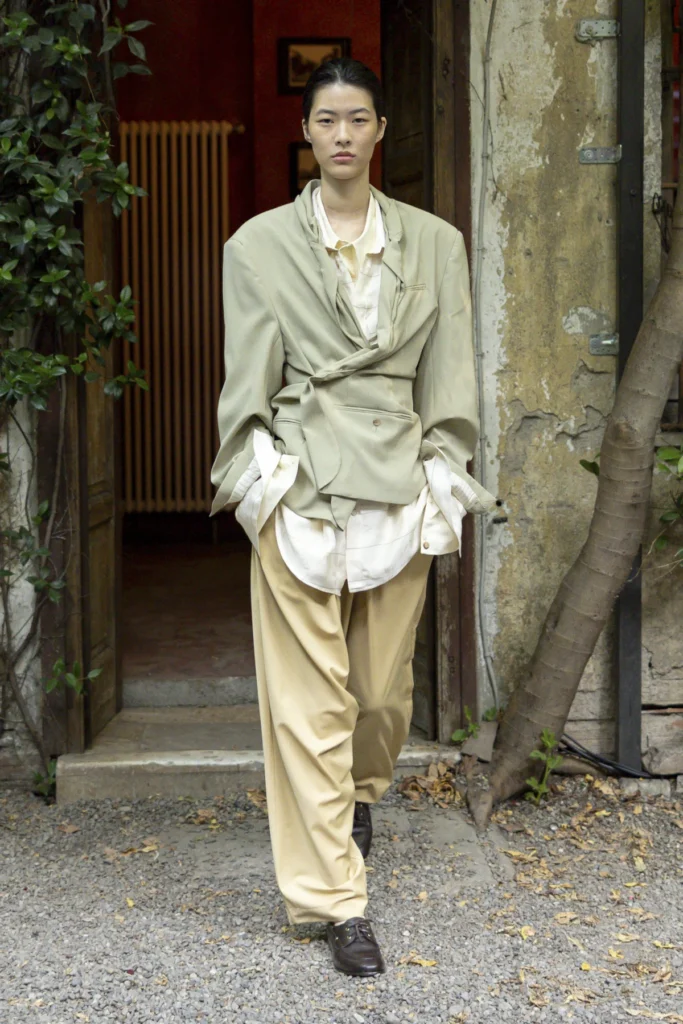
The collection is characterized by a deliberate manipulation of volume. Blazers have been reimagined with oversized silhouettes that drape effortlessly over the frame, while lapels have been twisted and reconfigured to break the monotony of traditional notch or peak styles. Sleeves and backs have been opened, creating apertures that introduce movement and ventilation, effectively turning the stiff structure of a jacket into a dynamic, flowing piece of attire.
Perhaps the most recognizable signature of Lin’s current work is his treatment of trousers. Utilizing a technique of multiple, precisely placed folds, he expands the volume of his mannish pants, creating a silhouette that is at once imposing and graceful. This recurring trait—a hallmark of his pattern-making prowess—serves to ground the collection, providing a heavy, grounded counterpoint to the lightness of his deconstructed shirts.
Chronology of the Collection’s Genesis
The development of this collection was a months-long process that prioritized sustainability and archival research.
- Phase I: Material Sourcing: The process began with the exhaustive acquisition of deadstock fabrics. By repurposing high-quality materials that would have otherwise gone to waste, Lin not only adheres to a sustainable ethos but also gains access to textures and weights that are often difficult to source in modern textile markets.
- Phase II: Pattern Drafting: Lin spent the mid-season months in his studio, literally deconstructing vintage tailoring patterns. He experimented with unconventional seam placements and structural offsets, focusing on how shifting a single line could alter the entire drape of a garment.
- Phase III: The "Unexpected" Detail Phase: The final two months were dedicated to the "micro-details." This included the sourcing of discarded buttons—mismatched to ensure that no two garments are identical—and the finalization of the raw-cut tucking techniques that define his shirts.
- Phase IV: Collaborative Integration: The final stage saw the integration of footwear and eyewear partnerships, ensuring that the collection’s accessories—provided by Saucony, Scarosso, and Akoni—aligned with the tonal, minimalist aesthetic of the clothing.
Supporting Data: The Anatomy of the Garment
The technical rigor behind the collection is best understood through the specific interventions Lin has applied to standard construction:
| Design Element | Traditional Construction | Lin’s Intervention |
|---|---|---|
| Blazer Lapels | Flat, pressed, fused | Twisted, layered, and detached |
| Trouser Volume | Single or double pleat | Multi-layered, expansive folding |
| Shirt Tucking | Standard tuck into waistband | Raw-cut openings beneath belt lines |
| Hardware | Uniform factory buttons | Mismatched, repurposed vintage buttons |
| Sleeves | Closed seams | Partially opened, allowing for layered reveal |
These modifications are not merely aesthetic; they are designed to challenge the wearer’s interaction with the garment. The raw cuts under the belt line, for instance, transform the act of tucking in a shirt from a mundane task into a stylistic choice, allowing the fabric to spill out in a controlled, intentional display of texture.
Official Perspectives and Creative Rationale
In discussions surrounding the collection, Lin has emphasized his desire to "elevate the mundane." For him, the beauty of design is not found in the exotic or the overtly luxurious, but in the subtle subversion of items that we see every day.
"The goal," Lin noted in a recent studio briefing, "is to make the ordinary unexpected. When you look at a blazer, you see a set of rules. I want to see how many of those rules I can break while still keeping the garment wearable."
This philosophy of elevation extends to his color palette. Lin favors tonal hues—a spectrum of greys, muted olives, and deep charcoals—that allow the structural complexity of his designs to take center stage. The layering of these tonal colors creates a visual depth that rewards closer inspection, a testament to his nuanced understanding of color theory.
Implications: The Experimental Edge
While the collection is a triumph of tailored deconstruction, it also marks a pivotal moment of transition for the designer. The final look of the runway show—a sculptural qipao constructed from bamboo—served as a bold, if somewhat jarring, conclusion to the presentation.
This piece, a clear nod to Lin’s Asian heritage, represents his most experimental work to date. By incorporating organic materials into a traditionally structured garment, Lin pushed his investigation of "the mundane" to its logical, and perhaps extreme, conclusion. While the piece was lauded for its craftsmanship and historical resonance, critics have noted that its rigid, sculptural nature stood in stark contrast to the fluid, relaxed tailoring that defined the rest of the lineup.
The implication for the future of the brand is clear: Lin is not content to be solely a "tailor." He is testing the boundaries between fashion and installation art. Whether this experimental direction will become a permanent fixture or remain an occasional indulgence is yet to be seen. However, it is evident that Lin is a designer in full command of his craft, unafraid to push his aesthetic into uncharted territory even when it risks the cohesion of a collection.
The Role of Strategic Collaboration
No modern collection exists in a vacuum, and Lin’s work is bolstered by a suite of strategic partnerships that enhance his brand’s identity. The collaboration with Saucony and Scarosso for footwear provides the necessary grounding for his voluminous trousers, offering sleek, understated profiles that do not compete with the complex silhouettes of the garments.
Similarly, the eyewear partnership with Akoni adds a layer of precision to the styling. The frames, characterized by their minimalist aesthetic, mirror the sharpness of Lin’s tailoring, effectively "framing" the look without distracting from the intricate pattern work. These partnerships reflect a mature understanding of brand ecosystem management; Lin realizes that in a competitive market, a designer must curate an entire visual experience rather than simply producing individual pieces.
Conclusion: A Poised Future
Luca Lin has successfully navigated the thin line between classicism and avant-garde. His ability to work with deadstock fabrics while pushing the boundaries of construction proves that sustainability and high-end design are not mutually exclusive. As he continues to refine his signature style—defined by those distinctive, voluminous folds and his sharp, subversive approach to tailoring—the fashion world waits to see how he will balance his newfound experimental impulses with the refined, poised aesthetic that has already earned him significant acclaim.
For now, Lin remains a designer of the "unexpected," a creator who asks us to look closer at the clothes we wear, and in doing so, discover the architectural beauty hidden within the everyday.



