

Introduction: The Invisible Shield of Global Trade
The global economy is inextricably linked to the veins of the ocean. With over 80% of world trade transported by sea, the safety of maritime corridors is not merely a matter of national security—it is a cornerstone of global stability. Yet, lurking in the shadows of major shipping lanes are threats that have persisted for centuries: piracy and armed robbery against ships. Standing at the frontline of this invisible war since 1991 is the International Maritime Bureau’s (IMB) Piracy Reporting Centre (PRC).
Operating as a 24-hour nerve center, the PRC serves as the primary conduit for information, crisis response, and intelligence gathering. By bridging the gap between vulnerable vessels and national law enforcement, the PRC has transformed how the shipping industry perceives and reacts to maritime crime. As geopolitical shifts and technological advancements redefine the nature of piracy, the PRC remains the industry’s most critical tool in safeguarding lives and cargo.
I. Main Facts: The PRC’s Operational Mandate
The IMB Piracy Reporting Centre is more than just an emergency hotline; it is an integrated intelligence hub. Its mandate is built upon three fundamental pillars: Reporting, Response, and Research.
1. 24/7 Crisis Coordination
Piracy does not adhere to business hours. The PRC operates a continuous watch, providing shipmasters and owners with an immediate point of contact when a vessel is under threat. Whether a ship is boarded in the Gulf of Guinea or targeted by armed robbers in the Singapore Strait, the PRC initiates a rapid-response protocol. This involves coordinating directly with coastal state authorities, regional navies, and law enforcement agencies to ensure that distress signals are not ignored.
2. Information Dissemination
Speed is the currency of maritime safety. Upon receiving a report, the PRC disseminates warning broadcasts and email alerts to ships operating in the vicinity. By alerting captains to "hot zones," the PRC empowers crews to implement hardening measures—such as increased watch keeping, the use of water cannons, or the maneuvering of the vessel—before an attack can escalate into a hijacking.
3. Data-Driven Intelligence
The Centre is the world’s most comprehensive repository for maritime piracy data. By meticulously cataloging every incident—whether an actual boarding, an attempted attack, or a suspicious sighting—the PRC provides the shipping industry with actionable insights. These insights allow stakeholders to map evolving threat patterns, helping them decide on rerouting, security staffing, and investment in anti-piracy technology.
II. A Chronology of Maritime Vigilance (1991–2025)
To understand the importance of the PRC, one must look at the evolution of maritime crime over the last three decades.
- 1991: The Inception. The IMB established the PRC in response to a growing surge in piracy in the waters of Southeast Asia. It was envisioned as a non-profit, independent body to fill the void where official reporting mechanisms were either lacking or slow to react.
- 1990s – 2000s: The Rise of Southeast Asian Piracy. The PRC became the primary source of truth during the turbulent years in the Malacca and Singapore Straits. Its data helped pressure regional governments to initiate coordinated patrols, leading to a significant drop in attacks.
- 2008 – 2012: The Somali Crisis. This era marked the darkest chapter in modern maritime history. Somali pirates, operating far out into the Indian Ocean, held massive tankers and their crews for ransom. The PRC was instrumental in advising vessels on "Best Management Practices" (BMP), which significantly reduced the success rate of hijackings during this peak period.
- 2013 – 2020: The Shift to West Africa. As the Somali threat waned due to international naval task forces, the Gulf of Guinea emerged as a new, more violent epicenter. The PRC shifted its focus, providing critical intelligence to companies operating in the region, leading to enhanced security standards for oil and gas vessels.
- 2021 – Present: The Digital and Diverse Threat. Modern piracy is no longer just about rifles and skiffs. It involves sophisticated criminal networks, potential cyber-security vulnerabilities, and opportunistic crime in areas like the Caribbean and the South American coast. The PRC continues to adapt, ensuring that its reporting mechanisms remain relevant in an era of asymmetric threats.
III. Supporting Data: The 2025 Mid-Year Landscape
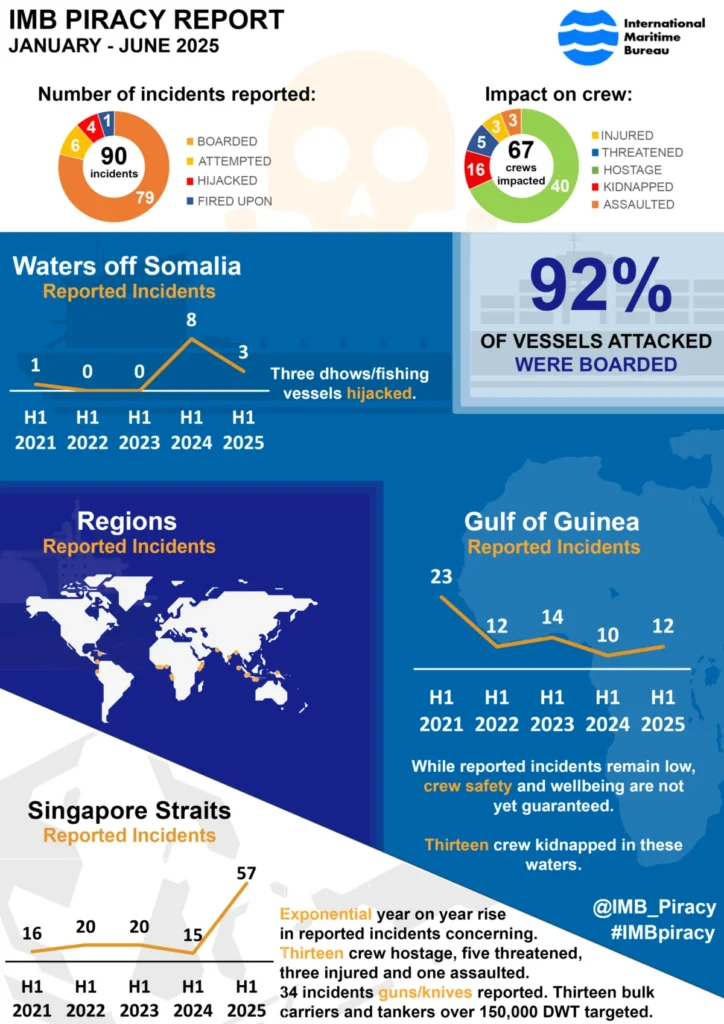
The recently released 2025 Jan – June Piracy and Armed Robbery Against Ships report underscores that while some regions have seen a decline in high-profile hijackings, the threat of armed robbery remains pervasive.
The data gathered by the PRC for the first half of 2025 indicates a complex picture:
- Under-Reporting Bias: The PRC warns that official statistics likely underestimate the true scale of the problem. Many shipowners, fearing increased insurance premiums or complex investigations, fail to report minor boarding attempts. The PRC’s ongoing campaign emphasizes that reporting is a vital first step to forcing governments to allocate resources.
- Geographic Trends: The report highlights that low-level armed robbery remains a persistent issue in the Singapore Straits and the Indonesian archipelago. These attacks are typically opportunistic, targeting ships at anchor or slow-moving vessels in narrow channels.
- Tactical Analysis: The data shows that the majority of successful boardings occur at night. By tracking the time of day, location, and nature of the attackers (e.g., number of pirates, weapons used), the PRC provides a granular view that allows shipping companies to adjust their operational security posture.
IV. Official Responses: The Call to Action
The IMB maintains a firm stance: maritime piracy is a global governance issue, not just a corporate burden. Michael Howlett, Director of the ICC International Maritime Bureau, has consistently advocated for a more robust, multi-lateral approach to maritime safety.
The Role of Reporting
The IMB encourages all stakeholders to adopt a "zero-tolerance" policy toward non-reporting. "Reporting is the lifeblood of our operation," says Howlett. "When a captain fails to report a suspicious incident, they deprive the entire maritime community of the intelligence needed to prevent a future tragedy."
Coordination with Authorities
The PRC acts as a liaison, pressuring coastal states to uphold their international obligations under UNCLOS (United Nations Convention on the Law of the Sea). By providing precise, verified data to these governments, the PRC makes it difficult for nations to ignore piracy within their territorial waters. This pressure has historically led to increased naval presence, improved maritime domain awareness (MDA), and the prosecution of criminal networks.
V. Implications for the Global Supply Chain
The implications of the IMB’s work extend far beyond the hulls of the ships being protected.
1. Economic Stability and Insurance
Maritime piracy acts as a "hidden tax" on global trade. High insurance premiums, the cost of armed guards, and the loss of cargo all drive up the cost of consumer goods. By reducing the frequency and success of attacks, the PRC helps maintain the efficiency of the global supply chain, ultimately benefiting the global consumer.
2. Crew Welfare: The Human Element
The most critical aspect of piracy is the human cost. Seafarers often spend months at sea, facing the psychological trauma of potential abduction or violence. The PRC’s work in coordinating rescue operations and providing post-incident support is essential for maintaining the morale and safety of the global workforce that powers our economy.
3. The Future of Maritime Security
As the industry moves toward autonomous shipping and increased digitization, the PRC is evolving to address new threats. The intersection of physical piracy and cyber-security—where criminals might use digital means to disable navigation or propulsion systems—is the next frontier for the Centre.
Conclusion: A Call for Continued Vigilance
The Piracy Reporting Centre stands as a testament to the power of collaboration and information sharing. Since 1991, it has served as a beacon for mariners in distress, a repository of vital knowledge, and a relentless advocate for the rule of law at sea.
However, the threat of piracy is dynamic. As long as there are vulnerabilities in the global maritime infrastructure, there will be those who seek to exploit them. For shipmasters, owners, and operators, the message remains clear: Report every incident. By doing so, you are not just fulfilling a regulatory requirement; you are contributing to a global safety network that protects thousands of lives and keeps the gears of the global economy turning.
For those seeking to understand the current threat landscape, the 2025 Jan – June Piracy and Armed Robbery Against Ships report is an essential read. It is a reminder that the safety of our seas is not a static achievement but an ongoing pursuit, demanding constant vigilance and the unwavering dedication of organizations like the IMB.
Contact Information
For further inquiries, detailed reports, or to coordinate on maritime safety initiatives, please contact:
Michael Howlett
Director, ICC International Maritime Bureau
Tel: +44 207 423 6960
Email: [email protected]
Official Resources: Request the 2025 Piracy Report



