

Introduction: The Architect of Air
In the high-stakes theater of global fashion, where designers often lean on elaborate sets and digital spectacles to convey their vision, Francesco Murano has chosen a more intimate, albeit technically rigorous, path. For his Fall 2026 Ready-to-Wear collection, Murano did not merely present garments; he orchestrated a study in kinetic sculpture. While the designer provided an extensive narrative backdrop—citing the dystopian grandeur of Fritz Lang’s 1927 masterpiece Metropolis as his primary muse—the clothing transcended the need for cinematic footnotes. Murano’s latest outing was a triumph of materiality, proving that when the construction is this masterful, the narrative serves only as a gentle frame for a much larger artistic achievement.
The Cinematic Muse: From Dystopia to Divine Form
The conceptual framework for the collection was undeniably ambitious. Murano sought to capture the duality of the Metropolis archetype: the spectrum of the feminine experience, ranging from the saintly to the sinful, the divine goddess to the cold, calculating humanoid robot.
In his pre-show notes, the designer spoke of a desire to create a "wardrobe for the multifaceted woman," a character who shifts between states of vulnerability and mechanical strength. By invoking the aesthetic of the Weimar-era sci-fi classic, Murano invited the audience to consider his silhouettes as modern-day armor. Yet, the brilliance of the collection lay in its ability to abstract these references. Rather than relying on literal interpretations—such as metal plating or industrial hardware—Murano translated the rigid, geometric lines of the film’s Art Deco architecture into the fluid, yielding medium of jersey. The result was a collection that felt distinctly futuristic, not because of its technological gimmicks, but because of its radical approach to volume and silhouette.
Chronology of a Cloud-Like Runway
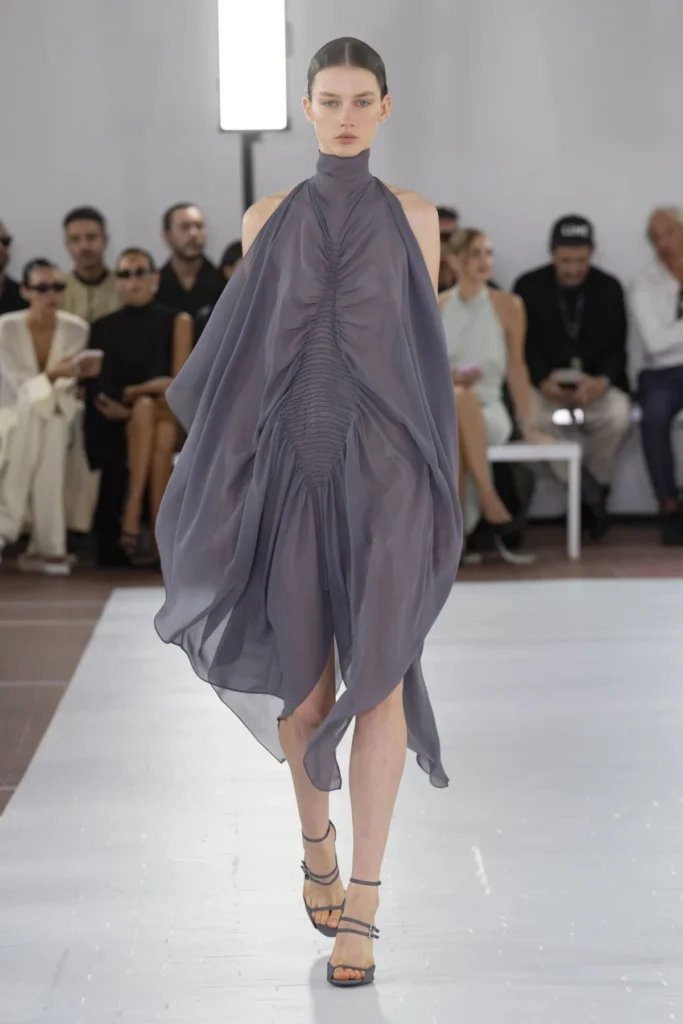
The runway presentation began with a moment of sensory deception. As the lights dimmed, the first model emerged, seemingly coalescing from a plume of atmospheric smoke. She was draped in a smoky gray jersey gown that appeared as light as air, featuring intricate plissé pleats at the bodice and a skirt that seemed to defy gravity.
This initial exit set the rhythm for a collection that prioritized weightlessness. A parade of "cloud-like" dresses followed, drifting across the runway in a soft, ethereal palette: pale blush pink, sunset peach, and a delicate, atmospheric baby blue. The construction was deceptively simple but technically daunting. Throughout the show, we observed:
- The Pleated V-Fronts: Deep, plunging necklines were balanced by delicate ruching at the small of the back, creating a silhouette that moved with the wearer like water.
- The Shawl-Wing Hybrids: A recurring motif involved delicate fabric extensions that functioned as both shawls and architectural wings, lending an angelic, almost avian quality to the movement of the models.
- The Red Carpet Statement: Several iterations featured high-slit fronts and dramatic, sweeping trains, designed explicitly for the demands of the modern red carpet, where presence is as vital as comfort.
- The Demure Shift: Contrast was provided by a standout long blue shirtdress. Featuring traditional French cuffs and a sharp, pointed collar, the piece was subverted by a singular, strategically placed cutout below the waist—a "peekaboo" detail that grounded the collection in a contemporary, sultry reality.
Supporting Data: The Geometry of Jersey
For those observing the collection from a technical standpoint, the most impressive takeaway was Murano’s mastery of his medium. Jersey is notoriously difficult to manipulate; its inherent stretch and lack of structure often make it a secondary material in luxury fashion, relegated to casual wear or base layers.
Murano, however, treated jersey as if it were malleable marble or wet clay. By using precise draping and tension, he forced the fabric to hold shapes that usually require stiffened silk or heavy internal corsetry. The garments appeared to "float" off the body, a feat of pattern-making that highlights the designer’s background in structural design.
Beyond the dresses, the collection featured slim-cut trouser suits defined by powerful, sharp-shouldered tailoring. These pieces served as the collection’s "saints"—composed, severe, and impeccably structured—contrasting sharply with the fluid, "sinful" nature of the gowns. The lack of heavy ornamentation was a deliberate choice. Murano allowed the seams, the folds, and the way the fabric caught the light to serve as the decoration.
The Final Act: The Armor of Light
The climax of the show provided the only departure from the matte, ethereal aesthetic. As the final model traversed the runway, the atmosphere shifted. She wore a liquid-metal gown, entirely paved with coppery sequins.
Unlike the matte jerseys that preceded it, this gown caught the runway lights with a sharp, metallic glint. It was designed to mimic the appearance of armor—a direct nod to the robotic inhabitants of Metropolis. Yet, even this piece remained slinky and elegant, avoiding the bulk that usually accompanies metallic garments. It was a poignant conclusion, summarizing the collection’s thesis: that armor, for the modern woman, is not necessarily something heavy or rigid. It is, instead, a second skin that allows for total freedom of movement while projecting an aura of invincibility.
Implications for the Brand and the Industry
Francesco Murano’s Fall 2026 collection arrives at a pivotal moment in the fashion cycle. As the industry moves away from the "quiet luxury" of muted, logo-less basics toward a desire for more sculptural, expressive fashion, Murano positions himself as a frontrunner in the "new formalist" movement.
Market Positioning
By focusing on high-level craftsmanship and avoiding excessive embellishment, Murano is building a brand identity based on timelessness rather than trend-chasing. This collection demonstrates that there is a significant market for garments that look high-concept but feel effortless. For retailers and buyers, these pieces offer a versatility that is rarely seen in evening wear; they are dramatic enough for a gala but constructed with the comfort of leisurewear.
The Evolution of the "Murano Woman"
The implications for the brand’s future are clear: Murano is evolving from a designer of interesting silhouettes into a master of material innovation. His ability to blend the sci-fi inspirations of the past with the technical demands of the future suggests a trajectory that will likely see him moving into even more experimental textile development.
Furthermore, the focus on "all sorts of women" indicates a desire to expand the brand’s reach. By providing silhouettes that range from the demurely covered to the provocatively exposed, Murano is signaling that his house is capable of dressing a diverse demographic without losing its signature "hand."
Conclusion
As the final lights faded, the impression left on the audience was not one of a specific movie reference, but of a feeling: the sensation of weightless grace. Francesco Murano has succeeded in doing the hardest thing in fashion—he made the complex look easy. By stripping away the noise and focusing on the interplay between the body, the fabric, and the movement, he has created a collection that is, in every sense, a testament to the power of pure design. Whether one views his work through the lens of a sci-fi epic or simply as a beautifully crafted wardrobe, the verdict remains the same: Murano is a visionary, and he is only just beginning to show us what he is capable of sculpting next.



