The integrated bracelet sports watch has become the defining horological category of the 21st century. While the market is currently dominated by titans like the Audemars Piguet Royal Oak, the Patek Philippe Nautilus, and the Vacheron Constantin Overseas, the true origins of this design language are often misattributed. Before the hype cycles of the current era, Baume & Mercier quietly introduced the Riviera in 1973. For decades, the collection has struggled with a shifting identity, often appearing as a reactive player in a fast-moving market. However, with the release of the new Baume & Mercier Riviera 73, the brand has made a decisive move to reclaim its heritage. By pivoting toward slimness, minimalism, and historical accuracy, the Riviera 73 offers an approachable, sophisticated entry point into luxury sports watches.
Main Facts: A Return to the 1973 Blueprint
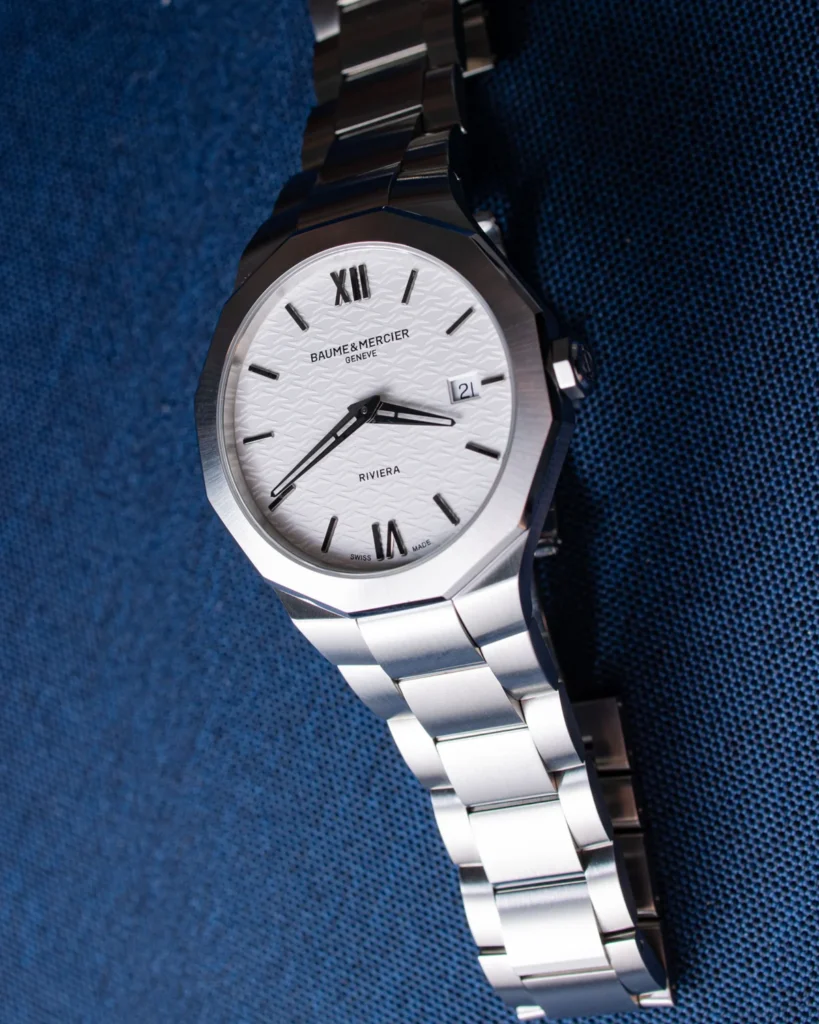
The Baume & Mercier Riviera 73 is a masterclass in restrained design. Measuring 39mm in diameter, the timepiece strikes a "Goldilocks" balance that satisfies both the vintage enthusiast and the modern collector. The most striking achievement of this model is its profile: at just 7.65mm thick, it offers a level of comfort and sleekness that is increasingly rare in an era of oversized, cumbersome sports watches.

The watch is powered by the reliable, Swiss-made ETA F06.115 quartz movement. While some purists may reflexively criticize the absence of a mechanical caliber, the choice here is intentional and historically authentic. The original 1973 Riviera was, by design, a quartz-driven watch, and the F06.115 offers practical benefits that a mechanical movement cannot match: a five-year battery life, high shock resistance, and an ultra-thin profile that maintains the watch’s svelte aesthetic. By stripping away the need for a sweeping seconds hand, the brand has leaned into a minimalist two-hand configuration that feels inherently more elegant than its busier counterparts.
The dial is characterized by a "less is more" philosophy. The signature Riviera wave-motif pattern remains, but it is presented with a sense of airy openness. Applied Roman numerals and indices float across the silvery-white dial, free from the clutter of scales or excessive text. The handset—semi-skeletonized dauphine needles—complements the minimalist dial while offering subtle textural contrast through a mix of brushed and polished facets.

Chronology: The Riviera’s Long and Winding Road
To understand the significance of the "73" iteration, one must look back at the original debut. In 1973, the luxury sports watch category was in its infancy. While Gérald Genta’s Royal Oak had debuted just a year prior in 1972, Baume & Mercier was already iterating on the concept of the dodecagonal (12-sided) bezel.
- 1973: The original Riviera reference 5112 is launched. It is a quartz-powered, integrated-bracelet design that emphasizes a "bezel-floating-atop-a-bracelet" aesthetic.
- 1980s-1990s: The collection sees various iterations, often struggling to find a consistent design language as the brand pivots through different market trends, leading to a period of relative obscurity.
- 2021: Baume & Mercier relaunches the modern Riviera collection, featuring a more robust, contemporary design with open-worked dials and automatic movements, aiming to compete directly with modern integrated sports watch offerings.
- 2026 (Present Day): The introduction of the Riviera 73. This model signals a departure from the "trend-chasing" approach of the early 2020s, opting instead to synthesize the brand’s history with a more refined, slimmed-down aesthetic.
Supporting Data: Engineering and Aesthetic Choices
The construction of the Riviera 73 reflects a deep commitment to geometry. The 12-sided bezel is the centerpiece of the design, and its execution is markedly more refined than in other recent versions of the watch. The top surface features a crisp sunburst brushing that terminates in two tiers of mirror-polished facets. The precision required to maintain sharp transitions on a dodecagonal surface is immense; Baume & Mercier has succeeded in creating a bezel that captures light beautifully, adding a sense of luxury that belies its $1,950 price point.

The integration of the bracelet is another point of evolution. The lugs have been softened and tapered, creating a smoother transition from the case to the bracelet. This specific design choice addresses the primary criticism of the modern Riviera: that it felt too chunky or disjointed. By rounding the interface, the 73 sits lower and wider on the wrist, mimicking the vintage "floating bezel" look of the original reference 5112.
Regarding water resistance, the watch is rated for 50 meters. While some may argue this is low for a "sports" watch, it is important to categorize the Riviera 73 correctly. It is not a diver; it is a sports-luxury timepiece designed for everyday wear. The 50-meter rating is more than sufficient for daily tasks and reinforces the brand’s commitment to maintaining a slim, elegant profile over excessive, unnecessary bulk.

Official Stance and Market Positioning
Baume & Mercier has positioned the Riviera 73 as the cornerstone of its new era. As the brand transitions under new ownership structures, the focus has shifted from "competing with everyone" to "being the best version of ourselves." The MSRP of $1,950 places it in a competitive, yet accessible, tier of the market. It serves as an entry-level luxury watch that provides the heritage and design pedigree of a storied house without the astronomical premiums associated with the "Holy Trinity" of watchmaking.
The brand has been vocal about the importance of the quartz movement in this specific model. During early previews, representatives emphasized that the quartz choice was not a cost-saving measure, but an aesthetic and functional one. By using a quartz movement, the watch achieves a level of thinness that would be prohibitively expensive—if not impossible—with a comparable automatic caliber, all while honoring the historical spirit of the 1973 original.

Implications: The Future of the Riviera Line
The release of the Riviera 73 suggests a fundamental shift in how Baume & Mercier views its flagship collection. For years, the brand seemed to be in an "identity crisis," constantly trying to keep pace with the hyper-competitive integrated sports watch arms race. The Riviera 73 represents a pivot toward confidence. By embracing its history, focusing on superior finishing, and refusing to succumb to the "bigger is better" trend, the brand is successfully carving out a niche for the "accessible luxury" buyer.
This watch is likely to attract a new generation of enthusiasts—those who appreciate the aesthetic of the 1970s but require the reliability and comfort of a modern timepiece. The decision to forgo a date frame at 3 o’clock is a point of contention for some, as it breaks the symmetry of the dial. However, in the broader context of the watch’s success, this is a minor critique.

The implications for the broader market are clear: the "Quartz is back" narrative is gaining momentum. As high-end collectors begin to tire of the maintenance and thickness associated with mechanical movements, watches like the Riviera 73 offer a compelling alternative. It is a watch that doesn’t need to prove its worth through a complex mechanical heartbeat; it proves it through line, form, and a legacy that dates back to the very birth of the integrated sports watch.
Ultimately, the Baume & Mercier Riviera 73 is a testament to the fact that heritage matters. By stripping away the noise and focusing on the core design principles that made the 1973 model an icon, Baume & Mercier has created a watch that feels not like a trend, but like a staple. It is a reminder that in the world of luxury, sometimes the most profound statements are the ones made with quiet, consistent, and well-executed restraint.